The updated rules for 401k catch up contributions 2026 bring important changes for workers nearing retirement, especially those over age 50. The newest IRS adjustments raise key contribution limits and activate additional SECURE 2.0 requirements that begin affecting savers next year. These updates are now confirmed and reflect the most current information available.
Table of Contents
Latest Confirmed Changes for 2026
The IRS increased several tax-advantaged retirement limits for 2026. These changes affect how much workers can save through salary deferrals and catch-up contributions:
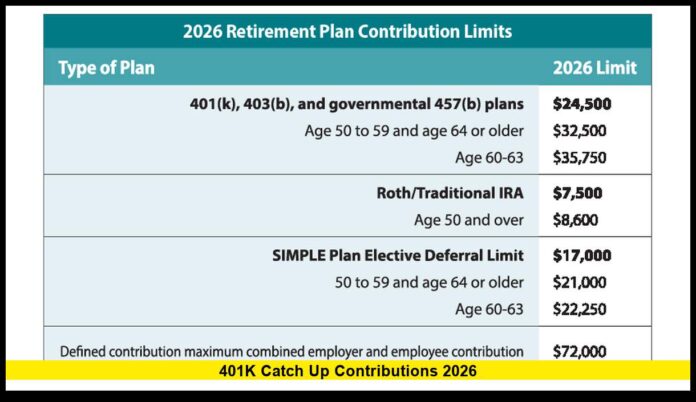
- The standard employee contribution limit for 401(k), 403(b), and most 457(b) plans rises to $24,500 in 2026.
- Workers age 50 and older may contribute an additional $8,000 as a catch-up contribution in 2026.
- Savers ages 60 through 63, if their employer plan permits, may use an enhanced “super catch-up” of up to $11,250 in 2026.
- When combining employee and employer contributions, the total 401(k) defined-contribution limit increases to $72,000 for 2026.
These increases provide older workers with their highest contribution potential ever offered under federal retirement savings laws.
How Much You Can Save in 2026
With the updated limits, eligible savers can now contribute significantly more toward retirement:
- Workers under age 50 may contribute up to $24,500 in 2026.
- Workers age 50 or older may contribute up to $32,500 (base limit of $24,500 + $8,000 catch-up).
- Workers ages 60 to 63, if their plan allows, may contribute up to $35,750 (base limit of $24,500 + $11,250 super catch-up).
These amounts apply only to employee salary deferrals. Employer matching and profit-sharing contributions may continue up to the combined plan maximum of $72,000 in 2026.
Roth-Only Catch-Up Rule for Higher Earners in 2026
A major SECURE 2.0 change takes effect in 2026 for certain high-income employees.
Workers whose FICA wages exceeded $150,000 in the prior year must make their 2026 catch-up contributions as Roth contributions. This means:
- Catch-up contributions will be taxed upfront.
- Withdrawals in retirement will generally be tax-free when Roth rules are met.
- Pre-tax catch-up contributions will no longer be available to these high-earning workers.
This requirement applies only to catch-up contributions, not to the standard elective deferral amount.
Why These Increases Matter
The new limits reflect inflation adjustments and the implementation timeline of SECURE 2.0. Lawmakers designed these expanded catch-up options to help late-career workers accelerate their retirement savings during their final working years, when earnings often peak.
The larger catch-up allowance for ages 60–63 is especially impactful. For many Americans, these years may be their strongest opportunity to close retirement gaps, add tax-advantaged savings, and prepare for rising costs in later life.
The new Roth-only rule for high earners shifts tax planning strategy as well. Those who can no longer use pre-tax catch-up contributions may want to reconsider overall Roth versus pre-tax allocations based on long-term tax expectations.
Age Group Breakdown for 2026
Below is a straightforward snapshot of contribution possibilities in 2026:
| Age Group | Employee Deferral Limit | Catch-Up Amount | Total Deferrals Allowed |
|---|---|---|---|
| Under 50 | $24,500 | None | $24,500 |
| 50–59 or 64+ | $24,500 | $8,000 | $32,500 |
| 60–63 (if plan allows) | $24,500 | $11,250 | $35,750 |
These limits apply per person, per year.
Steps to Take Before the 2026 Plan Year Begins
To make the most of the updated rules, workers should take a few key actions:
1. Review your employer’s plan
Not every 401(k) plan automatically allows standard or enhanced catch-up contributions. Some plans must be amended to support Roth-only catch-ups.
2. Identify your 2025 wages
Workers with more than $150,000 in FICA wages in 2025 will be subject to the Roth-only requirement in 2026.
3. Revisit tax strategy
With Roth-only catch-up rules in place, high earners may want to coordinate pre-tax and Roth contributions for optimal tax positioning.
4. Maximize contributions if possible
Workers who can contribute at the upper limits may significantly improve retirement readiness, particularly during peak earning years.
5. Factor in employer contributions
Your total contributions, including employer match or profit-sharing, must stay within the $72,000 defined-contribution limit for 2026.
How These Changes Influence Retirement Planning
The 2026 increases give savers more flexibility and more room to boost long-term retirement security. As costs rise and retirement horizons lengthen, larger catch-up allowances are especially valuable.
Older workers can now take advantage of the most generous retirement contribution options ever offered. Younger workers may also view the increased limits as encouragement to build habits that will benefit them long-term.
The required shift to Roth-only catch-up contributions for higher earners adds new tax-planning considerations. Tax-free withdrawals can be powerful in retirement, particularly in years when taxable income fluctuates.
Frequently Asked Questions
Who is eligible for catch-up contributions in 2026?
Anyone who is age 50 or older by the end of the calendar year. The enhanced “super catch-up” is available only to those ages 60 to 63, and only if their employer plan offers it.
How much can someone age 55 contribute in 2026?
A 55-year-old may contribute up to $32,500 in employee deferrals.
How much can someone age 61 contribute in 2026?
If the plan allows the super catch-up, someone age 61 may contribute up to $35,750.
Will my catch-up contributions be pre-tax or Roth?
If your FICA wages for 2025 are over $150,000, your catch-up contributions in 2026 must be Roth only. Otherwise, you may have the option to choose, depending on plan features.
Do employer matching contributions count toward the catch-up limit?
No. The catch-up limit applies only to employee deferrals. However, total contributions (employee + employer) must stay within the $72,000 limit.
What if my employer’s plan doesn’t allow catch-ups?
If your plan does not permit catch-up or super catch-up contributions, you cannot use them. You may consider adding savings through IRAs or other retirement vehicles.
What is the benefit of the super catch-up for ages 60–63?
It offers one of the largest short-term opportunities to accelerate retirement savings before retirement, especially helpful for those making up for earlier shortfalls.
If you qualify for the new limits, 2026 may be one of your best opportunities to boost retirement savings and strengthen long-term financial security.

 catch-up contribution limits expand savings opportunities for older workers and add new Roth requirements for high earners.)