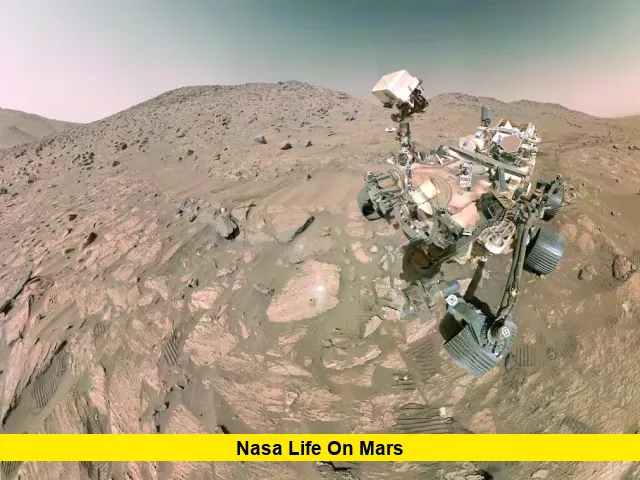
NASA’s recent announcement has pushed the discussion of life on Mars into the spotlight once again. On September 10, 2025, the Perseverance rover uncovered what may be the most convincing evidence so far of ancient microbial life inside Jezero Crater. This discovery is being described as one of the most significant steps forward in astrobiology, raising hopes that Mars once harbored living organisms billions of years ago.
Table of Contents
Discovery in Jezero Crater
The Perseverance rover drilled into a rock sample named Sapphire Canyon, taken from a geological formation called Cheyava Falls. This site is part of the Bright Angel formation within the Neretva Vallis region of Jezero Crater.
The rock itself is a reddish, clay-rich mudstone that dates back approximately 3.2 to 3.8 billion years. It was likely deposited in an ancient Martian lakebed, an environment where water once pooled and created favorable conditions for life.
Inside the sample, scientists identified several intriguing features:
- Ring-shaped nodules and dark reaction fronts in the rock that resemble patterns linked to microbial activity on Earth.
- Minerals such as vivianite and greigite, which are often associated with microbial processes in aquatic environments.
- Organic carbon traces embedded in the mudstone, an essential building block for life.
- Iron–phosphorus–sulfur chemistry consistent with low-temperature redox reactions, similar to those seen in microbial energy systems on Earth.
Why Scientists Are Excited
Researchers believe this sample may represent the clearest sign of potential life that Mars has ever revealed. On Earth, the combination of minerals, carbon signatures, and structural features would strongly point to microbial activity.
This finding strengthens the case that Mars once supported habitable environments. It suggests that billions of years ago, tiny microbial life forms may have thrived in its lakes and rivers.
The Cautious Approach
Despite the excitement, NASA is careful to emphasize that this is not definitive proof. While the evidence is compelling, non-biological processes can sometimes create similar chemical and geological signatures.
To confirm whether these features truly represent ancient life, the samples need to be studied with powerful laboratory instruments on Earth. Only then can scientists rule out non-biological explanations and confirm whether Mars was ever home to living organisms.
The Mars Sample Return Mission
To unlock the full secrets of the Sapphire Canyon rock, NASA is working with the European Space Agency on the Mars Sample Return (MSR) mission. This ambitious project aims to bring Perseverance’s collected samples back to Earth.
Originally, the target for sample return was around 2033, but technical and budget challenges have delayed the timeline. Updated estimates suggest that the mission may not be completed until the 2040s.
The mission will require several critical steps:
- A lander with a Mars Ascent Vehicle to retrieve the sealed rock tubes.
- A transfer spacecraft to bring the samples back across millions of miles.
- Strict protocols to prevent contamination both on Mars and once the samples reach Earth.
While the delays are frustrating, many experts argue that the scientific rewards justify the wait. These samples could hold answers to one of humanity’s biggest questions: Are we alone in the universe?
How Confident Are Scientists?
At this stage, the evidence is labeled as potential biosignatures. That means they are consistent with life but not proven to be caused by life.
Scientists will continue to analyze Perseverance’s data while planning for Earth-based examination. Some steps to boost confidence include:
- Comparing similar formations across Jezero Crater.
- Cross-checking data across multiple instruments to ensure accuracy.
- Modeling potential non-biological processes that could mimic the observed features.
The cautious but hopeful approach is what makes this discovery credible. NASA’s method is designed to eliminate doubt rather than overstate the findings.
What It Means for U.S. Science and Space Exploration
The discovery reinforces NASA’s leadership in planetary science and astrobiology. It highlights the value of long-term investment in space missions, even when results take years to unfold.
For the United States, this achievement strengthens the nation’s role in answering one of science’s deepest mysteries. It also underscores the importance of continued funding for programs like Perseverance and the Mars Sample Return mission.
Public interest in space exploration is expected to grow as these discoveries unfold. Many Americans are captivated by the possibility that our neighboring planet once hosted life, and future missions may only fuel this curiosity.
Key Takeaways
- Perseverance discovered potential biosignatures in a mudstone sample called Sapphire Canyon.
- The rock dates back more than 3 billion years and was formed in a Martian lakebed.
- Minerals, organic carbon, and redox chemistry all point toward possible microbial activity.
- NASA stresses that this is not proof of life yet—Earth-based analysis is needed.
- The Mars Sample Return mission could bring these samples back by the 2040s.
Final Thoughts
NASA’s discovery marks one of the most promising moments yet in the search for life on Mars. While not definitive, the evidence offers a glimpse into a time when the Red Planet may have been alive with tiny organisms. The world now waits for the day these samples return to Earth, where the mystery of Mars’ past could finally be solved.
Do you think these discoveries are enough to prove Mars once had life, or is the evidence still too uncertain? Share your thoughts below and join the conversation.

