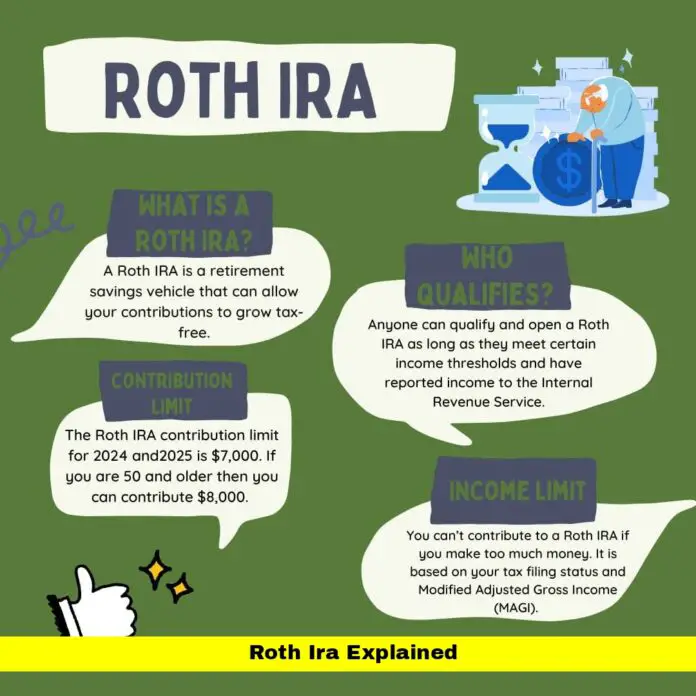
A Roth IRA explained simply comes down to understanding how this retirement account allows your money to grow tax-free. In 2025, contribution limits, income thresholds, and planning strategies are once again in the spotlight. Whether you are just starting or already saving, knowing the latest rules is essential to maximize your retirement future.
Table of Contents
Roth IRA Explained: 2025 Contribution Limits and Key Rules
The Roth IRA remains one of the most flexible retirement accounts. But the IRS has set clear contribution limits and income rules for 2025.
- For individuals under 50, the maximum contribution is $7,000.
- For those aged 50 and older, a $1,000 catch-up makes the total $8,000.
- These limits apply across all IRAs combined—both traditional and Roth.
Income also plays a big role:
- Single filers can contribute fully if their modified adjusted gross income (MAGI) is below $150,000.
- Married couples filing jointly can contribute fully if their MAGI is under $236,000.
- Partial contributions are allowed in a small phase-out range above those thresholds.
- Once your income exceeds the top end of the phase-out, direct Roth IRA contributions are not allowed.
Key Points Summary 📝
- Contribution limit: $7,000, or $8,000 if 50+.
- Income thresholds: full eligibility below $150,000 (single) and $236,000 (joint).
- Phase-out ranges allow reduced contributions.
- No required minimum distributions for account owners.
- Conversions still possible even if income exceeds the contribution limit.
Why the Roth IRA Stands Out in 2025
The Roth IRA continues to attract savers for three main reasons:
- Tax-Free Growth – Contributions are made with after-tax dollars, so all qualified withdrawals later are free of federal income tax.
- Flexibility – You can take out contributions (not earnings) at any time without penalty.
- No RMDs – Unlike traditional IRAs, you aren’t forced to withdraw at a certain age. This makes it an excellent tool for estate planning and long-term growth.
Understanding the Income Phase-Outs
The income phase-out ranges often confuse people, but they’re important.
- Single filers: Between $150,000 and $165,000, contributions reduce gradually. At $165,000+, you cannot contribute directly.
- Married filing jointly: Between $236,000 and $246,000, contributions reduce. At $246,000+, no direct contributions are allowed.
- Married filing separately: The phase-out is harsh—anything above $10,000 eliminates eligibility.
These numbers highlight why planning early in the year helps. If your income increases later, you might unintentionally push yourself out of eligibility.
Strategies People Are Using in 2025
To make the most of the current rules, many savers are adjusting their tactics:
- Front-Loading Contributions – Contributing early in the year before raises or bonuses increase income.
- Backdoor Roth IRA – For high earners, contributing to a traditional IRA and then converting it into a Roth remains an effective workaround.
- Roth Conversions – Converting traditional IRA or 401(k) balances into a Roth IRA while tax rates are favorable.
- Catch-Up Advantage – Those age 50+ are making sure to use the $1,000 catch-up contribution to maximize tax-free savings.
Roth IRA vs Traditional IRA in 2025
A side-by-side comparison makes the differences clearer:
| Feature | Roth IRA | Traditional IRA |
|---|---|---|
| Tax on Contributions | After-tax (no deduction) | Pre-tax or deductible (depends on income & coverage) |
| Tax on Withdrawals | Tax-free if qualified | Taxed as ordinary income |
| Contribution Age Limit | None (must have earned income) | None (must have earned income) |
| Required Minimum Distributions (RMDs) | None for owner | Required starting at age 73 |
| Income Limits | Yes (eligibility capped) | No contribution limit, but deduction phases out |
Avoiding Common Roth IRA Mistakes
Many investors make errors that lead to penalties. Here’s what to avoid:
- Over-Contributing – Going over the limit results in a 6% penalty per year until fixed.
- Ignoring Income Rules – MAGI miscalculations can make contributions ineligible.
- Early Earnings Withdrawals – Removing earnings before age 59½ and before the five-year rule can result in taxes and penalties.
- Neglecting Record-Keeping – Especially with conversions, it’s critical to track dates and amounts.
Practical Examples for 2025
- Case 1: Sarah, age 45, earns $140,000 as a single filer → She can contribute the full $7,000.
- Case 2: Mark and Elena, married filing jointly with $242,000 MAGI → They qualify for a reduced contribution, but not the full $8,000 each.
- Case 3: David, age 55, earns $170,000 → He can’t directly contribute but uses a backdoor Roth strategy.
Roth IRA and Long-Term Planning
The Roth IRA is more than just a retirement account. It is a tool for:
- Estate Planning – Beneficiaries can inherit Roth IRAs and enjoy tax-free growth.
- Tax Diversification – Having both Roth and traditional accounts provides flexibility against future tax law changes.
- Retirement Flexibility – Since contributions can be withdrawn penalty-free, some savers use Roth IRAs as an emergency backup fund.
Looking Ahead: What May Change Beyond 2025
While the 2025 numbers are set, future years could bring:
- Inflation Adjustments – Contribution and income limits typically rise slowly over time.
- Tax Policy Shifts – A change in tax rates could increase or decrease the appeal of Roth conversions.
- New Retirement Law Updates – Lawmakers occasionally tweak rules around catch-ups, conversions, and eligibility.
Being proactive now ensures you’re positioned for whatever comes next.
Closing Thoughts
Having Roth IRA explained in plain terms makes it easier to decide if this account fits your retirement plan. The 2025 rules bring both opportunities and limitations, but with careful planning you can maximize tax-free growth and long-term financial security. What’s your Roth IRA move this year? Share your thoughts and let’s keep the conversation going.
FAQs
Q1: Can I contribute to a Roth IRA and a 401(k) in the same year?
Yes, you can. Limits for Roth IRAs and 401(k)s are separate, so maximizing both can supercharge retirement savings.
Q2: Do I have to take money out of a Roth IRA when I retire?
No. Roth IRAs have no required minimum distributions for the account owner. That makes them unique among retirement accounts.
Q3: Is there a penalty for withdrawing Roth IRA contributions early?
No. You can withdraw contributions anytime without penalty. Only earnings are restricted by age and the five-year rule.
Disclaimer: This article is for informational purposes only. It is not tax, financial, or legal advice. Individual situations vary, so consult a qualified advisor before making decisions about Roth IRAs.

