Knowing when can you withdraw from Roth IRA money is one of the most crucial aspects of retirement planning. Roth IRAs remain one of the most popular investment accounts in 2025 because of their tax-free growth and withdrawals. However, the rules surrounding contributions, earnings, and conversions can be confusing. Getting it wrong may lead to unnecessary taxes and penalties, while getting it right allows you to maximize long-term wealth.
This detailed guide breaks down everything you need to know about Roth IRA withdrawals in 2025—from the 5-year rule to penalty exceptions, planning strategies, and real-world examples.
Table of Contents
Key Points Summary 📝
✔️ Contributions are always accessible without penalties or taxes.
✔️ Earnings require both the 5-year rule and age 59½ to be tax- and penalty-free.
✔️ Each Roth conversion has its own 5-year withdrawal rule.
✔️ Certain life events, like disability or first-time home purchases, qualify for early withdrawals.
✔️ Roth IRAs don’t have required minimum distributions during the account owner’s lifetime.
Why Withdrawals Matter in Roth IRAs
Roth IRAs are unique because you pay taxes before contributing. This upfront tax payment gives you the benefit of tax-free growth and withdrawals later—as long as you follow the rules. The IRS distinguishes between contributions (your after-tax money), earnings (growth from investments), and conversions (money moved from traditional accounts). Each category has separate withdrawal rules.
Getting familiar with these rules ensures you don’t face unexpected surprises during retirement or emergencies.
Breaking Down the Roth IRA Withdrawal Rules
Let’s explore how each category of funds inside a Roth IRA works:
1. Contributions
- These are your deposits made with after-tax income.
- You can withdraw contributions anytime without tax or penalty.
- Example: If you’ve contributed $20,000 over the years, you can withdraw that $20,000 whenever you want.
2. Earnings
- These are the profits made from your investments inside the account.
- You can only withdraw them tax-free if you meet two conditions:
- The Roth IRA has been open for at least five years.
- You’re 59½ or older, or qualify for an exception.
3. Conversions
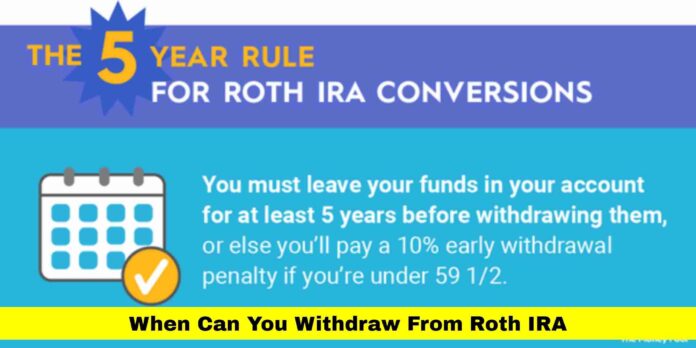
- If you convert money from a traditional IRA or 401(k) into a Roth IRA, those funds carry their own 5-year clock.
- Each conversion must age five years before you can withdraw it penalty-free.
The 5-Year Rule Explained Clearly
The 5-year rule is one of the most misunderstood parts of Roth IRAs.
There are actually two separate 5-year rules:
- 5-Year Rule for Earnings
- Applies to tax-free withdrawal of earnings.
- Starts on January 1 of the tax year of your first contribution.
- 5-Year Rule for Conversions
- Applies to penalty-free withdrawal of converted amounts.
- Each conversion has its own 5-year clock.
Example: If you made your first contribution in 2020, by January 1, 2025, you meet the 5-year rule for earnings. But if you converted funds in 2023, you must wait until 2028 to withdraw that conversion penalty-free.
When Exactly Can You Withdraw Without Penalty?
You can take money out of your Roth IRA without tax or penalty if:
- The account has been open for at least 5 years and
- You are at least 59½ years old.
Other qualifying situations include:
- You are permanently disabled.
- The withdrawal is due to death (and goes to beneficiaries).
- You use up to $10,000 for a first-time home purchase.
These conditions protect your earnings from taxes and penalties.
Penalty Exceptions You Should Know
Sometimes life forces early withdrawals. The IRS recognizes this and provides penalty exceptions, even if you don’t meet the 59½ age or 5-year requirements. These include:
- Higher education expenses for yourself or a family member.
- Medical costs exceeding 7.5% of your adjusted gross income.
- Health insurance premiums while unemployed.
- Disability.
- Adoption or birth expenses, up to $5,000.
- First-time homebuyer costs, up to $10,000.
While the penalty may be waived, keep in mind that income taxes on earnings may still apply.
No Required Minimum Distributions (RMDs)
Unlike traditional IRAs, Roth IRAs have no required minimum distributions during the account owner’s lifetime. This means:
- Your money can stay invested for as long as you live.
- It provides excellent estate planning benefits.
- Beneficiaries, however, must follow distribution rules when inheriting.
This flexibility makes Roth IRAs especially powerful for long-term wealth transfer.
Contribution Limits in 2025
Before withdrawals come contributions. For 2025, the Roth IRA contribution rules are:
- $7,000 per year for individuals under 50.
- $8,000 per year for those 50 and older (catch-up contribution).
- Income phase-out limits apply:
- Single filers: phase-out starts at around $150,000.
- Married filing jointly: phase-out starts around $236,000.
Your eligibility to contribute affects your withdrawal options later.
Strategic Withdrawal Planning
To maximize your Roth IRA benefits, consider these strategies:
- Emergency Fund Buffer: Contributions can be withdrawn anytime, making a Roth IRA a back-up emergency fund.
- Delay Earnings Withdrawals: Let your investments grow as long as possible before tapping earnings.
- Conversion Ladder: Spread out Roth conversions to manage taxes and track separate 5-year clocks.
- Estate Planning Tool: Leave the account untouched during retirement for tax-free inheritance.
Examples to Clarify Withdrawal Rules
- Example 1: Emma opened a Roth IRA in 2019 at age 50. By 2025, at age 56, she can withdraw her contributions and, since her account passed the 5-year mark, some earnings penalty-free if used for a first-time home purchase.
- Example 2: James converted $40,000 from a 401(k) to a Roth in 2024. If he withdraws in 2026 at age 45, he faces penalties because the conversion hasn’t aged five years.
- Example 3: Linda, 62, started her Roth in 2017. In 2025, she can withdraw everything—contributions and earnings—completely tax- and penalty-free.
Common Misconceptions About Roth Withdrawals
❌ Myth: All Roth IRA withdrawals are tax-free anytime.
✅ Truth: Only contributions are always tax- and penalty-free. Earnings have restrictions.
❌ Myth: The 5-year rule resets every year you contribute.
✅ Truth: The 5-year clock starts with your first contribution.
❌ Myth: Everyone must eventually withdraw money.
✅ Truth: Roth IRAs have no RMDs for the account owner.
How Withdrawals Affect Your Retirement Plan
Understanding when you can withdraw from Roth IRA funds isn’t just about avoiding penalties—it’s about optimizing your retirement income. Consider:
- Withdrawing too early reduces long-term compounding.
- Strategic Roth withdrawals can lower future tax brackets.
- Combining Roth with traditional IRA distributions creates tax diversification.
A thoughtful withdrawal strategy helps balance short-term needs and long-term growth.
What to Watch in 2025
Retirement rules shift with inflation adjustments and possible tax reforms. In 2025, key things to watch include:
- IRS updates on contribution and income limits.
- Adjustments in penalty exceptions for emergencies.
- Legislative proposals affecting Roth conversion strategies.
Staying updated ensures your withdrawal strategy remains effective.
Closing Thoughts
The question of when can you withdraw from Roth IRA money in 2025 comes down to understanding the type of funds, the 5-year rule, and whether you meet certain conditions. By following these rules carefully, you can make the most of Roth IRAs’ unique benefits—flexibility, tax-free growth, and no lifetime distribution requirements.
How do you plan to use your Roth IRA—early as a financial safety net, or later for tax-free retirement wealth? Share your thoughts in the comments.
FAQ
Q1: Can I take money out of my Roth IRA before age 59½?
Yes, but only contributions can be withdrawn tax-free anytime. Earnings may be taxed and penalized unless you qualify for an exception.
Q2: Does every Roth conversion have its own 5-year rule?
Yes. Each conversion starts its own 5-year countdown for penalty-free withdrawals.
Q3: Do Roth IRAs have required minimum distributions?
No. Roth IRAs don’t require withdrawals during your lifetime, making them powerful for estate planning.
Disclaimer: This article is for informational purposes only. Financial rules change, and individual situations vary. Always consult a professional advisor before making withdrawal decisions.

