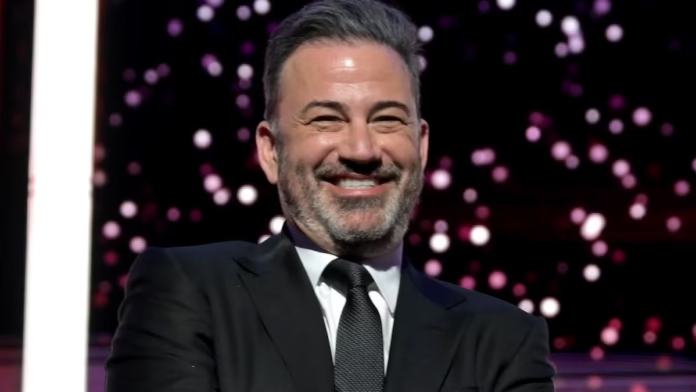
Sinclair Media Group has once again found itself at the center of a major national debate. This week, the company announced that it will not air Jimmy Kimmel Live! on any of its ABC-affiliated stations, despite ABC’s decision to reinstate the program after a brief suspension. The move by Sinclair Media Group underscores the power local broadcasters still hold in shaping what Americans see on their television screens—and raises larger questions about politics, free speech, and media influence.
Table of Contents
The Decision That Sparked Nationwide Attention
ABC initially suspended Jimmy Kimmel Live! after the host made controversial remarks referencing conservative activist Charlie Kirk. The suspension was lifted only a short time later, allowing the show to resume airing nationwide. However, Sinclair Media Group refused to comply, declaring that the action taken by the network was insufficient.
Executives at Sinclair Media Group demanded stronger accountability, including a public apology from Kimmel to Kirk’s family and what they described as a “meaningful act of restitution.” Until those conditions are met, the company says it will not allow the late-night show to be broadcast on its 39 ABC affiliate stations.
For millions of viewers across the country, this decision means the program has vanished from local TV lineups. In its place, Sinclair affiliates are filling the late-night slot with extended news coverage, syndicated comedies, or other alternative content.
Why Sinclair Media Group Took a Hard Line
The decision to block a network show is not taken lightly. For Sinclair Media Group, the choice reflects a combination of principles, strategy, and leverage:
- Accountability in programming: Sinclair’s leadership emphasized that late-night shows should uphold standards of respect and decency, particularly when sensitive topics involve the loss of life.
- Local station autonomy: The company has long argued that affiliates must retain the right to decide what best serves their communities, even when that means diverging from a network’s programming schedule.
- Political considerations: By standing firm, Sinclair Media Group has aligned itself with broader calls for accountability from political leaders who criticized Kimmel’s comments.
In this way, the blackout is more than a simple scheduling change—it is a statement of principle and a demonstration of the power broadcasters have in the evolving media landscape.
Working in Tandem With Nexstar
Sinclair Media Group is not standing alone in this battle. Nexstar Media Group, the largest owner of local television stations in the United States, has also chosen to keep Jimmy Kimmel Live! off its airwaves. Together, Sinclair and Nexstar control more than a quarter of all ABC affiliates nationwide.
The combined reach of these two companies means the blackout is felt across multiple regions, from Washington, D.C., to Texas, Ohio, Virginia, and California. This level of coordination has made the protest against Kimmel one of the most impactful acts of station resistance in recent memory.
Both Sinclair and Nexstar stressed the need for respectful dialogue and signaled that reinstating the program without additional steps could undermine that goal.
Viewer Impact Across the Country
The blackout by Sinclair Media Group is far from symbolic—it has immediate consequences for viewers. Markets where Sinclair controls ABC affiliates have seen abrupt schedule changes. Instead of tuning in to Jimmy Kimmel Live!, audiences now find local newscasts, syndicated sitcoms, or other short-form entertainment.
For many households, this shift may push them toward streaming services, where ABC still makes the show available. That shift could accelerate a broader trend: traditional broadcasters losing ground to on-demand platforms. At the same time, Sinclair’s choice illustrates the enduring relevance of local television in shaping public conversation, particularly in households that rely on over-the-air broadcasts.
The Political and Regulatory Context
The controversy surrounding Sinclair Media Group’s decision cannot be separated from the broader political climate. The Federal Communications Commission, under leadership aligned with the Trump administration, has taken a strong interest in how broadcasters handle content that it deems offensive or inappropriate.
Earlier statements from FCC officials suggested that networks failing to take action on Kimmel could face scrutiny. In this context, Sinclair Media Group’s refusal to air the program can also be seen as an act of alignment with regulatory expectations.
Critics argue that this level of political involvement blurs the line between regulation and censorship, while supporters contend that it holds media accountable in ways long overdue.
Financial Pressures at Sinclair Media Group
Behind the headlines, Sinclair Media Group is also contending with significant financial challenges. The company recently reported declines in revenue and a net loss in its quarterly results, reflecting both reduced advertising income and broader headwinds in the broadcasting industry.
As the advertising market becomes increasingly competitive and fragmented, Sinclair is investing in new ventures. This includes expanding its digital media presence, launching sports-focused podcasts, and developing datacasting services that leverage NextGen TV technology. These efforts are part of a larger plan to diversify beyond traditional television and open new revenue streams.
The decision to block Jimmy Kimmel Live! also fits into this strategy, reinforcing Sinclair’s brand identity as a company willing to take bold, controversial positions—even at the risk of criticism.
Broader Industry Implications
The standoff between ABC and Sinclair Media Group could reshape relationships between networks and their affiliates. Traditionally, networks have had final say over prime-time and late-night programming. But this clash highlights how station groups are asserting more independence, especially when they believe local values or political pressures demand it.
Key implications include:
- Greater affiliate autonomy: Other station groups may follow Sinclair’s lead, exercising more control over what airs in their markets.
- Shifts in late-night viewership: If large portions of the country can’t watch Jimmy Kimmel Live! on traditional TV, audiences may increasingly move to streaming platforms.
- Advertising uncertainty: Advertisers targeting late-night audiences may face disrupted campaigns, forcing them to reconsider strategies.
- Regulatory ripple effects: Ongoing FCC debates about ownership limits and media consolidation could be influenced by how Sinclair and Nexstar assert their authority.
What’s Next for Sinclair Media Group
The coming weeks will be critical in determining how this standoff unfolds. Several possible outcomes are on the horizon:
- Negotiations with ABC: Sinclair Media Group has not ruled out reinstating the program, but only if its conditions are met. Ongoing talks with Disney and ABC could determine whether a compromise emerges.
- Continued blackout: If no agreement is reached, viewers in affected markets may have to adjust permanently to alternative programming.
- Industry-wide response: Other affiliate groups may issue statements or make programming decisions that either support or oppose Sinclair’s stance.
- Regulatory developments: As media consolidation reviews move forward, Sinclair’s decision could become a focal point in FCC discussions about the balance of power between networks and local broadcasters.
Why This Matters
For viewers, the blackout may feel like an inconvenience. For the industry, however, it represents a defining moment in the ongoing tug-of-war between networks, affiliates, politics, and regulators. Sinclair Media Group has made it clear that it is willing to challenge network authority when it believes community standards or political accountability are at stake.
The decision also raises questions about the future of television itself. As more audiences migrate to streaming platforms, traditional broadcasters may rely increasingly on bold moves like this one to assert their relevance and protect their influence.
Final Thoughts
Sinclair Media Group’s decision to block Jimmy Kimmel Live! is more than a programming change—it is a battle over values, control, and the future of American broadcasting. Whether the standoff ends with a compromise or becomes a long-term shift, it has already made one thing clear: local station groups like Sinclair still hold powerful sway in shaping what Americans see on their screens.
What’s your view on Sinclair Media Group’s stance—necessary accountability or unfair censorship? Share your perspective in the comments below.

