The news that Comey indicted on federal criminal charges has instantly become one of the most consequential legal developments of the year. The former FBI director, long seen as a lightning rod in American politics, now faces allegations of making false statements to Congress and obstructing an official investigation. This indictment not only raises legal questions about his conduct but also ignites a broader national debate over whether justice is truly independent of politics.
Table of Contents
Breaking Down the Charges Against James Comey
The indictment outlines two specific charges, both of which carry significant weight under federal law.
- False Statements to Congress
Prosecutors allege that Comey knowingly misled lawmakers during testimony. The focus lies on key claims he made regarding his role in authorizing leaks and his awareness of internal FBI actions. Federal law makes it a crime to provide false or misleading information to Congress, regardless of whether it is under oath. - Obstruction of Justice
The second charge is tied to accusations that Comey attempted to obstruct a congressional investigation. According to the indictment, he acted in ways that hindered oversight committees as they examined the FBI’s handling of sensitive investigations. If proven, this charge could carry severe penalties, including prison time.
The legal case underscores how actions taken years earlier—during a deeply polarized political climate—are now being brought to the forefront of the justice system.
The Historic Nature of the Indictment
Never before has a former FBI director been indicted on criminal charges. This historic reality makes the case particularly explosive. The FBI has traditionally positioned itself as above partisan politics, yet the indictment of its former leader brings unprecedented scrutiny to the agency’s reputation.
The moment also highlights the shifting boundaries of accountability. For decades, senior officials often avoided legal consequences for controversial decisions, even when accused of mishandling sensitive matters. The indictment of James Comey signals a willingness by prosecutors to test those boundaries, regardless of the potential fallout.
The Role of Political Pressure
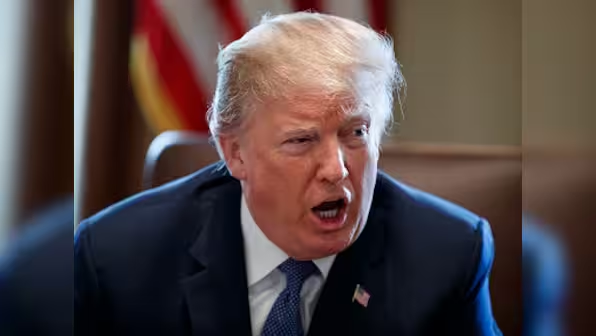
Critics point to the political backdrop surrounding the decision to indict. President Trump has for years accused Comey of acting improperly, frequently labeling him as dishonest and politically motivated. In recent weeks, Trump amplified those calls, demanding that Comey and other perceived adversaries face prosecution.
Prosecutors moved forward just days before the statute of limitations on one of the charges would have expired. This timing has raised questions: Was the case brought to ensure accountability at the last possible moment, or was it pushed through to satisfy political demands?
The debate reflects a growing concern in American politics—whether justice can truly remain separate from the influence of those in power.
Reactions from Washington and Beyond
The indictment has produced immediate and passionate responses from across the political spectrum.
- From the White House
President Trump celebrated the move, calling it a long-overdue step toward justice. In public remarks, he framed the indictment as proof that even the most powerful figures can be held accountable. - From the Justice Department
The Attorney General stated that the charges were based on evidence, not politics. The message was clear: the Department wants to be seen as restoring faith in the rule of law. - From Critics and Civil Rights Advocates
Many opponents argue that the indictment represents the politicization of federal prosecutions. They warn that the Justice Department risks undermining its credibility if cases appear to be driven by political vendettas rather than impartial evidence. - From the Public
Across social media and public forums, reactions have been divided. Supporters of the indictment say it finally delivers accountability. Detractors fear it opens the door for political retaliation against opponents in the future.
Comey’s Legacy and Why This Matters
James Comey has always been a controversial figure. His role in the FBI during the 2016 election made him one of the most polarizing public officials in modern history.
- The Clinton Email Probe
His decision to publicly announce the reopening of the Hillary Clinton email investigation just days before the 2016 election drew both praise and condemnation. Some saw it as transparency; others believed it directly influenced the election outcome. - The Russia Investigation
Comey later led the FBI during the early stages of the Russia probe, putting him at odds with President Trump. His dismissal in 2017 became one of the defining moments of Trump’s presidency, sparking debates over obstruction and presidential authority. - Public Persona
After leaving office, Comey positioned himself as a defender of integrity and an outspoken critic of Trump. Supporters viewed him as principled, but detractors saw him as opportunistic.
Now, with Comey indicted, his legacy faces perhaps its most defining test—not in the court of public opinion, but in a federal courtroom.
The Legal Road Ahead
With the indictment officially filed, the legal process now takes center stage.
- Initial Appearance
Comey will appear before a federal judge to hear the charges formally and enter a plea. - Pre-Trial Motions
His attorneys are expected to challenge the indictment, possibly arguing that the case is politically motivated or lacks sufficient evidence. - Trial Preparation
Both sides will prepare evidence, call witnesses, and line up testimony from those who were present during Comey’s 2020 congressional appearances. - Potential Outcomes
- An acquittal would be a political earthquake, potentially strengthening Comey’s claims of innocence.
- A conviction, however, could reshape how high-level officials are treated when accused of wrongdoing.
Regardless of outcome, the trial will attract global attention and dominate U.S. headlines for months.
Impact on the Justice Department
The case not only places Comey on trial but also puts the Justice Department itself under the microscope.
- Credibility at Stake
The DOJ is battling perceptions that it has been weaponized. Successfully prosecuting Comey could reinforce claims that no one is above the law. Failing to secure a conviction might deepen cynicism about political influence. - Future Precedents
This case may influence how future administrations handle political rivals. If prosecutions become routine for high-level officials, it could mark a shift toward a far more contentious and partisan justice system.
The Broader National Debate
The indictment taps into deeper issues about the role of truth, law, and accountability in American democracy.
- Supporters of the Case argue that Comey’s actions, if proven, show that even the most senior officials can mislead the public and institutions without facing consequences. For them, the indictment is long overdue.
- Critics of the Case insist that using criminal prosecutions against political opponents is dangerous. They warn that it risks transforming the United States into a system where political power dictates who faces justice.
This broader debate may ultimately shape how Americans view not only this case but also the balance between politics and law enforcement in years to come.
Public Trust and the Court of Opinion
Even before a verdict is reached, the case has already affected public opinion. For many Americans, trust in the FBI and the Justice Department has declined sharply in recent years. The indictment could either repair that trust—if it appears fair—or further erode it if the public believes the process is politically tainted.
The courtroom proceedings will not just be about James Comey. They will also serve as a mirror reflecting the nation’s values, divisions, and expectations of justice.
Conclusion
The reality that Comey indicted on criminal charges is a turning point in both legal and political history. It raises urgent questions about justice, accountability, and the independence of the institutions designed to protect democracy. Whether Comey is ultimately acquitted or convicted, the impact of this indictment will extend far beyond one man—it will shape how Americans view the intersection of politics and justice for years to come.
As the case unfolds, the world will be watching closely. And as this story develops, the real question remains: is this a moment of justice served, or a dangerous precedent being set?
Share your thoughts in the comments—how do you see this case shaping America’s future?

