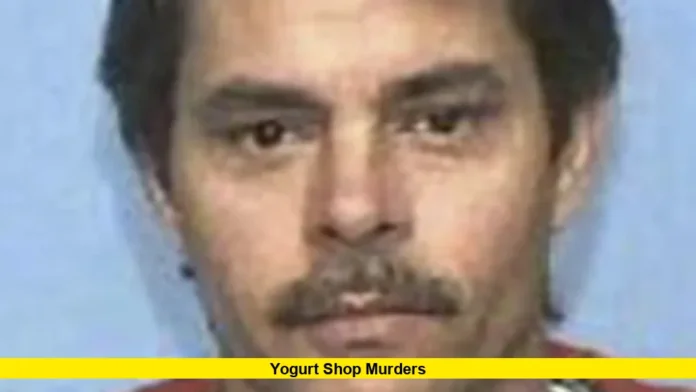
The yogurt shop murders of 1991 have stood as one of Austin’s most haunting unsolved crimes. For more than three decades, families of the victims and the community have carried the weight of unanswered questions. Now, thanks to groundbreaking DNA technology and forensic genealogy, investigators believe they have finally identified the man responsible: Robert Eugene Brashers.
This revelation marks a crucial turning point in a case that has baffled law enforcement, devastated families, and gripped the city of Austin for over 34 years.
Table of Contents
The Night That Shook Austin
On December 6, 1991, Austin was preparing for the holiday season. But in the north part of the city, tragedy struck at the I Can’t Believe It’s Yogurt! shop. Four teenage girls—Jennifer Harbison (17), her sister Sarah Harbison (15), their friend Eliza Thomas (17), and Amy Ayers (13)—were closing up for the night.
Sometime before midnight, the shop was set ablaze. Firefighters rushing to the scene made a horrific discovery: the charred remains of the four girls. Investigators soon learned they had been bound, gagged, shot execution-style, and left in a fire meant to destroy evidence.
The brutality of the murders stunned Austin. The victims were young, innocent, and full of promise. Overnight, the city was consumed by grief and fear.
Early Investigations and Missteps
The investigation into the yogurt shop murders began immediately, but from the start, the case proved extraordinarily difficult.
- Multiple Arrests and Convictions: Several men were arrested in connection with the murders. Two of them, Robert Springsteen and Michael Scott, were convicted in the late 1990s after confessing under intense interrogation. Their trials brought some sense of relief, but that relief was short-lived.
- DNA Exclusions: New DNA testing in the early 2000s showed that the biological evidence recovered from the scene did not match either Springsteen or Scott. Their confessions were eventually deemed unreliable, and the convictions were overturned.
- Lingering Suspicion: For years, suspicion continued to hover over those men and others who were once linked to the case, even though no scientific evidence tied them to the crime.
By the late 2000s, the case had gone cold again. Families were left waiting, and the city was left wondering if the truth would ever be uncovered.
Advances in Forensic Science
As decades passed, DNA technology advanced dramatically. By the 2010s, investigators could extract, amplify, and analyze smaller, more degraded DNA samples than ever before. The real breakthrough came with forensic genealogy—the same technique that identified the Golden State Killer.
Through this method, crime scene DNA is compared against profiles in genealogy databases. Investigators then build family trees to narrow down potential suspects. It is a labor-intensive process, but it has breathed new life into some of the nation’s toughest cold cases.
For the yogurt shop murders, this technology finally paid off.
The DNA Match: Robert Eugene Brashers
In September 2025, Austin police announced that DNA from the crime scene had been matched to Robert Eugene Brashers, a man with a violent criminal past.
Brashers was never on the radar during the initial investigation. But his DNA provided a clear match, leaving little doubt about his involvement. Investigators also discovered that a bullet casing found at the scene matched the type of weapon he was known to possess.
The revelation shocked many because Brashers had died by suicide in 1999 after a police standoff in Missouri. While his death means he will never face trial, identifying him provides a long-awaited breakthrough for families and a city still haunted by the case.
Who Was Robert Eugene Brashers?
Brashers lived a life of violence long before being linked to the yogurt shop murders.
- Early Crimes: In the mid-1980s, he attempted to murder a woman named Michelle Wilkerson, who survived his attack. He was convicted and imprisoned but released after serving time.
- Escalation: Following his release, Brashers committed additional violent crimes, including sexual assaults and homicides in other states.
- End of the Line: In 1999, cornered by police in Missouri, Brashers ended his life rather than face capture.
For years, he was remembered locally only as a dangerous drifter who left pain and destruction in his wake. Now, history paints him in an even darker light—as the prime suspect in Austin’s most notorious cold case.
Why the Case Took So Long to Solve
The yogurt shop murders highlight the challenges investigators faced in the 1990s:
- Limited DNA Tools: At the time, DNA analysis was in its infancy. The samples from the scene were too degraded for the technology available then.
- Pressure to Solve the Case Quickly: Investigators faced enormous pressure from the public and media. This contributed to reliance on shaky confessions rather than hard science.
- Complexity of the Crime Scene: The fire destroyed much of the physical evidence, making reconstruction difficult.
It took decades of patience, persistence, and scientific progress for the truth to finally come to light.
Impact on the Families
For the families of Amy, Eliza, Jennifer, and Sarah, the past 34 years have been marked by grief, frustration, and unanswered questions. Many of them publicly criticized earlier prosecutions, which they felt relied too heavily on coerced confessions rather than solid evidence.
Now, with Brashers identified as the likely killer, the families have a clearer picture of what happened that night. While nothing can erase their loss, this breakthrough offers a measure of closure and the hope that their daughters’ memories will no longer be overshadowed by uncertainty.
The City of Austin Remembers
The yogurt shop murders became more than just a crime story—they became part of Austin’s collective memory. For years, the case was discussed in classrooms, true crime documentaries, and local gatherings. It became a cautionary tale of how even seemingly safe communities could be rocked by unimaginable violence.
Memorials and vigils have kept the memory of the victims alive. Each anniversary has been a reminder of the work still to be done. With the identification of Brashers, the city can now look at the case with a new perspective—one that emphasizes perseverance and the eventual triumph of truth.
What Happens Next in the Case
Even though Brashers is deceased, the yogurt shop murders investigation is not entirely closed. Investigators continue to:
- Confirm all forensic links to ensure the DNA match is conclusive.
- Review whether Brashers acted alone or had accomplices.
- Re-examine evidence that might now hold new significance in light of the match.
- Evaluate past investigative missteps to understand how the case can inform future work.
Law enforcement officials are expected to share more updates in the coming weeks as they finalize their findings.
A Legacy of Justice Through Science
The yogurt shop murders stand as a grim reminder of how violent crime can devastate a community. But the resolution of this case—through DNA and forensic genealogy—also represents hope.
It demonstrates that no matter how much time passes, advances in science can bring answers where once there were only questions. It also underscores the importance of carefully preserving evidence, as materials collected decades ago can still hold the key to solving crimes in the present.
Conclusion: An End to the Silence
The identification of Robert Eugene Brashers as the suspect in the yogurt shop murders closes one of the darkest chapters in Austin’s history. Though justice in court will never be possible, the truth has finally emerged.
For the victims’ families, the breakthrough cannot erase the pain of loss, but it can help ease decades of uncertainty. For the city of Austin, it is a reminder that persistence and progress can bring light, even to the darkest mysteries.
The yogurt shop murders may finally have an answer—but the conversation about justice, healing, and remembrance will continue. What are your thoughts on this long-awaited breakthrough? Share them below and stay connected as more details unfold.

