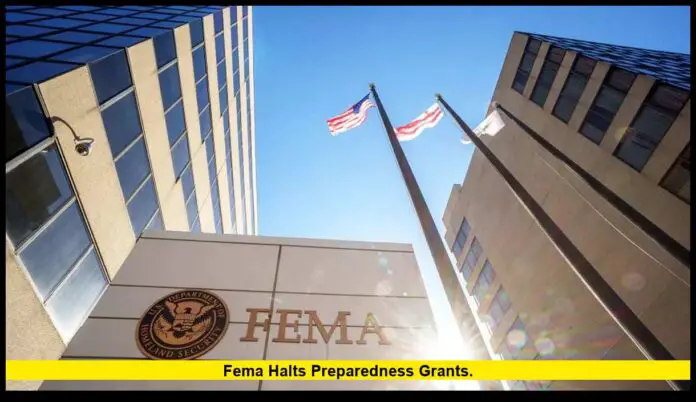
The news that FEMA halts preparedness grants has sent shockwaves through state and local emergency management agencies across the United States. The decision to pause the disbursement of critical grant funding comes as the agency demands states verify population figures used to calculate funding levels. This sudden shift is affecting hundreds of millions of dollars in disaster preparedness resources nationwide.
Table of Contents
A Sudden Halt to Vital Funding
On October 2, FEMA officially froze the distribution of preparedness grants that support disaster readiness, training, and infrastructure improvement across states and local jurisdictions. The agency claims that discrepancies in population data must be resolved before funds can be released.
This freeze impacts programs that rely on consistent funding to maintain readiness levels, causing widespread concern among state emergency offices already operating on tight budgets. For many, the grants represent the financial backbone of planning and response efforts.
Which Grants Are Impacted
The primary program affected by this halt is the Emergency Management Performance Grants (EMPG) program. This long-standing grant provides federal funding to state and local emergency management offices based on population formulas.
Additionally, portions of the Building Resilient Infrastructure and Communities (BRIC) program are affected. Several planned projects have been paused, and future funding rounds are uncertain. Together, these programs total hundreds of millions of dollars that help states prepare for and respond to disasters.
Why FEMA Is Requiring Population Verification
FEMA has stated that states must prove the accuracy of their population figures before grant money continues to flow. Population numbers are used to determine how funds are allocated, and discrepancies can significantly alter how much each state receives.
This verification process requires states to provide audited census data or other official demographic evidence to validate their claims. While the agency views this as a safeguard against misallocation, many state officials see it as an administrative hurdle introduced too late in the fiscal year.
Impact on States and Local Communities
The freeze has immediate and significant consequences for emergency preparedness operations at the state and local levels. Key areas affected include:
- Emergency Operations Centers that rely on grant funds for staffing and training
- Disaster response drills and community preparedness exercises that must be postponed or scaled back
- Equipment purchases and upgrades necessary to maintain readiness standards
- Mutual aid networks that depend on federal grants to support coordination between counties and regions
For rural areas with smaller tax bases, these grants are often the only reliable source of funding for preparedness programs. Without them, some communities may face reduced readiness heading into severe weather seasons or potential emergencies.
Legal and Political Pushback
Several states have begun challenging the decision, arguing that FEMA’s action disrupts budgets that were already approved and undermines local disaster preparedness. Attorneys general and emergency management leaders have criticized the timing, pointing out that states were not given adequate notice to adjust their plans or reporting procedures.
Some states have also pursued legal avenues to temporarily block the reallocation or suspension of funds. They argue that the federal agency overstepped its authority by changing funding conditions mid-cycle, creating uncertainty for state and local governments that depend on predictable federal support.
Timeline of Key Events
| Date | Event |
|---|---|
| Early 2025 | FEMA began reevaluating population data used in funding formulas |
| Mid 2025 | States received preliminary notices to update demographic information |
| September 2025 | Tensions grew as FEMA warned of a potential funding pause |
| October 2, 2025 | FEMA officially halts preparedness grants pending verification |
| October 3, 2025 | States began legal and administrative responses to the freeze |
Administrative Challenges Ahead
To unlock their funding, states must now provide extensive demographic documentation. This includes updated census data, independent studies, or legally certified population records. For some states, this is a manageable task. For others—particularly those with disputed counts or recent demographic shifts—it poses a significant challenge.
Emergency management offices must balance this administrative work with ongoing disaster response and preparedness responsibilities, creating additional strain on limited personnel.
Short-Term Risks of the Grant Freeze
The halt in funding introduces immediate risks to national preparedness efforts. These include:
- Interrupted training programs for first responders and emergency personnel
- Delays in critical infrastructure upgrades, such as communication systems and evacuation planning tools
- Reduced regional coordination, making it harder for states to collaborate during large-scale disasters
- Lower community readiness levels, particularly in areas prone to hurricanes, wildfires, floods, and other natural hazards
Without swift resolution, these short-term disruptions could impact real-world disaster response capabilities in the coming months.
Long-Term Implications for Federal-State Cooperation
Beyond the immediate financial and operational effects, this decision highlights deeper issues in how federal agencies and states coordinate disaster preparedness funding. Trust between federal and state partners is critical, and sudden changes to funding structures can strain these relationships.
Some experts warn that prolonged freezes could lead to delays in nationwide disaster preparedness benchmarks, weakening collective resilience at a time when extreme weather events and emergencies are becoming more frequent.
Looking Ahead
States are now under pressure to verify their population figures quickly. FEMA has indicated that once accurate data is submitted and reviewed, funding will resume. However, no fixed timeline has been provided for when states can expect to receive their withheld grants.
This lack of clarity has left many emergency managers in limbo, forced to make difficult decisions about which programs to sustain and which to pause.
The Bottom Line
The decision that FEMA halts preparedness grants has set off a chain reaction affecting state budgets, local preparedness efforts, and national emergency readiness. As states scramble to provide the necessary population data, communities are watching closely to see how long the freeze will last and what it means for disaster response capacity in the months ahead.
How do you think this funding freeze will affect local preparedness in your area? Share your thoughts below and stay tuned for updates as the situation develops.

