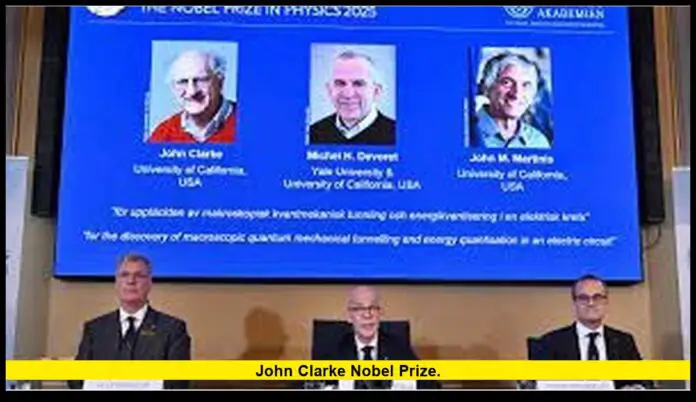
John Clarke Nobel Prize recognition has made global headlines in 2025 after the UC Berkeley professor was officially awarded the Nobel Prize in Physics. His pioneering work, conducted alongside Michel H. Devoret and John M. Martinis, transformed how scientists understand quantum behavior in large-scale systems. This year’s prize celebrates decades of research that laid the groundwork for modern quantum technologies.
A Landmark Achievement in Modern Physics
The 2025 Nobel Prize in Physics was awarded “for the discovery of macroscopic quantum mechanical tunneling and energy quantization in an electric circuit.” John Clarke’s research showed that quantum effects—usually confined to atoms and subatomic particles—can also appear in circuits visible to the naked eye.
His experiments, dating back to the 1980s, demonstrated two critical phenomena:
- Macroscopic Quantum Tunneling: The ability of an electric circuit to “tunnel” through energy barriers, similar to particles in quantum mechanics.
- Energy Quantization in Circuits: Just like electrons in atoms, the circuit’s energy levels were discrete, not continuous.
These discoveries bridged the gap between classical and quantum physics, becoming the foundation for technologies like quantum computers and ultra-sensitive sensors.
John Clarke: From Cambridge Scholar to American Innovator
Born in Cambridge, England, John Clarke completed his doctorate in 1968 before joining the University of California, Berkeley in 1969. Over more than five decades, he became one of the world’s leading figures in superconductivity and low-temperature physics.
At Berkeley, Clarke advanced the development of Superconducting Quantum Interference Devices (SQUIDs)—tools that can detect minute magnetic fields with exceptional precision. His laboratory became a global hub for pushing the boundaries of quantum phenomena on a macroscopic scale.
Upon receiving the Nobel call, Clarke expressed surprise and gratitude. Now an emeritus professor, he joins an elite group of Berkeley Nobel laureates, reinforcing the university’s position as a leader in American scientific research.
Historic Win for American Quantum Science
For the United States, the John Clarke Nobel Prize win represents a significant moment. All three laureates have close ties to major American institutions:
- Clarke at the University of California, Berkeley
- Devoret at Yale University and UC Santa Barbara
- Martinis at UC Santa Barbara
The prize carries a monetary award of 11 million Swedish kronor (about $1.2 million), shared among the three physicists. More importantly, it highlights the United States’ leadership in quantum science and its role in shaping the future of technology.
Impact on Quantum Technology
The implications of Clarke’s work extend far beyond the lab. His discoveries laid the foundation for multiple industries and scientific frontiers:
| Field | Impact of Clarke’s Research |
|---|---|
| Quantum Computing | Enabled the use of superconducting circuits as qubits, a key component in most modern quantum computers. |
| Quantum Sensing | Improved measurement accuracy through ultra-sensitive superconducting detectors. |
| Secure Communication | Supported advancements in quantum encryption and secure data transmission. |
| Fundamental Physics | Expanded understanding of where classical physics ends and quantum effects begin. |
This Nobel Prize highlights how fundamental research from decades ago has become essential to current technological progress.
Strengthening America’s Scientific Future
The recognition of Clarke’s achievements is likely to inspire new generations of physicists, engineers, and innovators. In the U.S., this award is expected to:
- Encourage greater investment in quantum research and development.
- Strengthen the position of American universities and laboratories in global physics.
- Boost interest in STEM education, particularly in fields like quantum computing and superconductivity.
- Support collaborations between academia and the growing quantum tech industry.
Such achievements emphasize that world-changing innovations often arise from persistent, long-term scientific work rather than short-term breakthroughs.
A Nobel Prize with Global Impact
John Clarke’s Nobel Prize is not only a personal triumph but also a symbol of the United States’ continued leadership in cutting-edge research. His discoveries are shaping the technologies that will define the next century—quantum computers, advanced sensors, and secure communications systems.
As the world turns its attention to the rapidly evolving quantum landscape, Clarke’s legacy stands as a reminder that today’s transformative technologies were born from yesterday’s bold scientific questions.
Final Thoughts
The John Clarke Nobel Prize win cements his place among the great physicists of our time. His groundbreaking work has bridged the mysterious world of quantum mechanics with the technologies shaping the future.
What are your thoughts on this historic Nobel Prize win? Share your views and stay connected for more important scientific updates.

