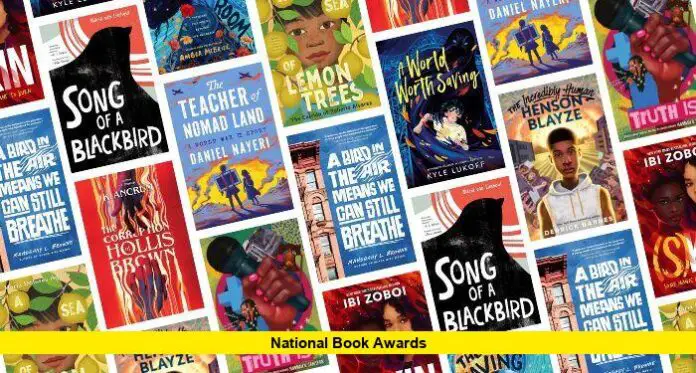
The National Book Awards have captured the attention of America’s literary community with the announcement of their 2025 finalists. From fiction and nonfiction to poetry, translation, and young people’s literature, the selected works reflect both the evolving landscape of U.S. letters and the expansive reach of storytelling across borders.
Table of Contents
Finalist Announcement: What We Know Now
On October 7, the National Book Foundation revealed the five finalists in each of its five competitive categories. The winners will be named at the 76th National Book Awards Ceremony & Benefit Dinner in New York City on November 19, 2025. Each winner will receive $10,000 and a bronze medal, while each finalist is awarded $1,000 and a medal.
Additionally, the Foundation will honor two literary figures with lifetime achievement awards: George Saunders and Roxane Gay, in recognition of their long-term contributions to American letters.
This year’s National Book Awards finalists reveal a fascinating mix of genres, voices, and experimental forms.
Fiction Finalists: Echoes of Home, Diaspora, and Reinvention
The fiction category often draws the greatest public attention—and 2025 does not disappoint. The finalists include:
- Rabih Alameddine, The True True Story of Raja the Gullible (and His Mother)
- Megha Majumdar, A Guardian and a Thief
- Karen Russell, The Antidote
- Ethan Rutherford, North Sun: Or, the Voyage of the Whaleship Esther
- Bryan Washington, Palaver
These works traverse landscapes both intimate and epic. Russell’s The Antidote returns to small-town Nebraska but weaves in surreal and folkloric elements. Alameddine’s novel spans Beirut to the California coast as it engages themes of memory and migration. Majumdar’s A Guardian and a Thief is her first novel since A Burning, and explores power, betrayal, and spiritual inheritance. Washington’s Palaver examines familial estrangement and queerness, and Rutherford’s North Sun blends myth, maritime adventure, and environmental urgency.
The fiction finalists stand out not only for their narrative ambition but also for their willingness to blur genre lines. North Sun, for example, feels part oceanic voyage, part mythic fable; The Antidote shifts temporal modes; Palaver centers emotional interiority.
Nonfiction: Memory, Conflict, Inquiry
In nonfiction this year, finalists include:
- Yiyun Li, Things in Nature Merely Grow
- Omar El Akkad, One Day, Everyone Will Have Always Been Against This
- Julia Ioffe
- Claudia Rowe
- Jordan Thomas
Li’s work is a deeply personal meditation on grief and the disappearance of her sons, while El Akkad turns outward—probing complicity, war, and global entanglements. The other finalists bring investigative, memoir, and narrative nonfiction forms to explore topics of power, identity, and moral reckoning.
Nonfiction finalists often reflect urgent cultural questions, and 2025 is no exception. The genre has broadened beyond traditional history or biography into hybrid forms—melding reportage, personal essay, and philosophical inquiry.
Poetry: Voices That Resonate
The poetry finalists are:
- Cathy Linh Che
- Tiana Clark
- Richard Siken
- Patricia Smith
- Gabrielle Calvocoressi
Poets on this slate are known for work that bridges the personal and the political, often invoking family, race, loss, and landscape with lyric intensity. The inclusion of such diverse voices crystallizes how poetry remains vital in capturing emotional truth in compact form.
Translated Literature: Global Voices in English Dress
One of the most exciting elements of this year’s National Book Awards is the strength of the translated literature finalists. The translated category was reestablished in 2018 to honor both authors and translators. The 2025 translated finalists include:
- Solvej Balle (On the Calculation of Volume (Book III), Danish)
- Gabriela Cabezón Cámara (We Are Green and Trembling, Spanish)
- Anjet Daanje (The Remembered Soldier, Dutch)
- Hamid Ismailov (We Computers: A Ghazal Novel, Uzbek)
- Neige Sinno (Sad Tiger, French)
These works bring stories from around the world into English, expanding the reach of U.S. readers. The award divides prize money between author and translator—a reminder that translation is creative labor and cultural bridge-work.
Reintroducing translated literature to the National Book Awards signals how American literary life is increasingly in conversation with global languages and experiences.
Young People’s Literature: Real Voices for Young Readers
The young people’s literature (YPL) finalists include:
- Amber McBride
- Hannah V. Sawyerr
- Ibi Zoboi
- Kyle Lukoff
- Daniel Nayeri
These authors have offered works that engage with identity, social justice, healing, and belonging. Some explore adolescence in crisis, others reimagine historical narratives for younger audiences. Their inclusion demonstrates how children’s and young adult storytelling has grown more ambitious and thematically rich.
One notable fact: several YPL finalists are returning names—authors who have built on earlier recognition to push deeper into complex narrative territory.
From Longlist to Finalists: The Curated Journey
Before the finalists appeared, the Foundation released longlists in September. Each longlist included ten titles per category. These selections drew early reader and critic attention, inviting engagement with a broader roster of worthy works.
For example:
- In fiction, longlist names included Susan Choi (Flashlight), Joy Williams (The Pelican Child), and Angela Flournoy (The Wilderness)—writers with strong reputations.
- The nonfiction longlist included entries by new and emerging voices, drawing on history, biography, climate, and memoir.
- The translated literature longlist included works in French, Korean, Arabic, Italian, and more.
- In young people’s literature, authors like María Dolores Águila and Mahogany L. Browne appeared.
- Poets from known and newer circles also featured.
This multi-stage system—submissions → longlist → finalists → winner—offers multiple opportunities for recognition, conversation, and visibility across a crowded literary marketplace.
Judging, Credentials, and Institutional Notes
This year, Rumaan Alam serves as chair of the judging panels. The Foundation published the full roster of judges, positioning them as practicing authors, translators, critics, and editors. Their diversity across genre and background helps ensure a broader lens of judgment.
The National Book Foundation’s timeline is consistent: the submission window typically opens in spring; longlists appear in early September; finalists in early October; and winners in mid-November. The Foundation also arranges public events each autumn—author readings, finalist panels, and “Teens Read the National Book Awards” gatherings—to engage readers across age groups.
The awards’ structure highlights both craft and community impact. Finalists and winners often see book sales increases, invitations to festivals, and wider media attention. But the National Book Awards also offer symbolic importance—recognizing whom we celebrate as American storytellers.
Trends & Takeaways from the 2025 Slate
- Risk and hybridity gain ground. More finalists cross genre boundaries—fiction with mythic elements, nonfiction with poetic memory, translation blending lyric and narrative.
- Global voices matter. Translated finalists from Denmark, Dutch, Uzbek, French, Spanish emphasize the growing interdependence of U.S. literary culture with global literature.
- Representation is central. Many finalists center racial, queer, immigrant, and global identities—not as themes but as lived experience.
- Young readers deserve weighty stories. The YPL finalists refuse to soften gravity—responding to the real lives of teens and children in turbulent times.
- Legacy and innovation cohabit. Lifetime awards to Saunders and Gay remind us of the weight of an author’s influence, while finalists push literary forms forward.
How to Follow & Engage with the Awards
- The awards ceremony on November 19, 2025 will be livestreamed for those unable to attend in person.
- The evening before, finalists often participate in readings and Q&A sessions that are open to the public (in person and virtually).
- Libraries, bookstores, and reading groups frequently organize special programming around finalists.
- Many finalists have appearances, interviews, and podcasts in the weeks leading to the gala—following their social media or author pages is a good way to catch those.
As readers, following the National Book Awards gives insight into what kinds of stories the U.S. literary establishment is valuing right now. It also guides you to exciting new works to read and discuss.
The National Book Awards represent more than prizes. They mark literary priorities, showcase emerging forms, and assert which voices merit public attention. The 2025 finalists reflect a country in dialogue—with history, with migration, with global culture, and with personal memory.
I’d love to hear which finalist you’re excited to read or which category you find most compelling—feel free to comment below or check back as the winners are revealed.

