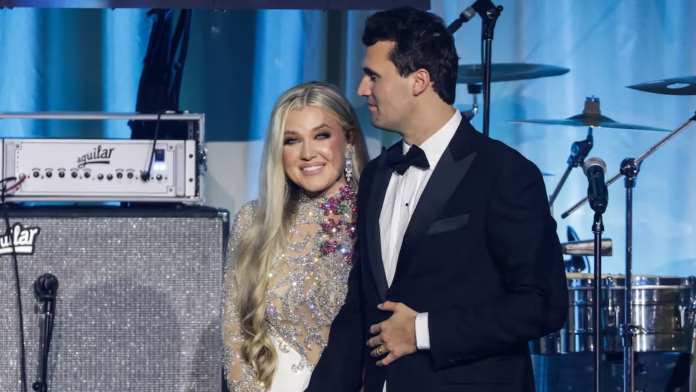
The Erika Kirk controversy has emerged as one of the most talked-about stories in American political culture this fall. Following the shocking assassination of conservative activist Charlie Kirk, his widow, Erika Kirk, has found herself thrust into the center of a media storm. Her rapid rise to leadership, legal developments, swirling conspiracy theories, and allegations about her past nonprofit work have created a complicated and emotionally charged public narrative.
As of mid-October 2025, the controversy shows no sign of slowing. Here’s a comprehensive look at the events, allegations, reactions, and unresolved questions surrounding Erika Kirk.
Table of Contents
A Sudden Spotlight: How the Controversy Began
The Erika Kirk controversy began in the immediate aftermath of Charlie Kirk’s death on September 10, 2025. Charlie was assassinated during a speaking engagement at Utah Valley University, a moment that sent shockwaves through political circles and social media platforms. Erika, previously known more for her philanthropic efforts than political leadership, became a central figure overnight.
Within days, she addressed the public in a widely viewed speech, vowing to continue her husband’s mission. Many supporters praised her composure, describing her as a symbol of strength in tragedy. Others, however, began questioning the speed with which she stepped into the public eye and how she presented herself during a moment of profound personal loss.
This combination—high-profile tragedy, immediate visibility, and public curiosity—set the stage for the intense scrutiny that followed.
A Swift Rise to Leadership
On September 18, just over a week after Charlie’s death, Erika Kirk was appointed CEO and Chair of the Board at Turning Point USA. The board stated that this decision reflected Charlie’s expressed wishes.
For Erika, the move represented both a personal commitment to her late husband’s legacy and a new public role of immense responsibility. She took over an organization that was already politically influential and media-savvy, making her leadership instantly high-profile.
Supporters argued that Erika’s appointment provided stability during a moment of uncertainty. Critics, on the other hand, suggested that the transition was unusually fast and that it blurred the lines between personal grief and political strategy. This leadership shift became one of the first major pillars of the Erika Kirk controversy.
The Legal Dimension: Protective Orders and Criminal Proceedings
In the days following the assassination, authorities arrested 22-year-old Tyler Robinson, who was charged with aggravated murder, weapons violations, and obstruction. A Utah court issued a protective order barring Robinson from contacting Erika Kirk during the pretrial period.
This legal backdrop placed Erika at the intersection of two powerful narratives: one as a widow involved in a high-profile criminal case, and another as a rising public figure leading a major political organization. Every legal development—from court hearings to procedural rulings—has been closely watched and often folded into the broader controversy surrounding her.
Candace Owens and the Surge of Conspiracy Allegations
One of the most explosive aspects of the Erika Kirk controversy came when commentator Candace Owens publicly questioned Erika’s behavior following Charlie’s death. Owens suggested that Erika had not sufficiently questioned the circumstances surrounding the assassination and implied that she may have had prior knowledge of certain events.
Her comments quickly went viral, sparking fierce debate. Some saw Owens’s words as insensitive and unfounded, accusing her of targeting a grieving widow. Others echoed her sentiments, viewing Erika’s demeanor and rapid leadership ascent as reasons for skepticism.
Erika responded firmly, stating that grief does not follow a fixed formula and that public expectations about how a widow “should” behave are both unrealistic and intrusive. This back-and-forth between prominent conservative figures added fuel to the controversy, making it not just a personal story but a public power struggle within a shared political space.
Romania Allegations and Nonprofit Work Scrutiny
Another key component of the Erika Kirk controversy involves allegations related to her past nonprofit work in Romania. Erika has long been associated with a philanthropic initiative called Romanian Angels, which focused on sending gifts and support to children in Romanian orphanages during the holiday season.
However, as public attention intensified, online claims emerged alleging that she had been banned from Romania for her involvement in child trafficking operations. These claims spread rapidly across social media platforms, despite lacking credible evidence.
Investigations found no official record of any Romanian ban or legal proceedings against Erika. Her nonprofit’s activities were limited to charitable programs, not trafficking networks. Nonetheless, the viral nature of these allegations ensured they became part of the controversy’s public narrative.
This episode illustrates how, in today’s digital landscape, unverified claims can shape reputations and influence public opinion in ways that are difficult to reverse—even when they are proven false.
Public Reaction and Social Media Narratives
Much of the Erika Kirk controversy has unfolded on social media, where public perception often develops faster than facts. Platforms such as X (formerly Twitter), Instagram, and Reddit have become arenas for speculation, debate, and commentary.
Several themes dominate these discussions:
- Tone and emotion: Erika’s calm, composed public appearances after her husband’s death divided observers. Some admired her strength, while others described her demeanor as detached or calculated.
- Leadership timing: The speed at which she assumed control of Turning Point USA led some users to speculate about preexisting plans, while others viewed it simply as honoring her husband’s wishes.
- Online conspiracy loops: Once conspiracy narratives began—particularly around Romania—they were amplified by influencers, reposted by anonymous accounts, and discussed in forums where speculation often blurred with fact.
This digital amplification has kept the story constantly evolving, even when no new developments occur.
Media Storms and Cultural Flashpoints
The controversy has also intersected with broader cultural debates. One widely criticized episode involved an online article describing a stunt in which witches were allegedly paid to place curses on Charlie Kirk just days before his death. Although intended as dark humor, the piece was met with outrage and quickly removed.
For Erika and her supporters, the incident symbolized a lack of empathy and the toxic nature of some online discourse. For critics, it demonstrated how every facet of the Kirk family’s public lives had become entangled with media spectacle.
A Detailed Timeline of the Erika Kirk Controversy
| Date | Event |
|---|---|
| September 10, 2025 | Charlie Kirk is assassinated during a speaking event at Utah Valley University. |
| September 13, 2025 | Erika Kirk delivers a widely covered public speech promising to continue Charlie’s mission. |
| September 16, 2025 | A protective order is issued against Tyler Robinson, prohibiting contact with Erika. |
| September 18, 2025 | Erika is appointed CEO and Chair of Turning Point USA. |
| Late September 2025 | Candace Owens raises conspiracy claims, triggering widespread online debate. |
| Late September 2025 | Romania allegations surface and are publicly debunked. |
| October 2025 | Public debates intensify as Erika leads Turning Point USA amid ongoing scrutiny. |
Public Image vs. Private Grief
A recurring theme in the Erika Kirk controversy is the gap between public expectations and private emotions. Many people project their own assumptions onto how a widow “should” behave—whether in demeanor, timing of public appearances, or decisions made shortly after tragedy.
Erika’s public image has been shaped not only by her own words but also by the interpretations of others. Every speech, facial expression, and organizational decision has been analyzed, sometimes sympathetically and sometimes harshly. This phenomenon highlights how personal tragedy, when it unfolds in the public eye, often becomes intertwined with public narratives in ways that are beyond one person’s control.
Political Implications and Future Outlook
Beyond personal and emotional dimensions, the Erika Kirk controversy has clear political implications. Turning Point USA plays a significant role in shaping conservative youth culture, and Erika’s leadership will likely influence its direction. Her ability to maintain authority, navigate legal proceedings, and counter online misinformation will be crucial in determining her future standing.
If she successfully leads the organization through this turbulent period, she may emerge as a powerful figure in her own right. If not, the controversy could overshadow her leadership and alter Turning Point USA’s trajectory. Either way, the stakes are high—not just for Erika personally, but for the broader movement she now represents.
Unanswered Questions
Several questions remain at the heart of the Erika Kirk controversy:
- How will the criminal case against Tyler Robinson progress, and what new information might emerge?
- Can Erika maintain her leadership role under sustained scrutiny and speculation?
- Will the conspiracy narratives fade with time, or will they continue to shape public perceptions?
- How will Turning Point USA evolve under her guidance in the long term?
These unresolved issues ensure that the controversy remains a dynamic story with significant implications.
Closing Thoughts
The Erika Kirk controversy is not a single event—it’s an evolving narrative shaped by tragedy, leadership, media dynamics, and political culture. It reflects how personal grief can become a public spectacle and how information—both factual and false—travels at unprecedented speed in the digital age.
As Erika Kirk continues to navigate this landscape, the nation watches closely to see how her story unfolds and what it reveals about the intersection of power, emotion, and public perception in modern America.
What are your thoughts on the Erika Kirk controversy? Share your perspective below and stay informed as this story continues to develop.

