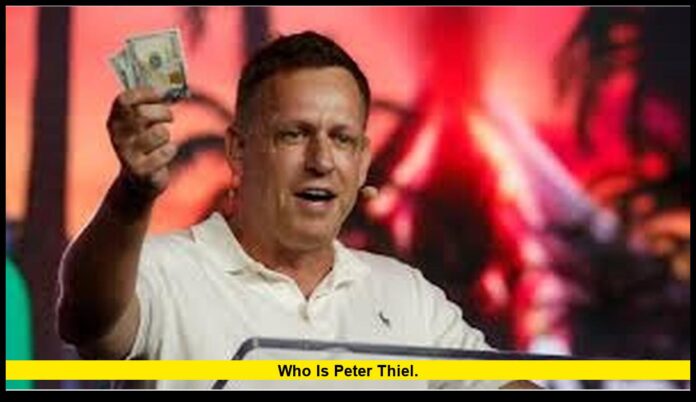
The question who is Peter Thiel has become more relevant than ever as his name continues to surface in conversations about Silicon Valley, political influence, artificial intelligence, and global power dynamics. Peter Thiel is a billionaire entrepreneur, venture capitalist, and political strategist whose impact reaches far beyond the world of startups. Known for co-founding PayPal, investing early in Facebook, and funding Palantir, Thiel is both celebrated and controversial in equal measure.
Table of Contents
Early Life and Education
Peter Andreas Thiel was born on October 11, 1967, in Frankfurt, West Germany. His family moved to the United States when he was a child, eventually settling in Foster City, California. Thiel excelled academically, developing a strong interest in mathematics and philosophy from an early age.
He attended Stanford University, where he earned a Bachelor’s degree in Philosophy in 1989 and later a Juris Doctor from Stanford Law School in 1992.
During his time at Stanford, Thiel founded The Stanford Review, a conservative-libertarian student newspaper that often challenged progressive ideas on campus. This experience shaped his worldview, blending libertarian ideals with a deep interest in technology, economics, and political power.
The Birth of PayPal and the “PayPal Mafia”
Thiel’s rise to prominence began when he co-founded PayPal in December 1998 alongside Max Levchin, Luke Nosek, and Ken Howery. Serving as CEO, he played a pivotal role in steering the company through its early growth and competition in the emerging online payment industry.
- 2002: PayPal went public and was quickly acquired by eBay for $1.5 billion in stock.
- Thiel reportedly made $55 million from the sale.
- The group of early PayPal employees — which included Thiel, Elon Musk, Reid Hoffman, and David Sacks — became famously known as the “PayPal Mafia.”
After PayPal’s sale, Thiel founded Clarium Capital, a hedge fund, and later co-founded Founders Fund, a venture capital firm that would become a key player in Silicon Valley investing.
Key Investments and Business Influence
Peter Thiel is widely regarded as one of Silicon Valley’s sharpest investors, known for making bold, early bets on companies that became global giants.
In 2004, Thiel invested $500,000 in Facebook, becoming the company’s first outside investor. He acquired a 10.2% stake and joined the board of directors. His investment turned into more than $1 billion after Facebook’s IPO, cementing his reputation as a visionary venture capitalist.
Palantir Technologies
Thiel co-founded Palantir in 2003, a data analytics company that works closely with U.S. government agencies on intelligence and security matters. Palantir’s tools are used for counterterrorism, fraud detection, and defense — making it one of the most politically significant tech companies in the world.
Other Investments
Through Founders Fund, Thiel has invested in several high-profile companies, including:
- SpaceX
- Airbnb
- Stripe
Thiel’s approach to business is famously contrarian. He often encourages entrepreneurs to build monopolies rather than compete in crowded markets, a philosophy he detailed in his bestselling 2014 book Zero to One.
Political Influence and Ideological Vision
Thiel is not just a businessman — he’s also a major political influencer. A self-described libertarian, he has often backed candidates and causes that align with his anti-establishment and technocratic worldview.
Support for Outsider Candidates
- 2016: Thiel broke ranks with most of Silicon Valley by supporting Donald Trump’s presidential campaign, donating $1.25 million and speaking at the Republican National Convention.
- 2022 Midterms: He backed candidates such as J.D. Vance in Ohio and Blake Masters in Arizona, both of whom reflected his ideological interests in technology, nationalism, and skepticism of traditional political elites.
Ideological Positions
Thiel’s beliefs can be summarized as:
- Skepticism toward government regulation and centralized authority
- Support for radical technological innovation
- Belief in the power of markets and private enterprise
- Interest in alternative governance structures like seasteading (floating cities)
- Advocacy for strong national security through technology
His political involvement has sparked debate. Admirers see him as a visionary unafraid to challenge conventional politics, while critics view him as a powerful figure using his wealth to reshape democracy in his image.
Recent Focus: AI, National Security, and Global Expansion
As of 2025, Peter Thiel has stepped back from some high-profile positions but remains deeply influential behind the scenes.
- Meta Board Exit: He left the Meta (Facebook) board in 2022 to focus on political and strategic interests.
- AI and Defense: Thiel has become a key backer of artificial intelligence startups, particularly those intersecting with defense and surveillance. Palantir continues to win major U.S. government contracts in these fields.
- Global Investments: He has expanded his investments outside the U.S., particularly in Europe and the Middle East, reflecting his interest in geopolitical influence.
Thiel is frequently mentioned in discussions about U.S.–China tech competition, AI regulation, and the role of private companies in national security.
Public Image and Controversy
Peter Thiel is one of the most polarizing figures in modern American business.
Admiration
- Seen as a strategic genius who spots transformative technologies early.
- Respected for his willingness to think differently and take bold bets.
- Praised for bridging technology and policy in meaningful ways.
Criticism
- Accused of pushing anti-democratic ideas through concentrated wealth and influence.
- Criticized for Palantir’s role in government surveillance programs.
- Known for funding the lawsuit that bankrupted Gawker Media, raising concerns about free press vs. personal privacy.
Thiel’s deliberate preference for operating behind the scenes only adds to the intrigue surrounding him.
Peter Thiel: Quick Facts
| Category | Details |
|---|---|
| Full Name | Peter Andreas Thiel |
| Date of Birth | October 11, 1967 |
| Nationality | U.S. (naturalized), also holds New Zealand citizenship |
| Net Worth | Estimated $9–10 billion (2025) |
| Key Roles | PayPal co-founder, Palantir co-founder, Facebook investor |
| Political Alignment | Libertarian-leaning conservative |
| Major Book | Zero to One (2014) |
Why Peter Thiel Matters
Peter Thiel’s influence on technology, politics, and global power structures makes him a unique figure in modern history. Few individuals have simultaneously shaped Silicon Valley’s startup culture, funded disruptive political movements, and built companies that redefine government surveillance and intelligence.
His ability to operate strategically — often away from the spotlight — ensures his presence will be felt in both the innovation economy and American political discourse for years to come.
What’s your perspective on Peter Thiel’s influence — visionary strategist or controversial power broker? Share your thoughts below.

