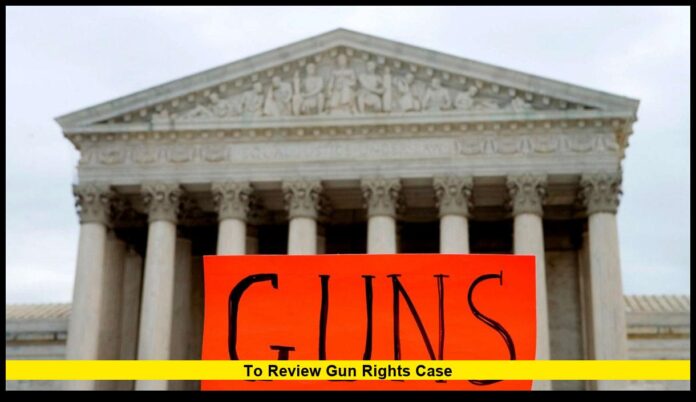
The U.S. Supreme Court has agreed to review gun rights case, marking one of the most consequential moments in modern Second Amendment law. On October 20, 2025, the Court granted review in a federal case challenging the law that prohibits individuals who use or are addicted to illegal drugs from possessing firearms.
Table of Contents
Background of the Gun Rights Case
At the heart of this case lies Section 922(g)(3) of Title 18 of the U.S. Code — a federal statute barring any person who is “an unlawful user of or addicted to any controlled substance” from owning or possessing firearms.
The law has existed for decades, but it now faces a fresh constitutional test following a wave of new legal interpretations inspired by the Supreme Court’s 2022 New York State Rifle & Pistol Association v. Bruen decision. That ruling reshaped how courts evaluate gun laws, requiring that any firearm regulation be consistent with the nation’s “historical tradition of firearm regulation.”
The current challenge originated in Texas, where a man was charged under the statute after police found a firearm and evidence of drug use in his home. A federal appeals court struck down the statute, ruling that it violated the Second Amendment under the new Bruen framework. The Justice Department appealed, and the Supreme Court has now taken up the case to determine whether the law aligns with the historical traditions that the Constitution protects.
Why the Supreme Court’s Review Matters
The Court’s decision to review this gun rights case could set a major precedent for how far the Second Amendment extends.
This case raises key questions about whether certain personal behaviors — such as illegal drug use — can justify limits on firearm ownership. It also tests how courts will apply the historical-tradition test to modern regulations that have no direct 18th-century equivalent.
The ruling could have sweeping implications. If the Supreme Court upholds the law, it would reaffirm the government’s ability to restrict firearm possession for individuals deemed dangerous or impaired. If it strikes the law down, it could open the door to broader gun rights for groups currently prohibited from owning firearms, including habitual drug users or others with similar restrictions.
Lower Court Decisions Leading Up to Review
The lower courts have been sharply divided on how to apply the Bruen standard to gun restrictions.
- The Fifth Circuit Court of Appeals ruled that the law was unconstitutional because the government failed to show a clear historical precedent for disarming individuals based on drug use.
- Other courts, however, have upheld similar laws, reasoning that public safety concerns and long-standing traditions of disarming dangerous individuals support such restrictions.
This split among lower courts likely contributed to the Supreme Court’s decision to intervene and bring national clarity on the matter.
Timeline of Key Developments
| Date | Event |
|---|---|
| 2022 | Bruen decision redefines Second Amendment analysis, focusing on historical tradition. |
| 2023 | Multiple lower courts begin striking down or questioning firearm restrictions. |
| 2024 | Federal appeals court in Texas rules Section 922(g)(3) unconstitutional. |
| October 2025 | Supreme Court agrees to review the case, setting up a landmark hearing. |
| Early 2026 (expected) | Oral arguments and final decision anticipated. |
Broader Legal Context
This gun rights case is part of a broader wave of Second Amendment litigation since the Bruen decision.
Recent Supreme Court cases have already reshaped firearm law in the United States:
- In 2024, the Court upheld the disarmament of individuals under domestic violence restraining orders.
- Earlier in 2025, the Court confirmed that “ghost gun” kits can be regulated under federal law.
Now, by taking up the case involving drug users and firearm possession, the Court is poised to define where the line lies between individual rights and public safety.
Potential Implications of the Ruling
The implications of the Court’s eventual decision are extensive and could influence both law enforcement and individual gun ownership nationwide.
If the Court Upholds the Statute:
- The federal government will retain broad authority to restrict firearm ownership for individuals deemed unfit or dangerous.
- Courts could continue to rely on the idea that certain modern regulations, though not explicitly found in history, serve public safety purposes that align with constitutional principles.
If the Court Strikes Down the Statute:
- It would expand the scope of the Second Amendment, limiting the government’s power to restrict firearm ownership based on personal conduct such as drug use.
- Hundreds of pending prosecutions across the country could be affected, leading to potential appeals or dismissals.
- Congress and state legislatures may need to rewrite firearm statutes to comply with the new constitutional framework.
Either outcome will have lasting effects on how gun laws are written, interpreted, and enforced across the United States.
What Happens Next
The Supreme Court is expected to schedule oral arguments in early 2026, with a decision likely by June of that year.
Observers anticipate intense debate over how the historical-tradition test should apply to this kind of modern restriction, especially in light of changing attitudes toward both gun rights and drug policy.
Legal scholars note that this case could help clarify whether the Court intends to continue expanding Second Amendment protections — or begin setting clearer limits after several years of broad pro-gun rulings.
Public and Political Reactions
The case has already drawn widespread attention from both gun rights advocates and gun control supporters.
- Gun rights organizations argue that the government’s restrictions are overly broad and that the Constitution protects responsible ownership regardless of personal behavior that does not directly threaten others.
- Gun control advocates warn that removing such restrictions could endanger public safety, especially amid rising concerns about drug abuse and firearm violence.
Political leaders on both sides are preparing for the potential ripple effects of the Court’s eventual decision, which may influence future legislative debates about gun control at both the federal and state levels.
Conclusion
The Supreme Court’s decision to review gun rights case concerning firearm possession by drug users signals another pivotal chapter in the evolving story of the Second Amendment. Whether the Court upholds or strikes down the law, its ruling will set a powerful precedent defining the boundaries between constitutional rights and public safety in America.
What do you think about this upcoming gun rights case? Share your thoughts in the comments and stay tuned for further developments.

