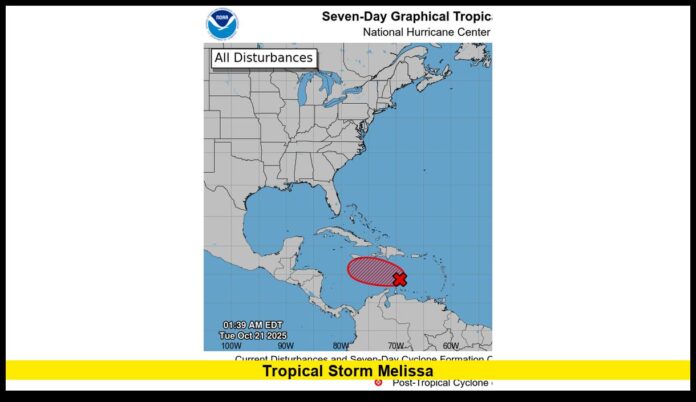
The latest update on Tropical Storm Melissa confirms that the system has officially formed in the Caribbean Sea and is being closely monitored by the National Hurricane Center (NHC). As of Tuesday morning, the storm was centered roughly 300 miles (480 km) south of Port-au-Prince, Haiti, with sustained winds of 50 mph (80 kph) and moving west at about 14 mph (23 kph). A hurricane watch has been issued for parts of Haiti, while Jamaica remains under a tropical storm watch as the system strengthens over warm waters.
Table of Contents
Current Status & Forecast
- Location: About 300 miles south of Haiti’s capital, Port-au-Prince.
- Sustained Winds: Approximately 50 mph (80 kph).
- Movement: Westward at near 14 mph (23 kph).
- Watches Issued:
- Hurricane watch for parts of Haiti.
- Tropical storm watch for Jamaica.
- Forecasted Threat Areas: Haiti and Jamaica are the highest near-term concern, though the U.S. mainland currently is not expected to face direct impacts.
Development and Trajectory Uncertainty
Meteorologists are analyzing multiple model scenarios for Tropical Storm Melissa’s path and intensity. The system originated as a tropical wave in the eastern Caribbean and had a high likelihood of developing into a named storm within the week. Now that it has strengthened, forecasting models diverge on its next moves.
- The American GFS model suggests a north-turn toward Hispaniola (Haiti and the Dominican Republic).
- The European ECMWF model shows a more westward path toward Jamaica, Cuba, or possibly Central America.
- Sea surface temperatures near 90 °F (32 °C) are unusually warm for late October, providing ample energy for further strengthening.
- Weak steering currents across the region mean the storm’s movement could slow, which increases the risk of prolonged heavy rainfall and flooding near land.
Potential Impacts
For Haiti and Jamaica:
- Heavy Rainfall: Expected to trigger flash flooding and possible mudslides in mountainous areas.
- Strong Winds: Gusts could reach or exceed tropical storm strength, especially in exposed coastal zones.
- Coastal Flooding: Rising seas, dangerous surf, and rip currents are likely along southern and western shores.
- Extended Threat: If the storm slows its pace, rainfall accumulation could worsen flooding impacts over several days.
For the United States:
At this time, there is no direct threat to the U.S. mainland. However, meteorologists emphasize that conditions could change later this week depending on how the storm interacts with upper-level winds. There remains a small chance the system could drift northwest toward the Gulf of Mexico or curve north toward the southeastern U.S. coast.
Even if the storm stays over the Caribbean, indirect effects — such as increased surf, rip currents, and coastal swells — could reach parts of Florida and the Gulf Coast later in the week.
Timeline Snapshot
| Date | Event | Notes |
|---|---|---|
| Oct 20 2025 | Disturbance monitored in Caribbean | Forecasted to develop within 48 hours. |
| Oct 21 2025 | System named Tropical Storm Melissa | Watches issued for Haiti and Jamaica. |
| Late this week | Uncertain track forecast | Models split between northward and westward paths. |
Why U.S. Audiences Should Stay Alert
Even though Tropical Storm Melissa poses no immediate danger to the continental U.S., there are strong reasons for Americans — particularly those in coastal or Gulf states — to keep an eye on developments.
- Late-Season Activity: The Atlantic hurricane season officially runs through November 30. Storms that form in late October can behave unpredictably due to shifting weather patterns.
- Indirect U.S. Effects: Large systems like Melissa can produce rip currents and strong waves along U.S. coastlines, even when hundreds of miles offshore.
- Track Variability: Tropical systems in the Caribbean often change direction quickly. If steering currents shift, Melissa could take a path that brings it closer to the U.S. or into the Gulf of Mexico.
- Preparedness: Monitoring now allows for quick readiness if the storm unexpectedly changes course.
Forecast Highlights
- Strengthening Likely: Warm ocean waters may help Melissa intensify further before it interacts with land.
- Path Scenarios:
- A northward track could bring it over or near Haiti and the Dominican Republic.
- A westward track could take it toward Jamaica, Cuba, or Central America later this week.
- U.S. Impact: No warnings or watches currently extend to the U.S., but forecasters will continue monitoring potential shifts.
- Rainfall Risk: Even without major wind damage, Melissa’s slow movement could dump several inches of rain in parts of the Caribbean, raising the flood threat.
Safety Precautions for Residents in Affected Areas
Residents in Haiti and Jamaica should be taking the following steps now:
- Stay informed through local authorities and weather advisories.
- Prepare emergency supplies, including food, water, flashlights, and batteries.
- Avoid flood-prone areas, especially near rivers or steep terrain.
- Follow evacuation orders if issued by local governments.
- Secure property by bringing loose outdoor items indoors and reinforcing doors and windows.
For U.S. coastal residents, now is a good time to review hurricane safety plans and remain weather-aware as the system evolves.
Expert Analysis
Forecasters note that Melissa’s future depends heavily on the strength and direction of surrounding atmospheric patterns. The storm’s current position places it in a region of high heat content, which typically fuels intensification. However, upper-level shear to the north could limit rapid strengthening if Melissa shifts closer to Hispaniola.
If the storm maintains a westward track, it could impact parts of Central America, potentially bringing heavy rain to Honduras, Belize, or Nicaragua later in the week. Meanwhile, a north-turning system would have to navigate mountainous terrain, likely weakening before re-emerging into the Atlantic.
While Melissa is not expected to become a major hurricane immediately, forecasters caution that late-season storms can surprise — similar to past October systems that strengthened quickly before landfall.
Key Takeaways
- Tropical Storm Melissa has formed south of Haiti with winds of around 50 mph and is moving westward.
- Watches are in effect for Haiti and Jamaica, with potential flooding and strong winds expected.
- The storm’s track remains uncertain, with possible paths ranging from Hispaniola to Central America.
- There is no direct threat to the U.S. at this time, but forecasters are keeping a close watch.
- Residents in the Caribbean should remain alert and prepared as the storm continues to evolve.
Stay tuned for further updates as Tropical Storm Melissa continues to develop — share your thoughts or experiences with the storm in the comments below.

