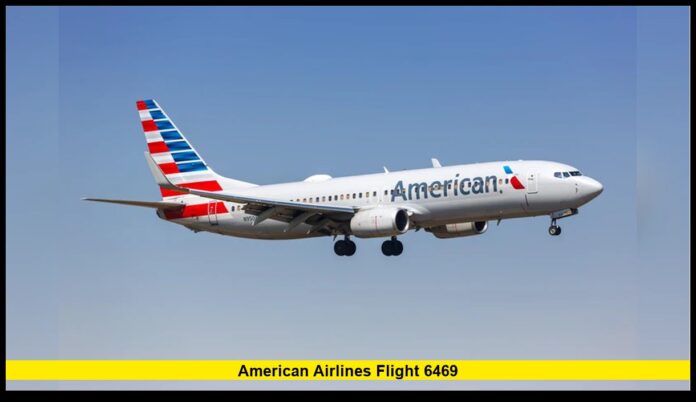
The American Airlines Flight 6469 incident has sparked discussion across the aviation industry after the flight made an unexpected return to Omaha on Monday night, following what was initially believed to be an attempted cockpit breach. Later investigations revealed that the situation was caused by a communication malfunction—not a security threat.
This incident, though safely resolved, offered an inside look at how even a minor technical issue can trigger emergency procedures aboard a commercial flight.
Table of Contents
What Happened on American Airlines Flight 6469
American Airlines Flight 6469, operated by SkyWest Airlines on behalf of American Eagle, departed from Omaha’s Eppley Airfield around 6:40 p.m. Central Time, bound for Los Angeles International Airport.
Roughly 40 minutes into the flight, the crew decided to turn the plane back toward Omaha after hearing unusual noises and receiving distorted intercom transmissions from the cabin. The pilots, unable to clearly communicate with flight attendants, grew concerned that someone might be attempting to force entry into the cockpit.
Key Details:
- Aircraft: Embraer ERJ-175
- Operator: SkyWest Airlines (for American Airlines)
- Flight Path: Omaha (OMA) → Los Angeles (LAX)
- Incident Time: Approximately 7:20 p.m. CDT
- Resolution: Safe landing in Omaha at 7:45 p.m.; no injuries reported
Upon landing, the plane was inspected and quickly determined to be safe. Authorities confirmed there was no attempted breach, and that the confusion stemmed from an intercom system malfunction.
Inside the Miscommunication: What Really Happened
The core of the problem was a technical glitch in the aircraft’s internal communication system. According to initial airline reports, the cockpit intercom remained open, producing static and muffled sounds that made it difficult for the pilots to hear cabin crew messages.
When flight attendants, unable to reach the cockpit through standard communication, knocked on the cockpit door, the pilots misinterpreted the noise as a potential intrusion attempt.
In accordance with FAA-mandated cockpit security procedures, the pilots immediately locked down the cabin and initiated a precautionary return to their departure airport.
By the time the jet landed safely in Omaha, it became clear that the situation had been purely technical.
Passenger Experience on Board
Passengers described a tense but orderly environment as the pilots announced the decision to return.
“We were told there was a communication issue and that it was safest to go back to Omaha,” one traveler said. “Everyone stayed calm, but you could tell something unusual was happening.”
Once back at the gate, passengers were briefed by both flight and ground crew. After inspection and clearance, many were rebooked on the next available flight to Los Angeles. No one was injured, and the airline praised the crew’s professionalism for following safety protocol “by the book.”
Airline Response and Official Statement
In a statement released after the incident, American Airlines confirmed that the decision to turn back was made “out of an abundance of caution” following a communication issue on board.
SkyWest Airlines, which operated the flight, said:
“Flight 6469 returned to Omaha shortly after takeoff due to a reported communication malfunction. The aircraft landed safely, and maintenance teams addressed the issue before releasing the plane back into service.”
Both companies emphasized that there was no security threat and that all onboard systems functioned normally once the intercom issue was identified and reset.
Safety First: Why the Crew’s Response Was Correct
Although some might question the quick return decision, aviation experts say the pilots handled the situation exactly as they should have.
Modern cockpit security rules leave no room for risk. Any unexplained noise, system malfunction, or sign of potential intrusion must be treated as a real threat until proven otherwise.
Key Safety Takeaways:
- Reinforced cockpit doors cannot be opened externally once sealed.
- FAA protocols require immediate communication with air-traffic control if pilots suspect interference or mechanical issues.
- Crew coordination is prioritized over passenger convenience when any uncertainty arises.
As one aviation analyst noted, “In this environment, it’s always safer to turn around than to assume it’s nothing.”
Technical Insight: How Communication Failures Escalate
Aviation relies heavily on flawless communication between pilots, cabin crew, and air-traffic control. Even a small disruption in those channels can create confusion.
On Flight 6469, the cockpit interphone system—used for secure communication between flight attendants and pilots—was likely transmitting constant background noise. This made it nearly impossible for pilots to distinguish between normal chatter and possible distress signals.
When flight attendants tried to physically alert the cockpit by knocking, the pilots, hearing distorted audio at the same time, connected the sounds to a worst-case scenario: a potential cockpit breach attempt.
The FAA’s post-9/11 security framework ensures that pilots respond immediately to any such possibility, triggering an emergency return.
Impact on American Airlines Operations
The short-lived disruption had a minor impact on American’s regional network Monday evening. Passengers were rebooked, and the aircraft underwent routine post-incident inspection before resuming operations.
For the airline, however, this episode highlights the critical importance of communication reliability on modern aircraft — especially smaller regional jets that rely on simplified intercom systems.
The company is expected to review:
- Interphone system maintenance protocols
- Crew training for ambiguous signal handling
- Incident escalation guidelines for future prevention
American Airlines reaffirmed that safety remains its “highest priority.”
Public Reaction and Traveler Concerns
The story of American Airlines Flight 6469 quickly spread across social media, with many praising the crew for their cautious response. Others expressed concern over how such a minor issue could be mistaken for a serious threat.
Aviation safety groups have reassured the public that this level of caution is both normal and necessary. According to the National Transportation Safety Board (NTSB), rapid response to ambiguous threats is a cornerstone of modern flight safety.
In most cases, false alarms like this one confirm that the system is working as designed — emphasizing prevention over reaction.
How Often Do Flights Turn Back?
Unexpected returns like Flight 6469 are uncommon but not rare. Commercial jets divert or return to origin several times each week across the U.S., most often for mechanical, medical, or weather-related reasons.
In this case, the event falls under a “non-emergency precautionary return” — meaning no imminent danger was detected, but the situation warranted landing for verification.
Such responses are intentionally conservative. Airlines prefer to err on the side of caution rather than risk misjudging a potential problem at altitude.
What Passengers Should Know During a Mid-Flight Turnaround
If you ever find yourself on a flight that turns back unexpectedly, here’s what experts recommend:
- Stay calm and listen carefully to crew announcements.
- Avoid speculation — early information is often incomplete.
- Follow instructions immediately if the crew begins safety checks or briefings.
- Expect rebooking delays, especially if maintenance or inspection is required.
- Know your rights — in most non-emergency diversions, passengers are entitled to rebooking and sometimes compensation.
Final Thoughts
The American Airlines Flight 6469 incident underscores how quickly aviation crews must act on limited information — and how small technical errors can mimic serious threats. Thankfully, the system worked as intended: the pilots responded cautiously, the passengers stayed calm, and the aircraft returned safely.
While the episode caused temporary alarm, it also reaffirmed the industry’s top priority: safety first, always.
Have you ever been on a flight that made an unexpected return or diversion? Share your experience and thoughts in the comments below — your perspective helps others understand what really happens behind the scenes when safety comes first.

