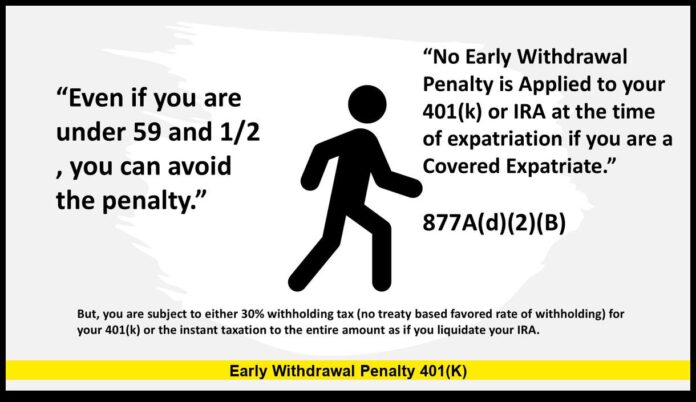
If you’re considering tapping into your retirement savings early, the early withdrawal penalty 401(k) rules have important changes and clarifications you should know. New updates from the Internal Revenue Service (IRS) and recent regulatory activity affect how the additional tax applies to withdrawals from employer‐sponsored retirement plans like the 401(k). These changes matter for U.S. workers navigating financial uncertainty or planning ahead for retirement.
Table of Contents
What is the Early Withdrawal Penalty 401(k)?
The early-withdrawal penalty for a 401(k) generally means that if you take money out of a qualified retirement plan before age 59½, you’ll owe:
- Ordinary income tax on the distributed amount.
- An additional 10% tax (extra to your regular income tax) on the early distribution—unless you meet an IRS exception.
In plain terms: withdrawing early from your 401(k) can significantly reduce your net amount—because you pay both the tax and the penalty.
What’s New and Updated as of 2025
Here are some of the most current developments regarding the early withdrawal penalty 401(k) rules:
- The IRS continues to enforce that — unless an exception applies — distributions from qualified plans before age 59½ remain subject to the 10% additional tax.
- Because of the SECURE 2.0 Act and related regulatory updates, new exceptions have been added or clarified. For example:
- Victims of domestic abuse may withdraw up to the lesser of $10,000 or 50% of their account without the 10% penalty.
- Since January 1, 2024, an emergency “personal or family” expense withdrawal up to $1,000 per year may be penalty-free under certain plan provisions.
- The “Rule of 55” remains in effect: if you separate from service in or after the year you turn 55 (for certain plans), you may take distributions without the 10% penalty.
- Financial tools from major institutions now highlight not just the penalty, but the compound-growth loss from early withdrawal.
Major Exceptions That Let You Avoid the 10% Penalty
Although the default is a 10% additional tax for early withdrawal, the IRS recognizes a number of exceptions. Important ones for 401(k) plans include:
- You reach age 59½ or older.
- You leave your job in the year you turn 55 (or older) and take distributions from that employer’s 401(k) — the Rule of 55.
- You become totally and permanently disabled.
- You die and the distribution goes to your beneficiary.
- Qualified birth or adoption of a child: up to $5,000 may be withdrawn penalty-free for expenses.
- Distributions due to federally declared disasters: up to certain amounts may avoid the penalty.
- Domestic abuse victim distribution (recently added): up to $10,000 or 50% of the account, whichever is less, may be penalty-free.
- Taking a series of substantially equal periodic payments (SEPP) under Section 72(t).
Key Impacts and Costs of Early Withdrawal
When the early withdrawal penalty for a 401(k) applies, the cost can take several forms beyond the immediate tax:
- Immediate tax burden: For example, if you withdraw $25,000 early, you may owe ordinary income tax plus the 10% penalty (i.e., $2,500 on the penalty alone).
- State tax: Depending on your state, additional income tax may apply.
- Lost compound growth: Withdrawing early means missing out on decades of investment returns. One example showed $25,000 might grow to about $135,000 in 25 years, assuming a 7% growth rate.
- Retirement readiness reduction: Taking funds now reduces your retirement nest-egg and undermines long-term goals.
How to Evaluate If an Early Withdrawal Makes Sense
Before you decide to use your 401(k) for an early withdrawal, keep these considerations in mind:
- Calculate the full tax and penalty cost, then compare against alternative sources of funds (emergency savings, personal loans, etc.).
- Use early withdrawal calculators to estimate how much the withdrawal will cost now and how much growth you’ll lose later.
- Check whether you qualify for any of the exceptions to avoid the 10% penalty. Even if you qualify, income taxes may still apply.
- Review your employer’s 401(k) plan rules: Not all plans allow every exception or withdrawal option.
- Consider alternatives: Taking a plan loan may allow access to funds while avoiding immediate taxes and penalties—but comes with repayment obligations and risk.
2025 Snapshot: What U.S. Workers Should Know
Here’s a quick table summarizing the early withdrawal penalty 401(k) rule as of today:
| Feature | Status as of 2025 |
|---|---|
| Additional tax for early withdrawal (before 59½) | 10% of the amount withdrawn (unless exception applies) |
| Income tax on amount withdrawn | Yes — ordinary federal income tax, plus state tax if applicable |
| New exceptions since SECURE 2.0 | Yes — e.g., emergency withdrawal up to $1,000/year; domestic abuse withdrawal up to $10,000 or 50% of account |
| Rule of 55 (separation from service at 55+) | Still valid for many plans to avoid the 10% penalty |
| Hardship distributions still subject to rules | Yes — plan must meet IRS criteria; exceptions may vary |
Important Disclaimer
The information presented here is for general informational purposes only and does not constitute legal, tax, or financial advice. Tax laws and regulations may change. You should consult a qualified tax professional or financial advisor to discuss how the early withdrawal penalty 401(k) rules apply to your individual circumstances.
FAQ – Early Withdrawal Penalty 401(k)
Q1: If I withdraw from my 401(k) at age 58, will I automatically pay the 10% penalty?
A1: Generally yes — if you withdraw before age 59½ and do not qualify for an exception, you’ll owe the additional 10% penalty plus income tax.
Q2: Can I avoid the 10% penalty if I retire at age 55?
A2: Possibly. Under the Rule of 55, if you separate from employment in the year you turn 55 (or later) and the plan allows it, you may take distributions without the 10% penalty—though you’ll still owe income tax.
Q3: What counts as a hardship that lets me withdraw without penalty?
A3: Hardship distributions may qualify if they meet the immediate and heavy financial need standard under IRS rules (medical expenses, home purchase, tuition, etc.). Income tax still applies unless another exception covers it.
Q4: What about the emergency withdrawal of up to $1,000 per year?
A4: Yes — under updated rules tied to the SECURE 2.0 Act, some plans allow penalty-free withdrawals (up to $1,000 per year) for personal or family emergency expenses. Income tax still applies.
Q5: If I’m a domestic abuse survivor, can I pull funds penalty-free?
A5: Yes — one of the newer exceptions allows victims of domestic abuse to withdraw the lesser of $10,000 or 50% of their vested account without the 10% penalty. Income tax still applies.
In closing, the early withdrawal penalty 401(k) remains a significant financial cost for most early distributions—but new rules and exceptions provide more flexibility for emergencies or qualified situations. If you’re considering withdrawing early, weigh the penalty, taxes, and long-term growth impact carefully. We’d love to hear your thoughts or experience—leave a comment below and stay tuned for the latest updates.

 rules, exceptions & tax impact for U.S. workers in 2025.)