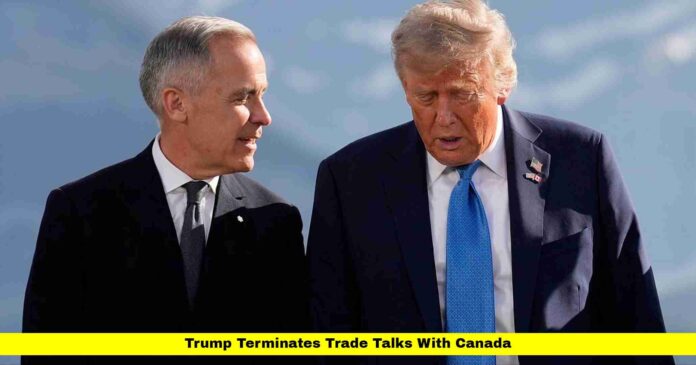
In a stunning diplomatic escalation, former U.S. President Donald Trump announced that he has officially terminated trade talks with Canada. The decision comes after growing friction between the two countries, triggered by a controversial advertisement released by the Ontario government. Trump described the ad as “fraudulent” and accused Canadian officials of interfering in American political and economic matters.
This announcement marks one of the most significant trade ruptures between the neighboring nations in recent history, threatening to reshape cross-border relations that have defined the North American economy for decades.
Table of Contents
Trump’s Announcement Sends Shockwaves Through North America
Trump declared the decision through a statement on his Truth Social platform, writing in bold terms that “ALL TRADE NEGOTIATIONS WITH CANADA ARE HEREBY TERMINATED.” The declaration caught many trade and political observers off guard, as talks had reportedly been progressing to resolve key disputes around tariffs and cross-border taxation.
The former president accused the Ontario government of spreading misinformation through a media campaign that allegedly misrepresented the U.S. position on tariffs. According to Trump, the ad attempted to manipulate American public opinion at a sensitive time when trade discussions were underway.
His message was unambiguous: the U.S. will no longer tolerate what he views as “unfair treatment or deception” from its northern neighbor.
The Controversial Ontario Advertisement
At the heart of this diplomatic fallout lies a campaign ad broadcast by the Ontario government. The advertisement featured edited remarks by former U.S. President Ronald Reagan, appearing to criticize protectionist policies and tariffs. The ad’s message suggested that tariffs hurt both economies and should be avoided for the sake of North American prosperity.
However, Trump’s team claimed that the Reagan footage was manipulated and taken out of context, calling it “deeply dishonest.” The Ronald Reagan Presidential Foundation later issued a statement clarifying that the late president’s words had been altered from their original intent.
Ontario Premier Doug Ford defended the campaign, saying it aimed to advocate for “open and fair trade that benefits working families on both sides of the border.” But for Trump and his allies, the ad crossed a line—turning economic debate into what they described as a political provocation.
Canada’s Reaction to Trump’s Decision
Canadian officials responded cautiously but firmly. Prime Minister Mark Carney expressed disappointment over the U.S. move, describing it as “a regrettable step backward for both countries.” He emphasized that Canada remained committed to diplomacy, urging calm and patience while reviewing the U.S. statement.
Ontario Premier Doug Ford, whose administration funded the ad, refused to apologize. He reiterated that the intent was not to mislead, but to defend Canadian workers affected by trade uncertainty. Ford stated,
“We’re going to keep standing up for Ontario workers. Our message was about cooperation, not confrontation.”
Still, the damage appears done. Canadian trade representatives have been reassessing their strategies, seeking to minimize potential fallout across sectors ranging from agriculture and steel to automotive and energy.
Economic Impact on Cross-Border Trade
The termination of talks could have deep economic consequences. Canada and the U.S. share the world’s second-largest trading relationship, valued at nearly $800 billion annually. The sudden freeze in negotiations threatens supply chains, investor confidence, and industry stability.
Key industries at risk include:
- Automotive Manufacturing: Thousands of vehicles and auto parts move across the border daily. A breakdown in trade cooperation could lead to higher production costs and delayed deliveries.
- Energy and Resources: Canada is the largest foreign supplier of oil to the United States. Disruptions could impact fuel prices and energy infrastructure planning.
- Agriculture: U.S. and Canadian farmers rely heavily on cross-border markets. Any tariffs or border restrictions could drive up prices for both producers and consumers.
Economists warn that prolonged trade tension could trigger inflationary pressure in both countries, particularly affecting food and manufacturing costs.
Business Community Expresses Concern
Business leaders in both nations reacted with alarm. The U.S. Chamber of Commerce issued a statement urging the restoration of dialogue, emphasizing that North American economic stability depends on cooperation.
Canadian manufacturing groups warned that any new barriers could result in job losses and investment slowdowns. Many companies rely on “just-in-time” production systems, where materials cross the border multiple times during assembly. Even slight policy changes can disrupt these operations.
Small business owners along the border expressed frustration and uncertainty. Exporters who depend on trade in goods like lumber, dairy, and steel fear that new tariffs or restrictions could devastate their profits.
The Political Dimension Behind Trump’s Decision
While economic implications are significant, the move also carries deep political undertones. Trump’s base has long supported his “America First” approach to trade, viewing it as a way to protect American jobs and industries from unfair foreign competition.
By terminating talks with Canada, Trump is reinforcing his tough stance on international trade ahead of the 2025 U.S. election cycle. Political analysts suggest this move could energize his supporters but alienate centrist voters and business-friendly Republicans.
For Canada, the timing couldn’t be worse. The country has been working to stabilize its post-pandemic economy and strengthen global trade ties. A major fallout with its closest trading partner could have ripple effects across its economic recovery.
Diplomatic Fallout and Strained Relations
The diplomatic relationship between the U.S. and Canada—traditionally one of the strongest alliances in the world—has taken a visible hit.
Canadian officials have hinted at the possibility of filing complaints through the World Trade Organization (WTO) or invoking dispute resolution mechanisms under existing trade frameworks like the United States-Mexico-Canada Agreement (USMCA).
If tensions persist, other nations might step in as mediators, hoping to prevent escalation that could destabilize North American trade. Yet experts warn that the personal tone of Trump’s remarks may make quick reconciliation unlikely.
Impact on American Consumers
Beyond politics and diplomacy, American consumers could feel the effects directly. Many everyday goods—from groceries to construction materials—depend on Canadian imports.
Possible consequences include:
- Higher Lumber Costs: Canada provides much of the lumber used in U.S. housing construction. New barriers could raise building and renovation costs.
- Increased Vehicle Prices: Automakers rely on cross-border part shipments. Trade disruption could inflate car prices and delay new model releases.
- Food Inflation: Products like beef, cheese, and seafood imported from Canada might become more expensive.
In short, the average consumer could end up paying more as tensions between the two nations continue.
Potential Pathways Forward
While Trump’s statement appears definitive, experts suggest several possible resolutions may emerge over time:
- Renegotiation Through Back Channels: Trade talks might resume quietly through diplomatic intermediaries or business coalitions.
- Legal Challenges or WTO Mediation: Canada could file trade disputes to protect its interests under international law.
- Diversification of Trade: Canada may intensify trade relations with the European Union, United Kingdom, and Asian markets to reduce U.S. dependency.
- Political Change: A shift in political leadership in either country could reopen doors for renewed dialogue.
Much will depend on how both nations balance domestic pressures with global economic realities.
Public and Political Reactions in Both Countries
Public reaction has been deeply divided. Trump’s supporters praised his firm stance, calling it a “necessary defense of American sovereignty.” They argue that Canada has often benefitted from U.S. trade concessions without offering enough in return.
Critics, however, see the decision as reckless and short-sighted. Political opponents within the U.S. warn that undermining a long-time ally could backfire economically.
In Canada, public opinion reflects growing frustration. Many view the termination as unfair punishment for an advertisement controversy that could have been resolved diplomatically. Others believe the event highlights Canada’s urgent need to strengthen its economic independence from the United States.
Broader Implications for Global Trade
The U.S.–Canada rift could have a ripple effect across the global economy. Other countries, particularly in Europe and Asia, are closely monitoring developments.
Experts believe this incident could embolden other nations to reconsider their trade strategies with the U.S., anticipating possible volatility under Trump’s leadership. It may also influence ongoing discussions about global supply chain resilience, encouraging countries to diversify production hubs.
North American trade integration has been one of the most stable pillars of global commerce. The termination of these talks, even temporarily, could reshape investment flows and manufacturing decisions worldwide.
Conclusion
Trump’s decision to terminate trade talks with Canada marks a historic shift in one of the world’s closest economic partnerships. What began as a dispute over a controversial advertisement has escalated into a full-scale political and trade standoff with global implications.
Both countries now face a difficult path forward—balancing national pride, economic necessity, and political strategy. Whether this rupture proves temporary or long-lasting will depend on the willingness of both sides to step back from confrontation and return to pragmatic cooperation.
For now, the future of U.S.–Canada trade remains uncertain, and the world is watching closely.

