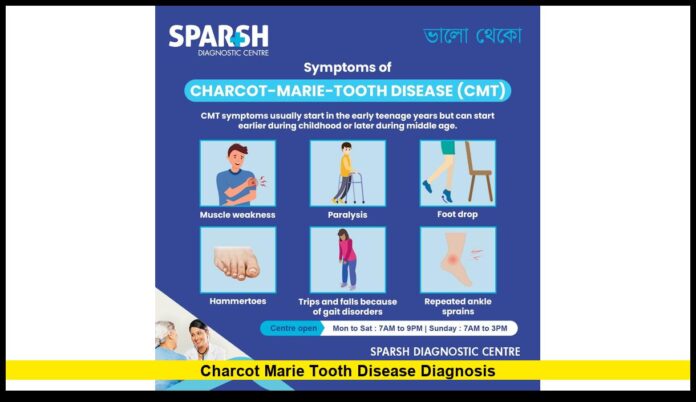
Charcot-Marie-Tooth disease diagnosis has seen significant progress in 2025, with new genetic testing tools, advanced imaging methods, and updated clinical guidelines improving how doctors identify and manage this hereditary neurological disorder. In the U.S., early detection remains crucial to prevent long-term disability and ensure better quality of life for patients.
Table of Contents
Understanding Charcot-Marie-Tooth Disease
Charcot-Marie-Tooth (CMT) disease is one of the most common inherited neurological disorders, affecting the peripheral nerves responsible for muscle control and sensation. It impacts approximately 1 in 2,500 people in the United States. CMT leads to progressive muscle weakness, loss of balance, and sensory problems in the hands, feet, and legs.
While the disease cannot currently be cured, advancements in CMT diagnosis and genetic testing have greatly improved the ability to confirm and classify the condition. These improvements help neurologists create personalized treatment and rehabilitation plans.
How Charcot-Marie-Tooth Disease Is Diagnosed
A Charcot-Marie-Tooth disease diagnosis typically begins with a neurological examination and family history review, followed by several specific tests designed to confirm the diagnosis and determine the CMT subtype.
The main diagnostic methods include:
- Physical and Neurological Exams: Doctors check for muscle weakness, decreased reflexes, and deformities such as high arches or hammer toes.
- Electromyography (EMG) and Nerve Conduction Studies (NCS): These measure how well electrical signals travel through the nerves and muscles.
- Genetic Testing: The most accurate and modern method of confirming CMT, identifying mutations in specific genes linked to the disease.
- Nerve Biopsy (in rare cases): Used only when genetic tests are inconclusive, a small portion of nerve tissue is examined under a microscope.
Breakthroughs in Genetic Testing (2025 Update)
Recent advancements have made genetic testing the cornerstone of Charcot-Marie-Tooth disease diagnosis. In 2025, expanded gene panels and faster DNA sequencing methods have dramatically improved detection rates for known and rare mutations.
New testing kits are now available in U.S. clinics that analyze over 100 genes associated with different CMT types. This allows clinicians to determine the exact subtype—such as CMT1A, CMT2, or CMTX—and to predict disease progression more accurately.
Some laboratories also use whole exome sequencing (WES) and whole genome sequencing (WGS), which analyze all protein-coding regions of DNA, revealing mutations that traditional tests might miss. These high-precision tools are now covered by more U.S. insurance providers, making them accessible to a larger number of patients.
Early Detection and Family Screening
One of the most important updates in 2025 involves family screening protocols. Because CMT is an inherited condition, close relatives of patients are encouraged to undergo predictive genetic testing even before symptoms appear.
Early identification allows individuals to make informed lifestyle and career choices, undergo physical therapy earlier, and prevent complications like foot deformities and joint damage.
Genetic counselors play a central role in helping families understand inheritance patterns, risks, and available testing options.
New Role of Imaging in CMT Diagnosis
While nerve conduction studies and genetic tests remain essential, imaging technology has begun to support the Charcot-Marie-Tooth disease diagnosis process.
Magnetic Resonance Imaging (MRI) and ultrasound imaging are increasingly being used to visualize nerve damage and muscle degeneration in real-time. MRI scans of the lower legs and hands can now show early structural changes in peripheral nerves that may appear before clinical symptoms develop.
These imaging tools are especially useful when patients have overlapping symptoms with other neuropathies such as diabetic neuropathy or chronic inflammatory demyelinating polyneuropathy (CIDP).
Updated Clinical Guidelines in the U.S.
In 2025, U.S. neurologists follow updated diagnostic guidelines that emphasize multidisciplinary evaluation. Physicians are now advised to use a combination of:
- Clinical observation and medical history
- Electrophysiological testing
- Genetic confirmation
The updated recommendations also encourage the use of digital health platforms to track disease progression and response to therapy. Some healthcare systems are integrating AI-assisted nerve conduction analysis, which helps interpret test results faster and more accurately.
Differentiating CMT from Similar Disorders
Because Charcot-Marie-Tooth shares symptoms with other peripheral neuropathies, accurate diagnosis can be challenging. Physicians must carefully rule out:
- Diabetic neuropathy
- Hereditary neuropathy with liability to pressure palsies (HNPP)
- Spinal muscular atrophy (SMA)
- Amyotrophic lateral sclerosis (ALS)
Modern diagnostic tools have made it easier to distinguish CMT from these conditions. Genetic testing remains the gold standard in confirming or excluding Charcot-Marie-Tooth disease.
Emerging Diagnostic Technologies
The diagnostic landscape for CMT continues to evolve with new technologies.
Some of the most promising innovations in 2025 include:
- Next-generation sequencing (NGS): Rapid, cost-effective gene analysis that can detect complex mutations.
- Digital biomarkers: Wearable sensors tracking gait, balance, and muscle activity, providing real-world data on disease progression.
- AI-based nerve conduction interpretation: Artificial intelligence algorithms that analyze nerve test results for faster, more precise readings.
- Proteomic and metabolomic analysis: Identifying protein and chemical patterns in the blood that may indicate early CMT changes.
These advancements help physicians make quicker, more accurate diagnoses, often within weeks instead of months.
Why Early Diagnosis Matters
An early and accurate Charcot-Marie-Tooth disease diagnosis allows for better disease management and quality of life. Detecting CMT in its early stages enables patients to:
- Begin physical and occupational therapy sooner
- Prevent muscle atrophy and contractures
- Manage pain and mobility issues effectively
- Access clinical trials and new therapies
- Receive appropriate orthopedic support
Timely diagnosis also helps avoid unnecessary surgeries or misdirected treatments for unrelated neuropathies.
Living With a Confirmed Diagnosis
Once CMT is diagnosed, patients usually work with a multidisciplinary team that includes neurologists, physiatrists, physical therapists, and orthotists. The treatment goal is to maintain mobility, prevent complications, and support daily independence.
Genetic counseling is recommended for all patients and families, especially when planning children. This counseling helps clarify recurrence risks and new options for genetic testing during pregnancy.
Looking Ahead: The Future of CMT Diagnosis
As 2025 progresses, researchers are exploring gene-editing and molecular therapies that may one day modify or correct the genetic errors causing Charcot-Marie-Tooth disease. While these treatments are still in clinical trials, their success depends on accurate and early diagnosis.
With the combination of improved genetic testing, AI technology, and family-based screening, the future of Charcot-Marie-Tooth disease diagnosis looks more precise, accessible, and personalized than ever.
Accurate and early Charcot-Marie-Tooth disease diagnosis remains the key to effective management, helping patients live fuller, more independent lives. Stay informed, consult a neurologist if symptoms appear, and encourage family members to get screened.

