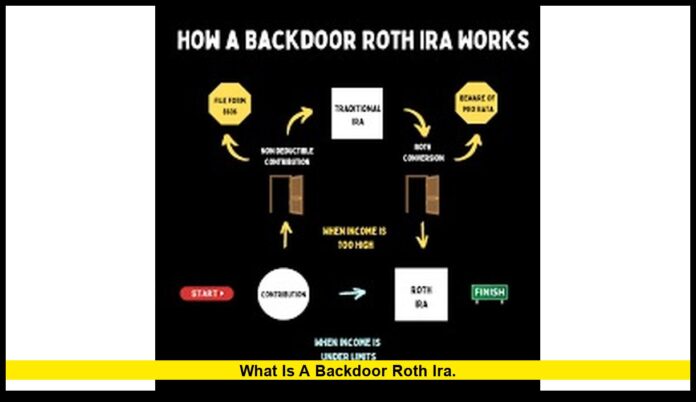
What is a backdoor Roth IRA has become one of the most frequently asked retirement planning questions among higher-income earners and financially aware households. This strategy has grown in popularity because it allows individuals who earn above the income limits for a Roth IRA to still access the powerful benefits that come with Roth retirement accounts—most notably tax-free growth and tax-free withdrawals in retirement.
As healthcare costs rise, tax laws gradually shift, and life expectancy continues to increase, many Americans are seeking ways to secure long-term financial stability. The backdoor Roth IRA has become a widely used planning tool among physicians, executives, business owners, engineers, and dual-income families who want to reduce future tax burdens. Understanding how the backdoor Roth IRA works—and how to perform the conversion correctly—can help individuals avoid costly tax errors and improve retirement outcomes.
This article explains the strategy in plain language, breaks down the steps, and highlights key rules to follow.
Table of Contents
Understanding the Roth IRA
Before diving into the backdoor method, it is helpful to clarify what a Roth IRA is and why it is so valuable.
A Roth IRA is a retirement savings account funded with after-tax dollars. Unlike a Traditional IRA, where contributions may be tax-deductible and withdrawals are taxed, Roth IRAs allow funds to grow tax-free and be withdrawn tax-free in retirement if eligibility rules are met.
Key Advantages of a Roth IRA
- Tax-free investment growth
- Tax-free withdrawals after age 59½ if the account is at least five years old
- No required minimum distributions (RMDs) during your lifetime
- Helpful for estate planning due to tax-efficient inheritance rules
However, there is a catch: Roth IRAs have income limits. Once your income exceeds a certain level, the IRS does not allow you to contribute directly.
Income Limits for Roth IRA Contributions
Roth IRA contribution eligibility phases out once modified adjusted gross income (MAGI) exceeds certain thresholds.
| Filing Status | Eligible for Full Contribution Below | Contribution Eliminated Above |
|---|---|---|
| Single | Roughly mid-$140K range | Roughly low-$160K range |
| Married Filing Jointly | Roughly mid-$230K range | Roughly mid-$240K range |
When income exceeds these limits, a direct Roth IRA contribution is not allowed. That’s where the backdoor Roth IRA becomes useful.
What Is a Backdoor Roth IRA?
A backdoor Roth IRA is not a special type of retirement account. It is simply a legal strategy that allows high-income earners to place money into a Roth IRA by first putting funds into a Traditional IRA and then converting that contribution into a Roth IRA.
Because Traditional IRAs allow non-deductible contributions regardless of income, anyone can use this method.
In Short:
- Contribute to a Traditional IRA with after-tax money.
- Convert that contribution into a Roth IRA.
- Pay taxes only on any gains that occurred between contribution and conversion.
This process effectively bypasses the Roth income limit—hence the name “backdoor.”
Step-By-Step: How to Complete a Backdoor Roth IRA
Step 1: Make a Non-Deductible Contribution to a Traditional IRA
You contribute up to the annual IRA limit (and catch-up amount if applicable).
Contribution Limits:
- Up to $7,000 per year
- If age 50 or older: $8,000 per year
Since high-income earners usually cannot deduct Traditional IRA contributions, this contribution is made with after-tax dollars.
Step 2: Convert the Funds to a Roth IRA
Once the contribution posts, you convert the amount to your Roth IRA. The process may take only a few clicks through your brokerage platform.
Most people perform the conversion shortly after contributing to minimize taxable investment gains.
Step 3: File IRS Form 8606 When You Do Your Taxes
Form 8606 documents that your IRA contribution was made with after-tax funds, preventing double taxation.
Missing this form is one of the most common—and costly—mistakes.
Understanding the Pro-Rata Rule (Critical Rule)
The IRS views all of your Traditional IRAs as one combined account when calculating taxes on Roth conversions. If you have any pre-tax Traditional, SEP, or SIMPLE IRA balances, the conversion may trigger taxable income.
This is called the pro-rata rule.
Example
If you have:
- $60,000 of pre-tax IRA funds
- $6,000 non-deductible contribution
Only a small percentage of your conversion is tax-free. The IRS prorates the taxable and non-taxable portions.
How to Avoid This
Some individuals roll pre-tax IRA balances into a 401(k) to isolate non-deductible contributions before performing a conversion.
This step should be carefully planned.
Who Should Consider a Backdoor Roth IRA?
A backdoor Roth IRA may be suitable for individuals who:
- Earn above the Roth IRA contribution income limits
- Want tax-free withdrawals later in life
- Expect their tax rate to be the same or higher in retirement
- Want to avoid required minimum distributions
- Value long-term estate planning control
Common Professions Using This Strategy
- Physicians
- Attorneys
- Engineers
- Executives
- Entrepreneurs
- Dual high-income households
These groups often prioritize tax-efficient retirement planning.
Benefits of a Backdoor Roth IRA
| Benefit | Why It Matters |
|---|---|
| Tax-Free Growth | Helps maximize long-term investment returns |
| No RMDs | Allows control over when to withdraw funds |
| Tax-Free Retirement Income | May help reduce Medicare surcharge and Social Security tax impacts |
| Estate Planning Advantages | Heirs receive Roth assets more efficiently |
Tax-free income in retirement can also help manage tax brackets strategically.
Potential Drawbacks and Limitations
- Requires careful handling to avoid triggering taxes
- Pro-rata rule complexity may affect tax outcomes
- Cannot be undone once the conversion is made
- Not always ideal if you expect a much lower future tax rate
- Requires consistent tax documentation
This is not a “set it and forget it” method; accuracy matters.
Backdoor Roth IRA vs. Mega Backdoor Roth IRA
There is a different strategy called a Mega Backdoor Roth IRA, which involves contributing after-tax dollars to a 401(k) and converting those funds into a Roth.
Key Difference
- Backdoor Roth: Uses IRA accounts
- Mega Backdoor Roth: Uses 401(k) account contribution rules
A Mega Backdoor Roth allows much larger contributions but depends heavily on employer plan design.
Common Mistakes to Avoid
| Mistake | Impact |
|---|---|
| Not filing Form 8606 | Risk of double taxation |
| Holding pre-tax IRA balances | Can trigger pro-rata tax complexity |
| Waiting too long to convert | Investment gains become taxable |
| Mixing pre-tax and after-tax contributions | Difficult tax tracking |
| Assuming all financial advisors understand the strategy | Not all do |
Being proactive prevents costly errors.
Frequently Asked Questions
1. Is the backdoor Roth IRA legal?
Yes. The IRS allows Roth conversions for any income level.
2. Do I owe taxes when I convert?
If the contribution was after-tax and converted immediately, usually little or no tax is owed. Pre-tax IRA balances change this.
3. Can I reverse a backdoor Roth conversion?
No. Reversals (recharacterizations) are no longer permitted.
Disclaimer
This article is for informational and educational purposes only and does not constitute financial, tax, investment, or legal advice. Individuals should consult a qualified financial advisor or tax professional before making retirement planning decisions.

