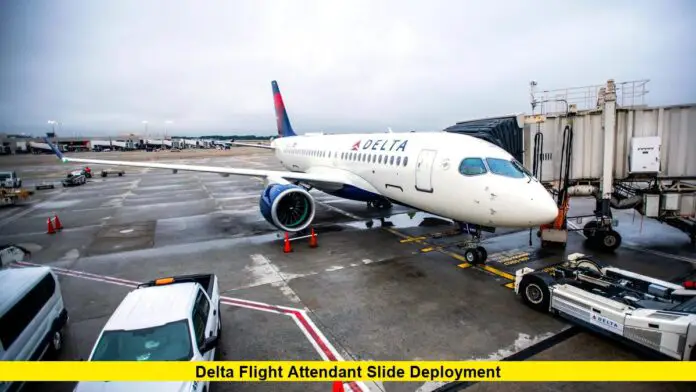
The recent delta flight attendant slide deploymen incident at Pittsburgh International Airport drew national attention, primarily because it involved an emergency system that is rarely triggered outside of actual evacuations. The incident happened just before takeoff, caused a lengthy flight delay, and resulted in a costly equipment replacement, while raising new discussions about airline safety procedures and human-factor challenges in aviation.
Table of Contents
Overview of the Incident
The event occurred as passengers boarded an Airbus A220 scheduled to depart from Pittsburgh to Salt Lake City. Boarding had finished, flight attendants were completing final cabin checks, and the aircraft was preparing for pushback from the gate. During this process, one of the forward doors was still in the “armed” state when its internal handle was moved. That movement automatically activated the evacuation slide, sending it inflating outward into the jet bridge.
No passengers or ground crew were injured, but the door deployment caused a complete halt to operations. The aircraft could not move until the slide was removed, the door system was inspected, and clearance was granted for the plane to continue service. The delay ultimately extended for several hours. Some passengers missed connecting flights, while others needed to rebook travel entirely.
How Aircraft Slides Work
Understanding why a small motion triggers such a large response requires understanding door arming procedures.
- Every commercial aircraft door has two basic modes: armed and disarmed.
- Armed means the emergency slide will deploy automatically if the door opens. This mode is used during taxi, takeoff, and landing.
- Disarmed means the door opens normally without triggering the slide. This mode is used when the aircraft is at the gate.
Flight attendants transition doors between these two states multiple times per flight and are trained to perform visual checks, verbal confirmations, and cross-checks with other crew members.
When the slide deploys, it does so using high-pressure gas cartridges. The inflation is forceful and rapid, happening in a matter of seconds. Once triggered, the process cannot be stopped. Because of this, accidental deployments are a serious operational issue.
Estimated Cost and Financial Impact
Emergency slides are highly engineered safety devices. They are made of specialized materials, tested for rapid deployment under extreme conditions, and require precise manufacturing. For this reason, replacement is expensive.
Across the airline industry:
- A single evacuation slide on an aircraft of this size can cost tens of thousands of dollars.
- Additional costs include labor to remove and replace the slide, inspection of the door mechanism, and certification checks after maintenance.
- When a slide deploys at the gate, the aircraft is taken out of service temporarily, which disrupts schedules and aircraft rotations.
- Delays cascade across the network. One long delay can affect flights later in the day for both the aircraft and crew members involved.
In this case, the cost to the airline was widely estimated in the range of $50,000 to $70,000, not counting passenger compensation or ripple-effect scheduling costs.
Operational Disruption for Passengers
For the passengers on board, the most immediate consequence was time. The flight did eventually depart, but over four hours behind schedule. Some travelers had connecting flights through Salt Lake City. Because of the delay, many of those connections were missed.
When this happens:
- Airlines must rebook travelers on later flights.
- If the final destination cannot be reached the same day, hotels, meals, and transport may need to be arranged.
- Customer service teams must handle rebooking queues and travel planning changes.
For travelers, even though the cause was a safety-system error rather than weather or traffic, the effect was the same — lost time, schedule changes, and logistical stress.
Why These Incidents Happen
Most cabin crews train extensively on door operation procedures. Flight attendants practice arming and disarming doors repeatedly during training and throughout their career. They also follow strict verbal phrases during every phase of operation.
However, aviation is a high-tempo environment. Many things are happening at once at the gate:
- Cabin announcements
- Boarding coordination
- Jet bridge movement
- Communication between flight attendants and pilots
- Passengers requesting help or attention
- Time pressure to maintain the schedule
Even highly experienced crew members are human. When a repetitive task is performed many times per day, cognitive slips can occur. In this case, the slide activation appears to have been the result of a sequence error — the door remained armed when the handle moved.
This type of mistake is known in the aviation world as human-factor error — a reminder that even well-trained professionals are susceptible to brief lapses in routine.
How the Industry Tries to Prevent Slide Deployments
Airlines treat inadvertent slide deployment as a preventable incident category. As a result, several procedural safeguards already exist:
- Verbal callouts when arming and disarming doors
- Cross-checks where a second crew member confirms the door status
- Point-and-touch confirmation where the crew member physically points to indicators during the process
Some airlines have implemented additional visual cues, training refreshers, or hardware enhancements to reduce errors. Still, the system depends heavily on human repetition and mental focus — which is why incidents, though rare, continue to happen.
The Role of Experience in Safety
One notable detail from this incident is that the flight attendant involved had many years of service. Experience is a strong component of aviation safety, but it also comes with familiarity — and familiarity sometimes introduces risk.
Experts in aviation safety point out:
- Most errors happen not in unfamiliar situations, but during routine tasks.
- The brain filters out repeated steps to work faster — sometimes too automatically.
- Safety culture requires not only training but constant reinforcement.
This does not imply negligence. It reflects the reality that in aviation, small actions have large consequences, and routine demands consistent mindfulness.
Passenger Awareness and Understanding
For passengers, this incident serves as a reminder of something important:
Safety systems on airplanes are always active — even when the aircraft seems still and quiet at the gate.
The procedures before takeoff are not just formalities. They ensure that if an emergency occurred during boarding, passengers could evacuate within seconds. The same system that caused the delay is the system that would save lives during an emergency.
While the effects of this particular event were inconvenient, the slide working as designed is evidence that safety systems remain reliable.
Conclusion
The delta flight attendant slide deployment incident at Pittsburgh highlights how complex airline operations are and how much coordination goes into every flight. A single switch left in the wrong position can affect hundreds of travelers and carry a significant financial cost. Yet it also serves as an example of how safety systems remain active and ready when needed. Human-factor errors are part of any high-paced profession, and incidents like this become learning opportunities that help improve training and consistency across the industry.
Have you ever experienced a flight delay due to an unexpected aircraft issue? Share your thoughts or experiences in the comments below — your perspective helps keep the conversation real and informed.

