
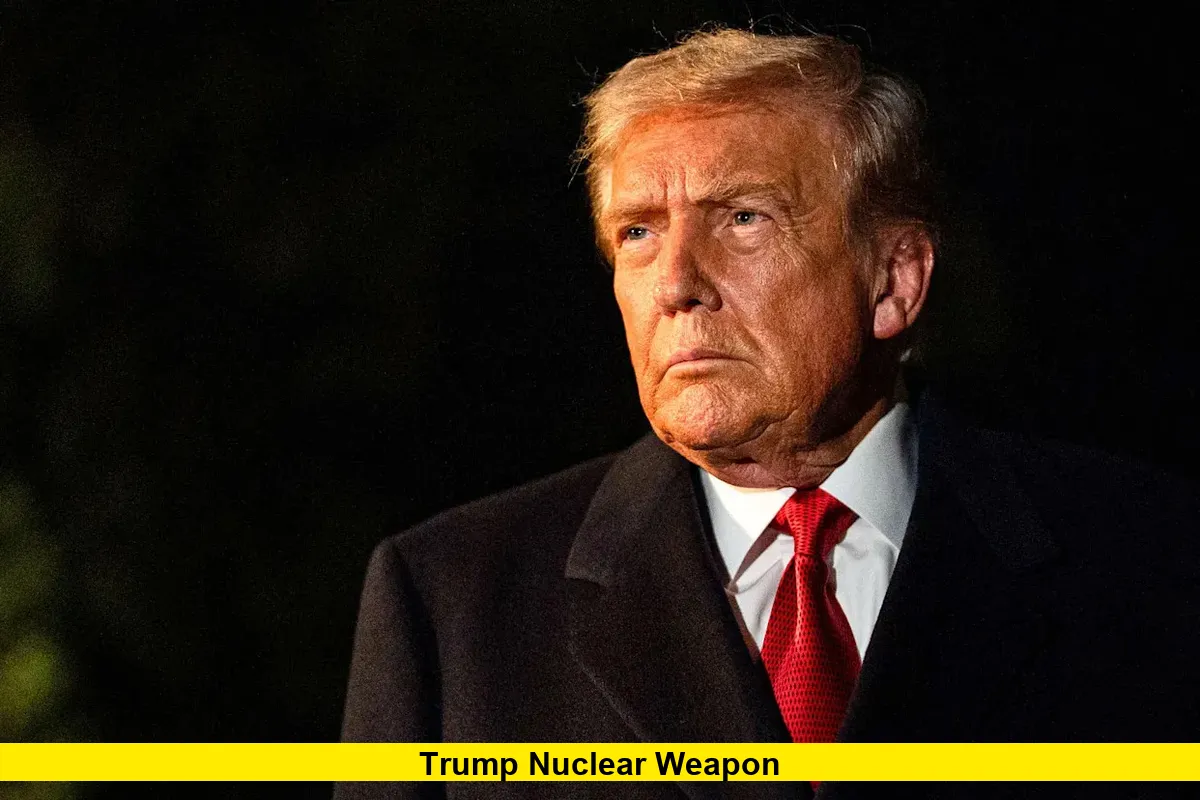
In a decision that has stunned both allies and adversaries alike, President Donald Trump has officially ordered the Pentagon to resume nuclear weapons testing — for the first time in over three decades. The Trump nuclear weapon directive ends a 33-year era of restraint, ushering in what many see as the most significant shift in U.S. nuclear policy since the end of the Cold War.
The last U.S. nuclear test occurred in 1992 under President George H. W. Bush, after which every administration maintained a voluntary moratorium. But now, Trump has declared that “the United States will test again to ensure we remain unmatched,” marking a clear pivot toward assertive deterrence.
Table of Contents
A Turning Point in U.S. Nuclear Strategy
Trump’s directive immediately sets into motion Pentagon planning to prepare for underground nuclear tests at existing facilities. The Nevada National Security Site, long dormant, is expected to be a key location if testing resumes.
Senior defense officials confirmed that Trump’s decision came after a months-long review of America’s nuclear readiness. Intelligence reports indicating increased nuclear activity by Russia and China reportedly influenced the move. The President framed it as a necessary step to “protect American dominance and maintain peace through strength.”
For decades, the United States relied on computer simulations and subcritical tests — non-explosive experiments — to assess the safety and reliability of its stockpile. Trump’s order would move beyond simulation, authorizing explosive testing if deemed essential for national security.
The announcement represents not just a policy change but a statement of power: the United States is no longer bound by restraint if its rivals continue to advance their arsenals.
Why Trump Ordered the Tests Now
Trump has long criticized what he perceives as unfair global standards, arguing that while America observes nuclear limits, its adversaries exploit loopholes. According to administration sources, Trump’s decision stems from three primary motives:
- Deterrence and Readiness: Intelligence assessments suggest Russia and China have conducted low-yield or simulated nuclear explosions in recent years. The Pentagon believes the U.S. must verify its capabilities through physical testing to maintain deterrence.
- Modernization of the Arsenal: The U.S. nuclear stockpile, though powerful, is aging. Testing could validate upgrades to warheads and delivery systems, ensuring long-term reliability.
- Strategic Leverage: The timing—just before a major meeting with Chinese President Xi Jinping—appears designed to give Trump added leverage in diplomatic discussions about military balance and trade tensions.
The Trump nuclear weapon strategy is part of a broader “Peace through Strength” doctrine. By demonstrating readiness to test, the administration believes it can compel other nations to return to arms-control talks on more favorable terms.
A Historic Break from Precedent
The United States has upheld a self-imposed moratorium on nuclear testing since 1992. While it signed the Comprehensive Nuclear-Test-Ban Treaty (CTBT) in 1996, the Senate never ratified it, leaving the U.S. free to withdraw from its obligations at any time.
Trump’s directive effectively signals that the moratorium is over. In practice, restarting tests would require months or even years of technical preparation: refurbishing test tunnels, recalibrating instruments, and recruiting personnel experienced in underground detonations.
Still, the symbolic impact is immediate. Ending a three-decade pause sends a global message that the United States is willing to reassert its dominance — even if it risks reigniting an arms race.
Global and Domestic Reactions
Reaction to the announcement has been intense across the world.
- Allied nations in Europe and Asia expressed deep concern that renewed testing could fracture long-standing non-proliferation agreements and spark similar moves by other powers.
- Russia responded by calling the move “provocative,” though Moscow’s officials have not confirmed whether they would resume their own testing.
- China, while cautious in tone, stated that “testing of this nature destabilizes global peace.”
- NATO members have been divided — some see it as a necessary display of strength, while others fear it undermines diplomatic stability.
At home, reactions have also split sharply. Supporters of the President hailed the directive as a “return to strength,” arguing that it ensures the U.S. remains technologically superior. Critics, however, accused the administration of “reckless escalation,” warning that the decision could undo decades of nuclear restraint.
Environmental and scientific organizations have raised alarms over potential contamination risks, citing the long-term health and ecological damage caused by previous underground tests in Nevada.
Military Implications and Next Steps
The Pentagon has reportedly begun early-stage evaluations for testing readiness. Officials are reviewing:
- Infrastructure Needs: Assessing tunnels, safety systems, and monitoring technologies at Nevada test sites.
- Personnel Requirements: Recruiting engineers and nuclear scientists experienced in controlled detonations.
- Environmental Safeguards: Developing plans for containment and mitigation of potential radioactive release.
- Timeline: Initial estimates suggest that full-scale testing could occur within 24 to 36 months if approved by Congress.
The Department of Energy’s National Nuclear Security Administration (NNSA) will oversee the scientific and technical aspects, while the Department of Defense handles operational logistics and security.
Trump’s directive also calls for new research into “low-yield” nuclear weapons — smaller warheads designed for tactical deterrence. Defense analysts believe this signals a shift toward more flexible nuclear options, moving away from the “mutually assured destruction” philosophy of the Cold War.
Potential Global Fallout
The Trump nuclear weapon announcement may ripple far beyond Washington. Analysts warn of multiple long-term effects:
- Renewed Arms Race: Other nuclear-armed states might interpret America’s move as justification to resume testing or expand their arsenals.
- Erosion of Treaties: Global arms control frameworks, already under strain, could collapse entirely if major powers abandon restraint.
- Diplomatic Tension: The decision could complicate future negotiations on disarmament or non-proliferation.
- Environmental Concerns: Even underground tests carry risks of radiation leaks and seismic impact.
If nuclear testing resumes, it will mark the beginning of a new strategic era—one in which military power again becomes the dominant currency of diplomacy.
Political Ramifications at Home
Trump’s decision arrives at a critical political moment. His administration views the directive as both a defense necessity and a political message — reinforcing his image as a leader unafraid to defy global conventions.
Supporters see it as a bold assertion of national strength. They argue that deterrence depends on visible capability, and testing is the only way to ensure reliability. Critics counter that such a move risks alienating allies, triggering a global backlash, and setting back efforts to reduce the world’s nuclear arsenal.
Within Congress, the debate is already heating up. Lawmakers from both parties have called for hearings to assess the environmental, legal, and strategic implications of resuming testing. Defense committees are also expected to question how such actions fit into the U.S. military budget and broader foreign policy objectives.
The Road Ahead
Experts expect several phases before any explosive testing occurs:
- Feasibility Assessments: Determine technical readiness and costs.
- Safety Preparations: Update containment systems for radiation.
- International Consultations: Manage fallout with allies to preserve diplomatic trust.
- Operational Timeline: Set schedule for controlled detonations, likely underground.
Even if testing doesn’t occur immediately, the President’s declaration alone signals intent. It positions the United States as prepared — and willing — to act if geopolitical conditions deteriorate.
A Defining Moment for Nuclear Policy
The Trump nuclear weapon decision marks more than just a policy shift; it’s a defining statement of philosophy. It reflects a worldview where deterrence depends not on promises or treaties, but on demonstrated capability.
The coming months will determine whether this becomes a full-fledged testing program or a political maneuver designed to pressure rivals. Regardless, the U.S. has now crossed a threshold — one that reopens debates many hoped were settled decades ago.
For the global community, this could be a turning point. The delicate balance between nuclear power, peace, and diplomacy is being tested again — quite literally.
The world is watching as America reawakens its nuclear testing era. Do you believe this bold move strengthens national security or risks global stability? Share your thoughts below and stay informed as this story continues to unfold.