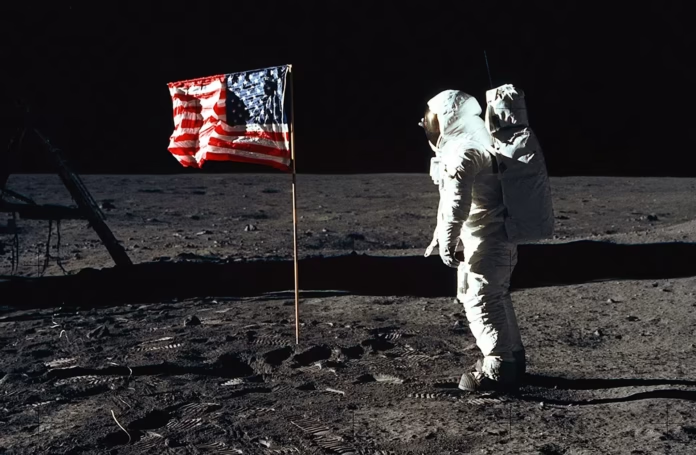
The Kim Kardashian Moon Landing Conspiracy Theory has ignited an international buzz after the media mogul and reality star voiced her disbelief in one of humanity’s most historic achievements—the 1969 Apollo 11 Moon landing. The comment, made on a recent episode of The Kardashians, immediately caught NASA’s attention, prompting a rare, public rebuttal from the space agency.
This viral exchange highlights the clash between pop culture and scientific fact, raising questions about how celebrity opinions shape public discourse in today’s media landscape.
Table of Contents
Kim Kardashian’s Controversial Remarks
During the October 30, 2025, episode of The Kardashians, Kim Kardashian sat down with actress Sarah Paulson and discussed her long-time fascination with conspiracy theories. The topic turned toward the Moon landing—an event that she openly questioned.
While chatting with Paulson on the set of her upcoming legal drama All’s Fair, Kardashian shared that she had been researching videos and interviews online that led her to doubt the authenticity of the Apollo 11 mission.
“There was no scary moment because it didn’t happen,” Kardashian said confidently.
She elaborated further, saying, “I know people will call me crazy, but I just don’t think we went to the Moon.”
The comments quickly went viral across social media platforms like TikTok, Instagram, and X (formerly Twitter). Within hours, hashtags such as #KimKardashianMoonLanding and #NASA began trending worldwide.
Kardashian’s skepticism mirrored long-standing conspiracy theories that claim the 1969 Moon landing was staged by the U.S. government. She specifically questioned:
- Why the American flag appeared to “wave” when there’s no air on the Moon.
- Why there were no stars in the photos taken by astronauts.
- Why the boot prints displayed in museums differ slightly from those in the original lunar images.
These remarks, though not new to conspiracy circles, gained enormous traction due to Kardashian’s celebrity reach—showing how quickly a casual conversation can turn into a global debate.
NASA’s Firm Response
NASA wasted no time addressing Kardashian’s remarks. Acting Administrator Sean Duffy posted directly on X, writing:
“Yes, @KimKardashian, we’ve been to the Moon—six times!”
Duffy’s tweet emphasized that between 1969 and 1972, the United States successfully completed six crewed Moon missions under the Apollo program. He further noted that the space agency continues to prepare for its upcoming Artemis missions, which will return astronauts to the lunar surface for the first time in over 50 years.
NASA later issued a formal statement reaffirming several key points:
- Over 800 pounds of Moon rocks and soil samples were brought back and have been verified by global scientists.
- Each mission was independently tracked by multiple countries, including the Soviet Union, making a cover-up impossible.
- Modern satellites have photographed the Apollo landing sites, showing footprints, rover tracks, and descent modules left behind.
NASA concluded by saying the Moon landing “remains one of humankind’s greatest scientific achievements” and that the evidence is “undeniable and publicly available.”
Buzz Aldrin’s Name Pulled Into the Debate
Kardashian referenced a supposed interview clip with astronaut Buzz Aldrin, where he appeared to confirm the landing “didn’t happen.” NASA quickly clarified that the clip was heavily edited and taken out of context.
Aldrin, now 95, has repeatedly affirmed that he and Neil Armstrong landed on the Moon on July 20, 1969. The viral clip, NASA explained, was originally part of a discussion about television animations used to visualize the mission during its broadcast—not a confession of a staged event.
This misrepresentation of Aldrin’s words has been circulating for years, often resurfacing whenever Moon-landing conspiracies gain new attention online. Kardashian’s reference to it reignited that old misunderstanding, prompting NASA to step in again to set the record straight.
Why This Story Spread So Fast
Kim Kardashian has a social media following that rivals the population of entire nations. Her combined reach—across Instagram, TikTok, and X—exceeds 500 million followers. When someone with that level of influence questions a major historical event, it creates an immediate ripple effect.
The story exploded because of three main reasons:
- Celebrity Influence: Kardashian’s fame amplifies everything she says, whether serious or casual.
- Algorithmic Amplification: Short video clips of her statement spread rapidly on TikTok, often edited without full context.
- Curiosity Culture: Conspiracy theories thrive on platforms that reward engagement and emotion over factual depth.
Within hours, countless “debunking” videos and memes appeared online—some mocking her, others supporting her skepticism. The conversation quickly shifted from a single TV moment to a full-blown cultural debate.
The Evidence NASA Wants Everyone to Remember
NASA used this moment to remind the public of overwhelming scientific proof confirming the Moon landings. Among the evidence:
- Lunar Rock Samples: The unique composition of lunar rocks has been verified by independent researchers around the world.
- Laser Reflectors: Mirrors placed on the lunar surface during Apollo missions are still used by scientists to measure the Earth-Moon distance precisely.
- Orbital Images: Modern lunar orbiters from various countries have captured clear images of the Apollo sites and equipment left behind.
- Global Verification: Independent observatories and space agencies, including those in Europe and Asia, tracked the missions in real-time during the 1960s and 1970s.
Each piece of evidence continues to be publicly accessible, making the idea of a “faked landing” scientifically implausible.
From Conspiracy to Conversation
While many criticized Kardashian for spreading misinformation, others saw NASA’s response as a brilliant PR move. Rather than ignoring the viral moment, NASA used it as a teachable opportunity—a way to bring space history back into the public conversation.
The agency even extended an invitation to Kardashian to visit the Kennedy Space Center, encouraging her to see evidence firsthand and learn more about the Artemis program.
This open and respectful approach was widely praised, with many saying NASA’s handling of the situation was “a masterclass in modern communication.”
The Larger Cultural Lesson
The Kim Kardashian Moon Landing Conspiracy Theory isn’t just a story about one celebrity—it’s a reflection of how information works in the 21st century.
It shows:
- How easily misinformation spreads when amplified by massive platforms.
- How quickly institutions must respond to keep pace with viral narratives.
- How pop culture can unexpectedly revive historical debates, even decades later.
In a world where attention spans are short and headlines travel faster than facts, NASA’s proactive approach demonstrates that factual engagement can still compete with sensationalism—if done in real time.
What Comes Next
As the buzz around Kardashian’s comments continues, NASA’s upcoming Artemis missions are poised to recapture public interest in space travel. The first crewed mission is expected later this decade, with astronauts set to land on the lunar surface once again—this time including women and people of color.
Meanwhile, Kardashian has not yet issued a formal follow-up to NASA’s response. However, insiders suggest she might address the controversy in a future episode of The Kardashians, potentially clarifying whether her comments were tongue-in-cheek or genuine skepticism.
Regardless, the topic has reignited global curiosity about the Moon, space travel, and how we verify truth in an age of viral information.
In Summary
The Kim Kardashian Moon Landing Conspiracy Theory shows just how easily a celebrity’s casual comment can spark a worldwide conversation about science, truth, and credibility. NASA’s swift and factual response served as a reminder that evidence—not speculation—defines history.
For NASA, it became an opportunity to reaffirm humanity’s greatest achievement. For Kardashian, it was a lesson in how every word from a public figure can orbit the world faster than a rocket.
Whether you believe in conspiracy theories or not, this story proves one thing: curiosity is powerful—and so is truth. What’s your take? Should NASA keep responding to celebrity skepticism, or should facts speak for themselves? Share your thoughts below and stay informed on the next chapter of this cosmic debate.

