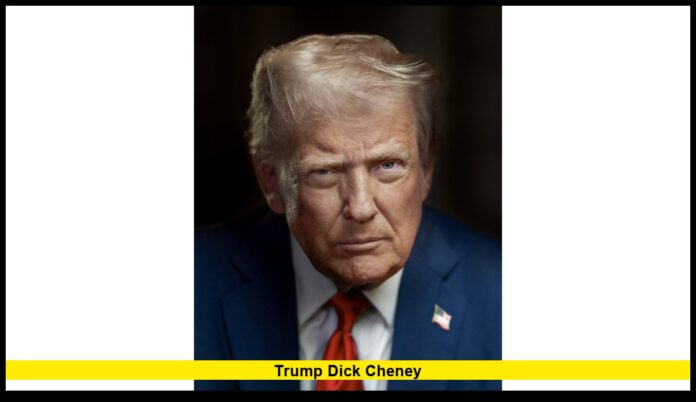
In the wake of the death of former Vice President Dick Cheney at age 84, the phrase Trump Dick Cheney resonates sharply in American political discourse. Cheney’s passing on November 3, 2025, due to complications from pneumonia and heart-related issues, marks the closing of a major chapter in modern Republican history.
Table of Contents
Background: A Republican Divide
Dick Cheney, who served as Vice President from 2001 to 2009 under President George W. Bush, became one of the most outspoken critics of former President Donald Trump in his later years. In a striking departure from the Republican establishment, Cheney stated publicly that “in our nation’s 246-year history, there has never been an individual who is a greater threat to our republic than Donald Trump.”
His sharp condemnation of Trump’s leadership style and his alleged disregard for constitutional order drew widespread attention. Cheney also openly supported Democrat Kamala Harris in the 2024 presidential election—an extraordinary decision for someone long viewed as a pillar of conservative power in Washington.
Trump, in turn, dismissed Cheney as “an irrelevant RINO,” using his signature phrase for “Republicans in Name Only.” This public feud revealed a deep ideological and generational divide within the Republican Party.
Latest Developments
Cheney’s family confirmed that he died peacefully surrounded by his wife Lynne and daughters Liz and Mary. His passing has reignited discussion about his fierce opposition to Trump and his late-life defense of traditional conservatism over populist politics.
One of Cheney’s most defining remarks came in 2022 when he called Trump “a coward” for refusing to accept the 2020 election results. That statement became a rallying cry for anti-Trump conservatives and positioned Cheney as one of the most senior Republican figures to denounce Trumpism so bluntly.
Now, with Cheney’s passing, political analysts are reassessing the long-term consequences of the Trump Dick Cheney clash—one that symbolized not just personal animosity but the struggle for the Republican Party’s identity.
Key Figures & Positions at a Glance
| Name | Role | Relationship to Trump Dick Cheney Dynamic |
|---|---|---|
| Dick Cheney | Former Vice President (2001–2009) | Public critic of Trump; supported Democrats in 2024 |
| Donald Trump | Former and influential Republican leader | Target of Cheney’s criticism; dismissed Cheney as a RINO |
| Liz Cheney | Daughter of Dick Cheney; former U.S. Representative | Echoed her father’s anti-Trump stance; lost GOP support |
| Kamala Harris | 2024 Democratic candidate | Endorsed by Cheney over Trump in the 2024 race |
Why the ‘Trump Dick Cheney’ Dynamic Matters
- A Battle for the GOP’s Soul: Cheney’s condemnation of Trump marked one of the clearest breaks between the party’s old guard and the Trump-era populists.
- Generational Shift: Cheney’s conservative realism and emphasis on global engagement contrasted sharply with Trump’s isolationist “America First” vision.
- Moral and Constitutional Grounds: Cheney’s critique was not just political—it was framed as a moral stand for constitutional democracy and rule of law.
- Electoral Consequences: Cheney’s endorsement of a Democrat sent shockwaves through conservative circles, showing that Trump’s dominance wasn’t universally accepted within the party.
- Long-Term Legacy: His dissent, amplified by his daughter Liz Cheney, has laid groundwork for future Republican figures who prioritize principle over party loyalty.
Public Reaction and Legacy
Following his death, tributes poured in from across the political spectrum. Many praised Cheney’s decades of government service, his role in shaping post-9/11 U.S. policy, and his influence on American foreign affairs. Yet, his final years were defined by his outspoken stance against Trump—a decision that cost him favor among many in his own party but earned him respect from moderates and independents.
The Trump Dick Cheney conflict also highlighted the broader fracture within the GOP—between those embracing Trump’s populist style and those advocating for institutional conservatism. Cheney’s rejection of Trump was not rooted in liberal ideology but in his belief that Trump had abandoned the traditional principles of governance and accountability that once defined Republicanism.
Liz Cheney, following in her father’s footsteps, also became one of Trump’s most vocal critics, particularly in the aftermath of the January 6 Capitol riot. Her political career mirrored her father’s final years: respected by some, ostracized by others, yet unwavering in conviction.
Implications for Republican Politics
- Redefinition of Loyalty: Cheney’s legacy forces Republicans to reconsider whether party loyalty should outweigh loyalty to democratic norms.
- A Symbol of Courage: To many observers, Cheney’s stand against Trump serves as an example of political courage—especially given his stature and long service within the GOP.
- The Future of Conservatism: Cheney’s death could spark renewed debate about what conservatism means in the post-Trump era—traditional values or populist nationalism.
- Impact on Voter Perception: For many voters, the public tension between Trump and Cheney underscores the continued evolution of the Republican Party heading into the 2026 midterms.
A Historical Parallel
Few Republican figures have split from their own party so decisively near the end of their careers. Cheney’s rebuke of Trump mirrors historical moments when elder statesmen broke ranks to defend constitutional values over partisan interests. His decision to prioritize democracy over loyalty echoed through Washington, signaling that even the most entrenched political figures could evolve in the face of changing national dynamics.
Conclusion
The Trump Dick Cheney story is more than a political feud—it’s a defining moment in the Republican Party’s modern history. Cheney’s death closes the chapter on a generation of conservative leadership that once shaped the global order, but his defiance against Trump ensures that his voice will echo long after. As America continues to navigate its political crossroads, the debate between loyalty, leadership, and legacy remains as relevant as ever.
The conversation about the Trump Dick Cheney divide reminds us that within every party, principles and power can collide—and history will judge who stood on the right side of that line.

