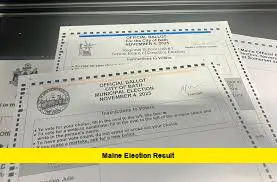
The Maine election result for November 2025 has drawn widespread attention across the state and beyond. Maine voters turned out to decide on two major referendum questions that could shape the state’s political and social landscape for years to come. The outcome was a split decision: Mainers rejected a proposal to tighten voting laws and approved a new red-flag gun law, underscoring a balance between preserving democratic access and advancing public safety.
Table of Contents
Voters Deliver a Clear Message
The two statewide ballot questions generated significant public debate in the weeks leading up to Election Day. Question 1 dealt with proposed changes to Maine’s voting process, while Question 2 focused on expanding the state’s ability to restrict firearm access in cases of potential danger.
By the end of the count, voters had rejected Question 1 by a decisive margin, maintaining the state’s current voting rules. At the same time, they approved Question 2, expanding Maine’s existing “yellow-flag” law to a broader red-flag system.
Together, these outcomes reveal how Maine voters are thinking — defending easy access to the ballot box while showing readiness to act on gun-safety measures.
Question 1: Voter-ID and Election Reform Defeated
Question 1 proposed to reshape how elections are conducted in Maine. It included several major changes that would have significantly altered voting access and absentee-ballot procedures.
Key proposals under Question 1 included:
- Requiring all voters to present a photo ID at the polls and when voting absentee.
- Reducing the period of in-person absentee voting by two days.
- Eliminating the ability to request absentee ballots by phone or through family members.
- Ending the ongoing absentee-ballot status available to seniors and people with disabilities.
- Banning prepaid postage for absentee ballots and limiting the number of drop boxes allowed per municipality.
The proposal was championed by proponents who argued that voter identification laws would increase confidence in elections and prevent potential fraud. However, opponents countered that these changes would make it harder for eligible citizens — especially the elderly, disabled, and rural residents — to cast ballots.
Ultimately, Maine voters sided with accessibility. The rejection of Question 1 maintains Maine’s current system, which is widely regarded as one of the most voter-friendly in the country. Election officials and advocates praised the result as an affirmation of Maine’s longstanding commitment to accessible and secure elections.
Why Maine Voters Said “No”
The defeat of the voting-law proposal suggests that Mainers are wary of reforms perceived as limiting participation. Historically, Maine has been a high-turnout state, with both parties encouraging civic participation through mail-in and early voting.
Voters appeared unconvinced that stricter ID rules were necessary, given Maine’s low record of voter irregularities. Many residents emphasized preserving the flexibility that absentee voting provides, particularly in rural areas where travel to polling places can be difficult.
The Maine election result thus reaffirms the state’s preference for maintaining balance — ensuring election integrity without restricting access.
Question 2: Red-Flag Gun Law Wins Approval
While Maine voters rejected changes to voting access, they approved a significant expansion of the state’s gun-safety framework under Question 2.
The measure expands Maine’s “yellow-flag” law, which previously allowed only law enforcement officers to petition a court to temporarily remove firearms from individuals deemed a threat. The new red-flag law empowers family and household members to request such court intervention, broadening who can act when warning signs arise.
This change follows years of debate in the wake of tragic incidents, most notably the mass shooting in Lewiston in 2023 that left 18 people dead. That event intensified calls for stronger intervention tools to prevent future violence.
Under the new red-flag system:
- Family members, partners, or household members can directly petition courts to restrict firearm access for someone showing signs of potential danger.
- Judges can issue temporary orders if credible evidence of risk exists.
- The process balances the right to due process with the need for swift protective action.
Why the Gun Measure Passed
Maine’s approval of the red-flag law reflects a growing consensus among voters that targeted, preventive measures can reduce risks of gun violence while respecting Second Amendment rights.
Supporters argued that empowering families to act could save lives by allowing early intervention before violence occurs. Many voters viewed the measure as a practical solution that bridges divides between gun ownership and public safety.
Opposition groups voiced concerns about potential misuse or false claims, but these arguments failed to gain enough traction to overturn the broad support for the proposal.
The Maine election result in this area marks a turning point — one that shows a pragmatic approach to firearm policy in a state known for its strong hunting and gun culture.
Voter Turnout and Political Context
Turnout for the 2025 Maine election was steady, showing that residents continue to engage deeply in issues of democracy and public safety. Analysts note that both questions drew voters from across the political spectrum.
Independent and moderate voters played a decisive role in shaping the outcome, as they often do in Maine elections. While partisan divides existed — with conservatives more supportive of the voter-ID proposal and liberals backing the gun-safety measure — the results show that many Mainers vote based on issue-specific reasoning rather than party alignment.
The election also reflected a broader national trend: voters across the country are showing skepticism toward measures that could restrict voting access, while remaining open to policies designed to address urgent safety concerns.
Detailed Overview: Maine Election Result
| Question | Issue | Result | Key Takeaway |
|---|---|---|---|
| Question 1 | Photo ID, absentee voting limits, drop-box restrictions | Rejected | Maine voters defend easy access to the ballot box |
| Question 2 | Family-initiated red-flag gun law | Approved | State expands intervention powers to prevent gun violence |
What the Results Mean for Maine
The Maine election result underscores a dual narrative — one of preservation and one of progress. By rejecting new voting restrictions, Mainers reaffirmed trust in their electoral system. By approving the red-flag measure, they endorsed proactive policies that prioritize community safety.
For lawmakers, this mixed outcome serves as guidance: voters value accessibility and fairness but are willing to embrace reforms that address immediate, tangible risks.
Implications moving forward:
- For election officials: Maine’s voting system will remain unchanged. Future proposals must emphasize transparency and fairness without curbing participation.
- For gun-safety advocates: The new red-flag law opens doors for collaboration between law enforcement, courts, and families to prevent tragedies.
- For policymakers: These results show that Mainers are issue-focused and value solutions rooted in practicality, not partisanship.
Maine’s Political Landscape After the Vote
Maine’s political identity remains defined by independence and pragmatism. Voters continue to evaluate proposals on their merits rather than party lines. This independence has long characterized Maine politics — from its history of electing moderates to its strong record of civic participation.
The Maine election result reinforces this tradition. Voters sent a message that they support policies rooted in balance — protecting the right to vote and promoting safety without eroding personal freedoms.
As implementation of the new red-flag law begins, policymakers and community groups will work to ensure that it is enforced effectively and fairly. Meanwhile, election administrators can proceed confidently with Maine’s existing voting procedures intact.
A Snapshot of Maine’s Civic Priorities
The two ballot measures showcased the dual values of Mainers: freedom and responsibility. Freedom, by maintaining unfettered access to the democratic process; responsibility, by approving mechanisms that prevent harm in communities.
That combination continues to set Maine apart as a state where policy decisions are guided not by ideology but by a deep-rooted sense of fairness and common sense.
The Maine election result reflects a state that values both liberty and safety — a community that listens, debates, and decides with thoughtfulness. What are your thoughts on these outcomes? Share your perspective or stay tuned as these changes take shape in the coming months.

