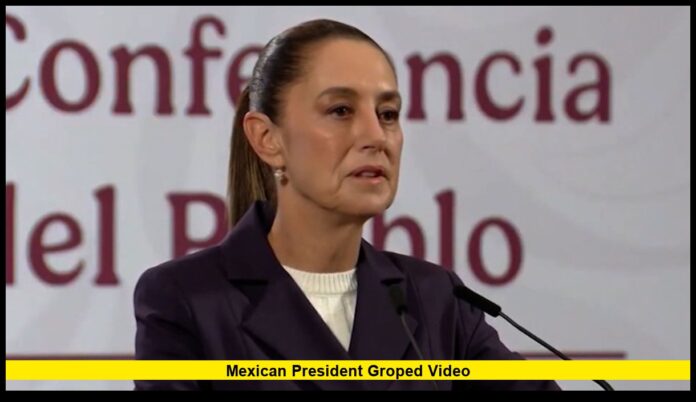
In the widely circulated Mexican president groped video, President Claudia Sheinbaum was visibly assaulted by a man while greeting citizens in Mexico City. The incident occurred on Tuesday, November 4, 2025, and has triggered both legal action and a renewed national conversation about violence against women.
Table of Contents
What Happened?
On the afternoon of November 4, 2025, President Sheinbaum was meeting citizens near the historic center of Mexico City, walking from the Presidential Palace toward the Ministry of Education.
A man, reportedly intoxicated, approached her from behind, placed his arm around her, touched her chest, and attempted to kiss her neck. Sheinbaum quickly removed the man’s hand and turned toward him, remaining composed as a staff member stepped in to intervene.
Video footage of the event circulated rapidly on social media, sparking outrage across Mexico and beyond. The clip—now known as the Mexican president groped video—spread across multiple platforms within hours, generating millions of views.
Legal Response and Arrest
Following the incident, President Sheinbaum filed a formal criminal complaint. The attacker, identified by local authorities as Uriel Rivera Martínez, was arrested later that evening and detained by Mexico City’s Sexual Offences Investigation unit.
In her public statement, Sheinbaum condemned the assault, emphasizing that even women in the highest positions of power are not immune to harassment. She remarked, “If this happens to the president, where does that leave all the young women in our country?”
Under Mexican law, the act qualifies as sexual assault, carrying a potential prison sentence ranging from one to six years. The case has since been forwarded to prosecutors for formal review.
Security Issues and Public Engagement
The video raised immediate questions about presidential security. During the moment of the attack, no visible security officers were standing close to Sheinbaum—a detail that led to public scrutiny of her team’s protective protocols.
Despite the breach, Sheinbaum made clear that she will not distance herself from citizens or avoid public contact. She stated that maintaining closeness with the people remains central to her leadership style and that she refuses to allow fear to dictate how she governs.
Broader Implications: Gender-Based Violence and Harassment
While the assault directly targeted the president, Sheinbaum framed it as a reflection of Mexico’s broader struggle with gender-based violence. She stated that this was not only an attack on her as a person, but on women throughout the nation who face daily harassment and assault.
Mexico continues to confront alarming statistics regarding violence against women. Hundreds of femicides are reported each year, and thousands of women file complaints of sexual assault or harassment. Advocates argue that many cases go unreported due to fear, stigma, and mistrust of authorities.
Activists and women’s rights groups across Mexico have used the incident to highlight the urgency of stronger legal protections and better enforcement. Demonstrations have been reported in several cities calling for harsher penalties for sexual violence and comprehensive reforms to women’s safety policies.
Timeline of Key Moments
| Date | Event |
|---|---|
| Nov 4 2025 | President Claudia Sheinbaum is publicly groped while greeting citizens in Mexico City. |
| Nov 4 2025 (evening) | The suspect, Uriel Rivera Martínez, is arrested by local authorities. |
| Nov 5 2025 | Sheinbaum files a criminal complaint and issues a national address condemning the assault. |
| Nov 6 2025 | The incident sparks nationwide protests and international attention. |
Media Conduct and ‘Re-Victimisation’ Concerns
President Sheinbaum publicly criticised certain media outlets for broadcasting the explicit video and still images of the attack. She described this as “re-victimisation” and said the publication of such footage perpetuates harm against victims of sexual violence.
Her office called on the press to show restraint and refrain from distributing materials that violate women’s dignity or safety. The government also reaffirmed its commitment to enforcing Mexico’s digital violence laws, which criminalise the non-consensual distribution of images related to sexual offences.
Why This Matters for U.S. Readers
Although the incident took place in Mexico, its implications extend beyond national borders.
- It underscores how even top officials remain vulnerable to sexual assault in public spaces.
- It draws attention to gender equality issues that resonate throughout the Americas, including the U.S., where harassment and assault remain pressing social concerns.
- It also highlights how quickly incidents can spread globally through social media, shaping international perceptions of leadership, security, and women’s rights.
For U.S. audiences, the event offers insight into both Mexico’s political climate and its ongoing cultural battle against gender-based violence—an issue that mirrors struggles faced worldwide.
What Comes Next
Legal Developments
The attacker faces formal charges under Mexico’s criminal code. Prosecutors have indicated that the case will proceed swiftly, given the clear video evidence and public nature of the assault.
Policy and Reform
President Sheinbaum has directed the Ministry of Women’s Affairs to review existing harassment and assault laws nationwide. Discussions are underway about expanding penalties for public sexual aggression and increasing training for law enforcement officers handling such cases.
Public Awareness
The viral spread of the Mexican president groped video has reignited awareness campaigns about respect, consent, and gender equality. Advocacy groups have launched digital initiatives encouraging women to report sexual violence and demand accountability.
A Moment That Redefined Boundaries
This single act of aggression against Mexico’s first female president has become a national wake-up call. Beyond politics, it represents a shared struggle faced by millions of women—one demanding systemic change and lasting respect.
The incident has reminded citizens that progress toward equality cannot be achieved without safety, accountability, and cultural transformation.
The “Mexican president groped video” has sparked more than outrage—it has ignited a movement. Share your thoughts below and stay informed as this story continues to evolve.

