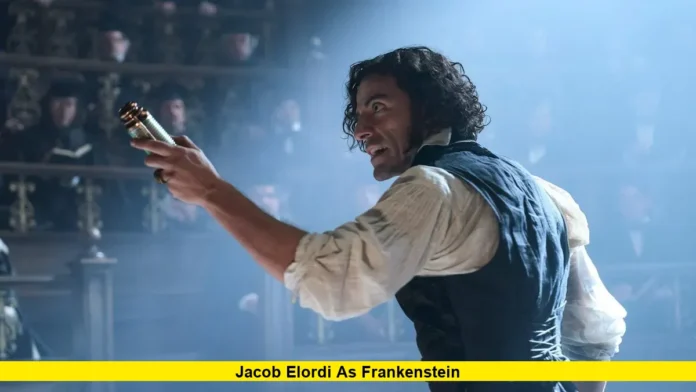
Jacob Elordi as Frankenstein has quickly become one of the most talked-about transformations in modern cinema. The Australian actor, best known for his breakout roles in Euphoria, Saltburn, and Priscilla, takes on the iconic role of Frankenstein’s Creature in Guillermo del Toro’s highly anticipated 2025 adaptation, Frankenstein. With its release now streaming globally on Netflix, Elordi’s performance has drawn major attention across the United States, with fans and critics calling it a bold and emotional reimagining of Mary Shelley’s classic creation.
Table of Contents
A Bold Leap in Jacob Elordi’s Career
For Jacob Elordi, the role of Frankenstein marks a major turning point. Until now, audiences primarily knew him as a heartthrob or dramatic lead in contemporary films and series. Playing Frankenstein’s Creature demanded something entirely different — a balance of physical endurance, emotional rawness, and complete surrender to the character’s tragic soul.
Guillermo del Toro’s version of Frankenstein is not a typical horror movie. It’s a darkly poetic exploration of life, love, creation, and rejection — and Elordi’s performance captures those themes with astonishing humanity. He doesn’t just play a monster; he embodies a being born into a world that fears him. His portrayal of confusion, pain, and longing gives the Creature a depth rarely seen in modern adaptations.
Elordi’s tall frame, haunting gaze, and emotional vulnerability make his transformation one of the most mesmerizing in recent cinema. Viewers and critics alike have noted how he brings both grace and terror to the screen, redefining the role for a new generation.
How Elordi Became Frankenstein’s Creature
When Jacob Elordi was announced as the Creature, many were surprised. Known for his striking looks and effortless charisma, he seemed an unexpected choice for the role. But for del Toro, that was precisely the point — to cast someone who could blend physical presence with a deeply human spirit.
Elordi replaced a previous actor who left the project due to scheduling conflicts, giving him only a short window to prepare. Despite this, he committed himself completely to the role, spending long hours in the makeup chair and undergoing intensive physical training to capture the Creature’s unsteady movement and overwhelming strength.
- Transformation Process: Each day on set began with hours of prosthetic application, bringing the Creature’s stitched skin, hollow eyes, and towering silhouette to life.
- Performance Method: Elordi relied heavily on body language, movement, and silence to convey the Creature’s emotions — often communicating more through his eyes than through dialogue.
- Artistic Vision: Working closely with del Toro, Elordi focused on the Creature’s innocence rather than his horror, emphasizing his childlike curiosity and capacity for love.
The result is a performance that feels both ancient and fresh — a monster who is terrifying not because of his appearance, but because of how deeply he makes us feel.
Inside Guillermo del Toro’s Frankenstein (2025)
This adaptation of Frankenstein is one of Guillermo del Toro’s most ambitious projects to date. A lifelong admirer of Mary Shelley’s novel, del Toro envisioned the film as a gothic drama rather than pure horror.
Set in 19th-century Europe, the story follows Victor Frankenstein, a brilliant but obsessive scientist who brings the Creature to life in a moment of unbridled ambition. Horrified by what he’s created, Victor abandons the Creature, setting off a tragic chain of events that explores themes of creation, rejection, and revenge.
Jacob Elordi’s Creature becomes the film’s emotional anchor. His journey from innocent newborn to tormented outcast mirrors humanity’s struggle for meaning and connection. Through del Toro’s lens, Frankenstein’s monster isn’t evil — he’s misunderstood, desperate for affection in a world that refuses to see beyond his scars.
The film combines del Toro’s signature visual beauty — elaborate sets, moody lighting, and rich costume design — with a deeply emotional narrative. Every scene feels carefully constructed, blending horror and tenderness in ways that resonate with audiences on a personal level.
Critical and Audience Response
Since its premiere, Frankenstein has been met with widespread acclaim. Critics have praised its visual grandeur and the emotional intensity of Elordi’s performance. Many have called it his most mature and impressive role to date.
In the United States, audiences have responded passionately to the film’s mix of gothic atmosphere and modern emotional storytelling. Social media is filled with praise for Elordi’s portrayal, noting how he captures the Creature’s pain and dignity without ever resorting to clichés.
Film analysts predict that this performance will likely shape the next phase of Elordi’s career — opening doors to awards recognition and solidifying him as one of Hollywood’s most versatile young talents.
A Role That Redefines the Monster
Jacob Elordi’s take on Frankenstein’s Creature stands apart from previous versions. Classic interpretations often emphasized the monster’s brutality or fearsome strength. Elordi, under del Toro’s direction, focuses instead on the creature’s humanity — the aching desire to be loved and understood.
This shift gives the film emotional power. When the Creature looks into a mirror, sees his reflection, and recoils in horror, it’s not just about physical deformity — it’s about realizing that the world will never accept him. Elordi channels that heartbreak with precision, using stillness, silence, and subtle facial expressions to draw the audience in.
By the film’s final act, viewers find themselves sympathizing deeply with him. He is no longer just “Frankenstein’s monster”; he’s a victim of abandonment, a mirror to human cruelty, and a tragic reminder of how easily love can turn into fear.
Behind the Scenes: The Making of the Monster
Creating the Creature was a massive collaborative effort between Elordi and del Toro’s production team.
- Prosthetics and Makeup: The makeup process took up to ten hours a day. Layers of prosthetics, artificial veins, and textured skin were applied to make the Creature’s body look pieced together from various corpses.
- Costume Design: The wardrobe was inspired by 19th-century gothic fashion, combining worn leather, heavy wool, and industrial metal details to emphasize the Creature’s fragility beneath his strength.
- Cinematography: Shot using muted tones and candlelight, the visual palette mirrors the Creature’s duality — beauty and decay intertwined.
- Sound Design: Each movement and breath was amplified to evoke the physical burden of being alive, adding to the film’s eerie yet sorrowful tone.
Every element of production — from design to sound — serves to make Jacob Elordi’s portrayal even more immersive and believable.
The U.S. Connection: Why It Resonates
For American audiences, Frankenstein feels especially timely. In an age dominated by technology and artificial intelligence, the story’s themes of creation and control are more relevant than ever.
Jacob Elordi’s Creature represents the struggle of being human in a world driven by perfection and performance. His vulnerability and loneliness echo the social isolation many people feel today. U.S. viewers have connected with that, making the film more than just a period piece — it’s a reflection of modern emotional reality.
Moreover, the accessibility of the movie through Netflix ensures that audiences across the country can experience the story simultaneously. It’s not just a film; it’s a shared cultural event.
Jacob Elordi’s Next Chapter
The success of Frankenstein has positioned Jacob Elordi as one of Hollywood’s most dynamic actors. His willingness to take on physically demanding, emotionally draining roles shows a depth that goes beyond traditional stardom.
Elordi has hinted that he wants to continue exploring darker, more complex stories. After Saltburn and now Frankenstein, he has proven he can thrive in roles that challenge conventional expectations. Industry experts believe he could soon find himself in the running for major awards recognition, and possibly collaborate again with directors known for bold, artistic storytelling.
A Modern Monster for a Modern World
In the end, Frankenstein (2025) is not just a horror story — it’s a tragic meditation on humanity, creation, and compassion. Jacob Elordi’s portrayal makes it impossible to see the Creature as anything less than fully alive, fully feeling, and heartbreakingly real.
His eyes, his movements, and his silence speak louder than any dialogue. Through this performance, Elordi invites the audience to question who the real monster is: the one who is created, or the one who creates without responsibility.
This role is not just a milestone for Elordi’s career; it’s a cinematic achievement that redefines a two-hundred-year-old story for today’s generation.
Jacob Elordi as Frankenstein is a haunting, powerful reminder that even the most monstrous beings can carry the deepest humanity. Share your thoughts about his performance below — do you see his Creature as a monster, a man, or something in between?

