Fans of Vince Gilligan have been buzzing with one big question since the debut of his latest series: Is Pluribus related to Breaking Bad? The curiosity is understandable. After all, the two shows share the same creator, take place in Albuquerque, and even feature Rhea Seehorn — the fan-favorite actress from Better Call Saul. But while Pluribus carries echoes of Gilligan’s signature style, the reality is clear: it is not part of the Breaking Bad universe. Instead, it marks a bold and visionary leap into an entirely new genre — one that explores the complexities of human consciousness, happiness, and individuality.
Below, we break down everything confirmed so far about Pluribus — its plot, cast, creative direction, and exactly how (and why) it differs from Breaking Bad.
Table of Contents
A New Era for Vince Gilligan: What Is Pluribus?
Pluribus is a newly released Apple TV+ original sci-fi drama series created by Vince Gilligan, the mastermind behind Breaking Bad and Better Call Saul. It premiered on November 7, 2025, with two episodes launching simultaneously. The first season will air weekly, and Apple TV+ has already greenlit a second season — proof of the streaming platform’s confidence in Gilligan’s creative vision.
Set once again in Albuquerque, New Mexico, Pluribus tells the story of a strange, world-altering event that fuses humanity into a single collective consciousness. Everyone becomes linked — sharing thoughts, emotions, and experiences — resulting in a society that claims to have achieved perfect happiness. But there’s one exception: a single woman who remains separate from the hive mind.
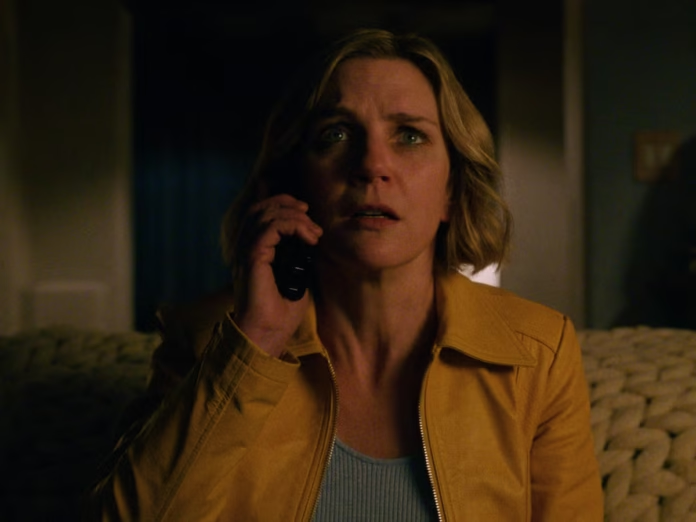
This woman, portrayed by Rhea Seehorn, becomes the last truly “individual” person on Earth. The narrative follows her as she uncovers the truth behind this eerie new reality and confronts questions about what it means to be human in a world where no one can think for themselves.
The concept is deeply philosophical and emotionally charged, fusing science fiction, existential drama, and psychological suspense. It’s not about crime, cartels, or moral corruption — it’s about identity, choice, and the cost of collective peace.
Is Pluribus Related to Breaking Bad? Let’s Set the Record Straight
The short answer: No, Pluribus is not related to Breaking Bad.
While there are stylistic similarities and returning collaborators, Pluribus is a completely separate story. Here’s a closer look at why people are asking — and what makes them different:
1. The Shared Creative DNA
Both Breaking Bad and Pluribus were created by Vince Gilligan, whose meticulous storytelling style, cinematic visuals, and moral complexity have made him one of the most respected writers in television. His name alone immediately draws comparisons — and expectations.
2. Familiar Faces
Rhea Seehorn, best known for playing Kim Wexler in Better Call Saul, now stars in Pluribus. Her return to Gilligan’s creative world fueled speculation that the show might be connected to the Breaking Bad universe. However, Seehorn plays a completely different character — not a lawyer, but a lone survivor of humanity’s consciousness collapse.
3. The Albuquerque Connection
Both shows are set in Albuquerque, New Mexico — a city that has become iconic in Gilligan’s work. The familiar desert landscape and wide panoramic shots carry over into Pluribus, but they serve an entirely new purpose. Instead of symbolizing isolation and decay (as in Breaking Bad), the desert here represents freedom and individuality in a world consumed by unity.
4. Thematic Differences
While Breaking Bad explored greed, morality, and the consequences of power, Pluribus dives into identity, conformity, and the paradox of happiness. Gilligan has described Pluribus as a “spiritual successor” — not in plot or world-building, but in emotional depth and tone.
The Vision Behind Pluribus
Vince Gilligan’s move from dark crime drama to science fiction wasn’t accidental. After nearly two decades in the Breaking Bad universe, he wanted to challenge himself — to tell stories that questioned human behavior from a new perspective.
Gilligan’s new world is vast, visual, and allegorical. While Breaking Bad was grounded in moral realism, Pluribus uses speculative fiction to explore timeless philosophical ideas. What happens when humanity achieves perfect harmony? Is individuality a curse or a gift? These are the questions Pluribus wrestles with.
The show’s tone is atmospheric and mysterious. Instead of the violent confrontations of Breaking Bad, tension in Pluribus builds through psychological unease and eerie quiet. The world feels peaceful — too peaceful — creating a sense of creeping dread beneath the surface.
Rhea Seehorn’s Breakthrough Role
Rhea Seehorn’s casting is one of Pluribus’ biggest talking points. After earning critical acclaim for her complex performance in Better Call Saul, she reunites with Gilligan in a role that pushes her emotional range even further.
Her character — the last individual left in a collective world — serves as the emotional anchor of the series. She embodies both resistance and vulnerability, torn between longing for connection and the terror of losing herself.
This performance has already drawn widespread praise from early viewers and critics, with many calling it her most powerful work yet.
The Tone, Style, and Aesthetic
Although Pluribus is set in the same state as Breaking Bad, it looks and feels entirely different. The familiar dry, sunburnt deserts are now surreal and dreamlike, filmed in soft gold and violet hues that hint at both beauty and unease.
The series uses symbolism heavily — reflections, mirrors, and split imagery represent the conflict between self and society. The pacing is deliberate, echoing Gilligan’s signature slow-burn storytelling, but the focus is inward rather than external.
Sound design also plays a major role. Instead of tense silences and sudden violence, Pluribus uses faint echoes and ambient noise to convey the interconnected hum of the collective consciousness.
Why Fans Thought It Was a Breaking Bad Spin-off
The misconception that Pluribus was tied to Breaking Bad spread quickly online after the first teaser trailer dropped. Here’s why:
- Marketing Hints: The promotional tagline — “One of us isn’t happy” — had the dark, ironic tone that fans associate with Breaking Bad.
- Visual Parallels: The opening trailer used Albuquerque’s landscapes and moody cinematography reminiscent of Breaking Bad’s earliest seasons.
- Rhea Seehorn’s Involvement: Many viewers assumed her casting meant a continuation or alternate storyline for her Better Call Saul character.
- Gilligan’s Track Record: Having created two connected shows before (Breaking Bad and Better Call Saul), audiences expected a third.
However, the first few episodes made the truth obvious — Pluribus is not a spin-off, sequel, or shared-universe project. It’s an entirely standalone narrative that expands Gilligan’s storytelling horizon.
How Pluribus Reinvents Vince Gilligan’s Legacy
For over a decade, Vince Gilligan has been synonymous with morally complex anti-heroes — Walter White, Jesse Pinkman, and Saul Goodman. With Pluribus, he’s deliberately moving away from that archetype.
Here, the focus is not on descent or corruption but on preservation — the preservation of individuality, emotion, and humanity in the face of overwhelming conformity. The protagonist doesn’t seek power; she seeks meaning.
This shift marks a defining evolution in Gilligan’s career. It shows that his genius doesn’t rely on one formula — crime, violence, or greed — but on understanding what drives human behavior at its core.
Early Reception and Future Outlook
Since its release, Pluribus has earned acclaim for its originality, visual ambition, and emotional resonance. Critics have praised it as a “thoughtful and haunting meditation on identity,” highlighting Seehorn’s performance and Gilligan’s directorial vision as major strengths.
Viewership numbers have been strong on Apple TV+, bolstered by Breaking Bad fans curious to see Gilligan’s next chapter. The streaming platform has already renewed the show for a second season, with production expected to begin in mid-2026.
If Breaking Bad was about transformation through corruption, Pluribus is about transformation through connection — and the cost of losing oneself in the process.
So, Is Pluribus Related to Breaking Bad?
To put it simply: Pluribus is related to Breaking Bad only by creator and style — not by story or universe.
Both shows share a distinctive visual language, sharp dialogue, and Albuquerque setting, but that’s where the connection ends. Pluribus is a completely independent narrative — one that explores questions of identity, freedom, and the collective human experience through a sci-fi lens.
For Vince Gilligan, this marks a powerful new era of storytelling — one that challenges audiences to think, not just watch.
In summary, if you’re wondering, “Is Pluribus related to Breaking Bad?” — the answer is no. But it’s every bit as gripping, emotional, and thought-provoking as Gilligan’s previous masterpieces. It may not bring back Walter White or Saul Goodman, but it brings something else entirely — a vision of the future that asks us who we are when we stop being individuals.
Do you think Pluribus can ever surpass Breaking Bad’s cultural impact? Share your thoughts below and stay tuned for more updates as the series unfolds.

