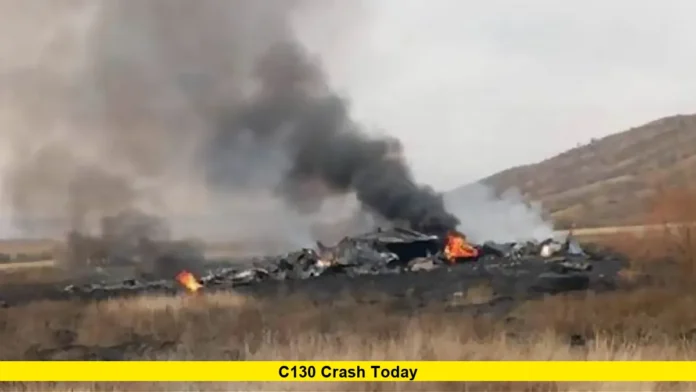
A devastating C130 crash today has left the world in shock as a Turkish military cargo aircraft went down near the Azerbaijan-Georgia border, claiming multiple lives. The tragic event occurred on November 11, 2025, when the aircraft, carrying 20 personnel, vanished from radar shortly after entering Georgian airspace. Search and rescue operations are underway, as both Turkish and Georgian authorities work together to recover the wreckage and determine what led to the sudden and catastrophic crash.
Table of Contents
The Tragic Incident Unfolds
The ill-fated C130 Hercules transport plane, operated by the Turkish Air Force, departed from Ganja International Airport in Azerbaijan in the morning. It was bound for a Turkish airbase but lost radar contact approximately 30 minutes into its flight. The aircraft reportedly disappeared over the Kakheti region in eastern Georgia, near the town of Sighnaghi, close to the Azerbaijan border.
Eyewitnesses from nearby villages described a terrifying scene: a loud explosion followed by thick smoke rising from the mountainous terrain. Several locals reported seeing the aircraft descending rapidly in a spiral motion before crashing, suggesting a possible mid-air structural failure or engine explosion. The area surrounding the crash site was immediately sealed off as emergency responders and military personnel began recovery operations.
Officials confirmed that there were 20 people on board, including pilots and support crew. As of now, no survivors have been found, and authorities have expressed fears that all on board perished in the impact.
About the Aircraft
The Lockheed C130 Hercules is one of the most reliable and widely used military transport aircraft in the world. It has been in service since the 1950s and is known for its versatility, capable of performing a wide range of missions, including troop transport, cargo delivery, aerial refueling, and humanitarian aid.
The specific aircraft involved in today’s crash was reportedly one of Turkey’s older models, believed to have been in service for several decades. While the C130 remains a robust aircraft, its age raises questions about maintenance standards, fatigue in structural components, and the need for modernization. Turkey’s Air Force, like many NATO members, continues to operate several variants of the C130 due to its proven design and adaptability.
However, aviation experts often note that older airframes, even when regularly maintained, can face metal fatigue, corrosion, and stress fractures that may not always be detected during routine inspections. These concerns could play a critical role in the ongoing investigation into today’s tragic accident.
Flight Timeline
| Time (Local) | Event |
|---|---|
| 10:15 AM | C130 departs Ganja International Airport, Azerbaijan |
| 10:40 AM | Enters Georgian airspace; communication remains normal |
| 10:45 AM | Radar contact lost; no distress signal received |
| 10:50 AM | Eyewitnesses report explosion and smoke near Sighnaghi, Georgia |
| 11:20 AM | Search and rescue teams dispatched to the crash site |
| 2:00 PM | Turkish Ministry of Defense confirms aircraft missing |
| Evening | Wreckage found; joint investigation launched |
The loss of radar contact without a distress call suggests that the incident occurred suddenly, giving the crew little or no time to react. Preliminary data indicates that the aircraft was flying at a cruising altitude before rapidly descending, which aligns with witness accounts of a sudden spiral and explosion mid-air.
Government and Military Response
The Turkish Ministry of National Defense confirmed the crash and expressed deep sorrow over the loss of the aircraft and its personnel. In a statement, officials referred to the fallen service members as “martyrs,” emphasizing their dedication and sacrifice in the line of duty.
Turkish President Recep Tayyip Erdoğan also issued a condolence message, pledging a thorough investigation and support for the families of the victims. He described the crash as “a painful tragedy that has struck the heart of the nation.”
In Georgia, Prime Minister Irakli Kobakhidze extended condolences to Turkey and offered full cooperation in the investigation. Georgian emergency services have joined forces with Turkish military rescue teams to secure the site, recover remains, and collect evidence for the investigation.
Helicopters, drones, and specialized ground units are currently combing the mountainous terrain to locate debris and the aircraft’s black boxes. Officials have confirmed that the flight data recorder and cockpit voice recorder are among the top priorities in the recovery effort, as they will be critical in identifying the root cause of the accident.
Possible Causes Under Investigation
Although the official cause of the C130 crash today has not yet been determined, several potential factors are being explored by investigators:
- Mechanical Failure
The most likely theory so far points to mechanical malfunction or structural failure. Witness accounts and early visual evidence of the plane disintegrating mid-air suggest that one or more critical components—possibly a wing or an engine—may have failed catastrophically. - Fatigue and Maintenance Issues
The C130 involved was reportedly an older aircraft. Metal fatigue, undetected cracks, or worn parts may have contributed to the loss of control. Investigators will review maintenance records and inspection histories to check for any missed faults. - Fuel or Fire-related Incident
The reported smoke trail could indicate a fuel leak or onboard fire. If confirmed, this would explain why the crew had no time to send a distress call. - Human or Environmental Factors
Although weather conditions were reported to be clear, investigators will examine whether human error, navigational problems, or unexpected turbulence played a role. Crew fatigue and flight duration will also be considered.
Each of these possibilities will be carefully examined as recovery teams analyze wreckage and flight data in the coming days.
International and Regional Reactions
The crash has drawn international attention, particularly from NATO allies and defense organizations. Turkey, a key NATO member, has a long history of using C130 aircraft in joint operations with allied forces. The loss of such a vital military transport plane has raised questions about the safety of aging aircraft fleets across multiple nations.
Expressions of sympathy have poured in from leaders around the world, with many nations offering technical assistance in the investigation. Aviation experts note that this incident could accelerate Turkey’s ongoing efforts to modernize its transport fleet, possibly replacing older C130 models with updated versions or newer-generation aircraft.
Beyond the technical and political implications, the tragedy has also struck an emotional chord among citizens. Social media platforms have been flooded with messages of grief, unity, and support for the families of the fallen crew members. In Turkey, flags were lowered to half-staff at military bases, and moments of silence were observed across government offices.
The Ongoing Investigation
Both Turkish and Georgian officials have established a joint investigative task force to examine all evidence related to the crash. Forensic teams are gathering debris and remains for identification, while aviation engineers are expected to analyze the wreckage to identify structural weaknesses.
Key focus areas for investigators include:
- Recovering and analyzing the flight data and cockpit recorders
- Examining wreckage patterns to identify the point of failure
- Reviewing maintenance logs and previous flight histories
- Assessing flight control system performance and communications data
Initial findings are expected within a few weeks, though a full investigation may take several months. Authorities have pledged transparency and promised to release results as soon as they are verified.
A Nation in Mourning
In Turkey, the mood is somber. Vigils are being held at military bases and public spaces as citizens pay their respects to the fallen airmen. The Ministry of Defense has announced that a national ceremony will be organized in Ankara to honor their memory, with attendance expected from senior officials and the victims’ families.
The bond between Turkey and Azerbaijan has also been highlighted during this tragedy. Azerbaijani officials have expressed deep sympathy, calling the loss “a tragedy shared by brothers.” Joint memorial events are expected in both countries.
The Legacy of the C130
The Lockheed C130 has been the backbone of many military operations for over 70 years. It has served in war zones, disaster relief missions, and peacekeeping operations worldwide. Despite its age, the Hercules remains one of the most respected aircraft in aviation history due to its durability and adaptability.
However, this latest crash is a sobering reminder that even proven designs must evolve with time. Modernization efforts, including the introduction of C130J Super Hercules variants, have already begun in several countries. Today’s tragedy may serve as a turning point for Turkey and its allies to reexamine fleet maintenance programs and ensure the highest possible safety standards.
Conclusion
The C130 crash today near the Azerbaijan-Georgia border marks a somber chapter in Turkish military aviation history. While investigations continue, the loss of 20 dedicated service members stands as a powerful reminder of the dangers faced by those who serve their nation in the skies. The coming weeks will bring crucial answers, but for now, both Turkey and the global aviation community mourn the lives lost in this devastating event.
Our thoughts are with the victims and their families — share your messages and stay informed as new details emerge about this tragic crash.

