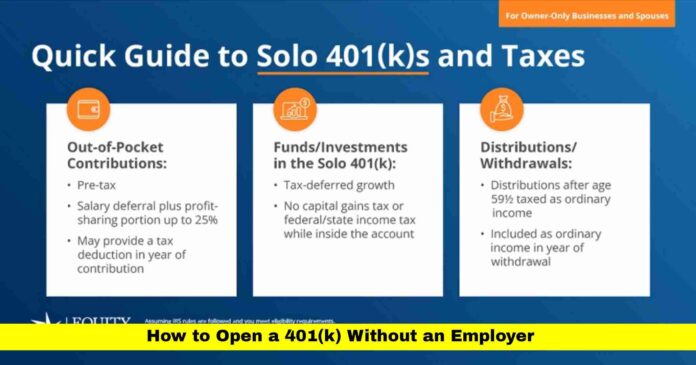
Learning how to open a 401(k) without an employer is essential for self-employed individuals, freelancers, and anyone looking to build retirement savings outside a traditional job. While 401(k) plans are commonly offered through employers, there are alternative accounts such as Solo 401(k)s that allow individuals to contribute independently. These plans provide substantial contribution limits, tax advantages, and investment flexibility, making them an ideal solution for anyone aiming to secure their financial future without relying on corporate-sponsored retirement programs.
Table of Contents
Key Points Summary
For quick insights on opening a 401(k) independently:
- Solo 401(k): Best suited for self-employed individuals or freelancers with no employees, except possibly a spouse.
- Contribution Limits 2025: Employees can contribute up to $22,500, with catch-up contributions of $7,500 for those aged 50 or older. Total combined contributions including employer portion can reach $66,000, or $73,500 with catch-up.
- Investment Options: Includes stocks, ETFs, mutual funds, and in some plans alternative investments like real estate.
- Tax Advantages: Traditional contributions are pre-tax, reducing taxable income; Roth contributions grow tax-free.
- Eligibility Requirements: Must have self-employment income; simple IRS forms establish the account.
- Control and Flexibility: Investors choose contribution levels, allocation, and can roll over existing accounts.
These points give readers a fast overview of options for starting a retirement account independently.
Understanding Solo 401(k) Accounts
A Solo 401(k) is designed for self-employed individuals or business owners with no full-time employees, aside from a spouse. It mirrors traditional 401(k) plans by offering both traditional (pre-tax) and Roth (after-tax) options. Contributors can act as both employee and employer, allowing larger annual contributions than standard IRAs.
Eligibility is straightforward: any individual earning self-employment income from freelancing, consulting, or a small business can open a Solo 401(k). These plans provide the same tax advantages as employer-sponsored accounts, including pre-tax contributions and tax-deferred growth, while offering greater control over investment choices and contribution strategies.
Advantages of a Solo 401(k)
- High Contribution Limits: Allows up to $66,000 total contribution per year ($73,500 with catch-up contributions if age 50+).
- Tax Benefits: Contributions reduce taxable income for traditional accounts, while Roth contributions grow tax-free.
- Investment Flexibility: Offers a wide range of assets, including stocks, ETFs, mutual funds, and sometimes alternative investments.
- Account Control: You decide how much to contribute, where to invest, and when to adjust allocations.
- Rollover Options: Previous 401(k) or IRA accounts can be consolidated into a Solo 401(k) for easier management.
- Catch-up Contributions: Individuals over 50 can make additional contributions to accelerate retirement savings.
- Spousal Contributions: If your spouse earns income, they can also contribute to increase household retirement savings.
Step-by-Step Guide to Opening a Solo 401(k)
- Confirm Eligibility: Ensure you have self-employment income or own a business with no employees other than a spouse.
- Select a Provider: Financial institutions and brokerages offer Solo 401(k) plans; compare fees and investment options.
- Choose Between Traditional and Roth: Consider tax implications based on current income and anticipated retirement tax bracket.
- Complete Plan Forms: Most providers handle IRS-required adoption documents and account setup.
- Fund the Account: Determine employee and employer contributions within IRS limits.
- Allocate Investments: Choose investments aligned with retirement goals and risk tolerance.
- Monitor Contributions: Track yearly contributions to avoid exceeding IRS limits.
- File IRS Forms if Required: Solo 401(k) accounts exceeding $250,000 in assets must file Form 5500 annually.
Contribution Limits for 2025
- Employee Contribution: Up to $22,500, plus $7,500 catch-up for age 50+.
- Employer Contribution: Up to 25% of compensation, allowing combined totals up to $66,000 ($73,500 with catch-up).
- Flexibility: Can split contributions between traditional and Roth options depending on tax strategy.
Understanding contribution limits is crucial for maximizing retirement savings while staying compliant with IRS regulations.
Investment Options in Solo 401(k)
Solo 401(k) plans provide diverse investment options to match various risk tolerances:
- Stocks: Individual equities for growth opportunities.
- ETFs: Diversified, low-cost index options.
- Mutual Funds: Professionally managed portfolios for diversification.
- Bonds: Fixed-income options for stability.
- Alternative Assets: Some providers allow real estate, private equity, or other alternative investments.
A diversified approach helps balance risk and growth potential across your retirement portfolio.
Traditional vs. Roth Solo 401(k)
- Traditional Account: Contributions are pre-tax, reducing taxable income now; withdrawals taxed in retirement.
- Roth Account: Contributions are made with after-tax dollars, and withdrawals are tax-free.
- Combined Strategy: Many investors split contributions between Roth and traditional accounts to balance tax benefits.
Choosing the right structure depends on current income, expected future taxes, and retirement goals.
Spousal Contributions
- Eligibility: If a spouse earns income from your business, they can contribute to the Solo 401(k).
- Separate Account or Same Plan: Most providers allow spousal participation within the same plan.
- Contribution Limits: Spouses can contribute up to the same limits as the primary account holder.
- Benefit: Increases total household retirement savings and tax advantages.
Rollover Options
- Previous 401(k)s: Old employer accounts can be rolled into a Solo 401(k) for consolidated management.
- IRAs: Both traditional and Roth IRAs can typically be rolled in if permitted by the provider.
- Advantage: Simplifies investment management, may reduce fees, and keeps tax benefits intact.
Tax Benefits and Considerations
- Traditional Contributions: Reduce current taxable income.
- Roth Contributions: Tax-free growth and withdrawals.
- Catch-up Contributions: Extra $7,500 for those 50+.
- Employer Contributions: Enhance tax-deferred growth potential.
- Recordkeeping: Accurate records ensure IRS compliance and maximize benefits.
Common Mistakes to Avoid
- Exceeding Contribution Limits: Can lead to IRS penalties.
- Missing Deadlines: Timely contributions and filings are required.
- Ignoring Spousal Options: Missing spousal contributions reduces household savings potential.
- Investment Concentration: Lack of diversification increases risk.
- Neglecting Required Forms: Solo 401(k)s over $250,000 require annual Form 5500 submission.
Advantages Compared to a Traditional IRA
- Higher Contribution Limits: Solo 401(k) allows much larger annual contributions than IRAs.
- Catch-up Contributions: Larger additional contributions for those over 50.
- Employer Contributions: Available only with Solo 401(k)s.
- Loan Option: Some plans allow borrowing from the account for personal or business needs.
Planning for Retirement Without an Employer
- Set Clear Goals: Determine retirement age and target savings.
- Maximize Contributions: Take advantage of both employee and employer contributions.
- Diversify Investments: Spread assets across multiple investment types.
- Review Regularly: Adjust contributions and investment allocation as circumstances change.
- Stay Informed: Monitor IRS updates and retirement plan options annually.
Conclusion
Understanding how to open a 401(k) without an employer is vital for freelancers, self-employed workers, and small business owners. Solo 401(k)s offer high contribution limits, flexible investment options, and significant tax benefits, making it possible to build a secure retirement without an employer-sponsored plan. By establishing a Solo 401(k), tracking contributions, and carefully selecting investments, individuals can take control of their retirement and optimize their long-term financial security.
FAQs
Q1: Can I open a Solo 401(k) without any employees?
A1: Yes, Solo 401(k)s are specifically designed for self-employed individuals with no employees except a spouse.
Q2: How much can I contribute in 2025?
A2: Total contributions can reach $66,000, or $73,500 if you are age 50 or older.
Q3: Can I roll over an old 401(k) into a Solo 401(k)?
A3: Yes, most Solo 401(k) plans allow rollovers from traditional or Roth 401(k)s and IRAs.
Disclaimer: This article is for informational purposes only and does not constitute financial or tax advice. Consult a professional for personalized guidance.

 without an employer using a Solo 401(k) for self-employed individuals, maximizing retirement savings and tax advantages.)