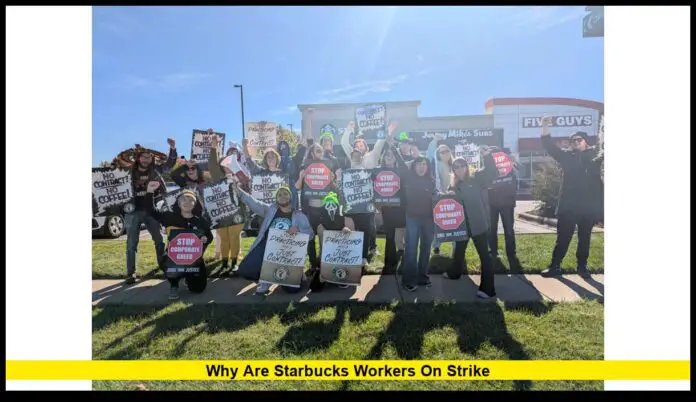
Unionized employees at Starbucks across the U.S. are striking today as part of a coordinated work stoppage. The strike began at more than 65 company-owned stores on November 13, 2025, timed to the chain’s major annual “Red Cup Day” promotion.
Here’s a detailed, up-to-date breakdown of why are Starbucks workers on strike, what they’re demanding, how the company is responding, and what this could mean moving forward.
Table of Contents
What’s happening right now
- More than 1,000 unionized Starbucks baristas from over 65 stores have walked off the job in at least 40 U.S. cities—including New York, Seattle, Dallas, Philadelphia, Minneapolis and San Diego.
- The strike is open-ended: it will continue until key demands are met or until the company returns to serious bargaining.
- This action coincides with Red Cup Day, one of Starbucks’ busiest retail days of the year—a strategic move by the union to amplify leverage.
- The union behind the strike is Starbucks Workers United (SWU). They represent workers at roughly 550 company-run U.S. stores, though the company disputes the exact figure.
Key reasons — why are Starbucks workers on strike
1. Lack of a first union contract
Workers say they first unionized starting in 2021, but despite that, no national collective bargaining agreement has been successfully concluded. The union claims negotiations have been stalled, and that management is negotiating in bad faith.
2. Pay, scheduling and staffing issues
Baristas point to low pay, inconsistent hours, and chronic understaffing. For example:
- Some part-time workers say they’re given fewer than 20 hours a week, which keeps them just short of benefit eligibility.
- Pay rates cited by workers include figures around $16/hour in some cities, which they say is not sufficient.
- They argue that staffing issues lead to long wait times and higher stress in stores.
3. Resolution of unfair labor practice claims
The union has filed over 1,000 unfair labor practice (ULP) charges with the National Labor Relations Board (NLRB), alleging things like retaliation against unionizing workers or refusal to bargain. The workers say they want those claims addressed as part of any contract.
4. Strategic timing and leverage
Scheduling the strike on Red Cup Day suggests the union plans to use visibility and business disruption as leverage. By targeting a key sales event, the workers hope to pressure the company to return to the table.
Company stance and context
- Starbucks says the majority of its stores will remain open and unaffected—less than 1% of total U.S. locations were reportedly impacted on day one of the strike.
- The company maintains it offers “the best job in retail,” citing average hourly pay and benefits worth more than $30/hour (inclusive of benefits) for U.S. hourly partners.
- Starbucks contends the union represents only about 4% of its U.S. workforce, disputing the scale of disruption or participation claims.
- Leadership changes: CEO Brian Niccol took over in late 2024 amid a company-wide restructuring. Some workers say that leadership change has coincided with increased frustration around contract delays.
Timeline of key events
| Date | Event |
|---|---|
| Late 2021 | First Starbucks store in U.S. votes to unionize. |
| Oct 2025 | Union holds strike-authorization vote across multiple cities. |
| Nov 13 2025 | Strike begins at 65+ stores on Red Cup Day. |
| Ongoing | Strike remains open-ended; more stores may join if no deal. |
What could happen next?
- If Starbucks and the union return to serious bargaining, a contract could be reached which would likely set precedent for other union-ized stores nationwide.
- If not, the strike could expand to more stores—SWU has warned they may escalate.
- Business impact appears limited so far, but visibility remains high. A larger, protracted strike could affect public perception and operations.
- The resolution of unfair labor practice claims may become a major bargaining point.
- Investors and stakeholders may increasingly watch how Starbucks handles its labor relations as part of company strategy and brand reputation.
Why are Starbucks workers on strike: Bottom line
The primary reason Starbucks workers are on strike is failure to secure a fair collective bargaining contract. They believe the company is dragging its feet on key issues: wages, hours, staffing and labor-practice complaints. The strike’s timing—on a peak promotional day—underscores their urgency to be heard. The company maintains it offers strong compensation and is ready to negotiate but disputes the union’s narrative about scale and disruption.
If you have thoughts on this strike or want to follow updates, feel free to share in the comments below!

