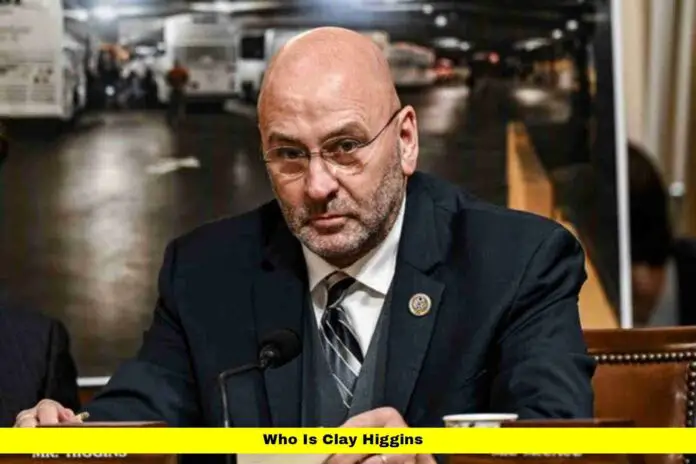
Rep. Clay Higgins has once again stirred Washington, becoming a vivid, polarizing figure whose actions and rhetoric refuse to fade into the background. Known for his hardline conservatism, unapologetic style, and willingness to break from his own party, he remains central to some of the most charged political debates today.
Early Life and Law Enforcement Roots
Clay Higgins was born Glen Clay Higgins on August 24, 1961, in New Orleans, Louisiana. Raised in a large family, he moved as a child to Covington, where his upbringing leaned toward rugged individualism and public service. He attended Louisiana State University, though he did not graduate.
In his early career, Higgins gravitated toward law enforcement. He served in the Louisiana National Guard and eventually joined the Opelousas Police Department. Later, he worked with the Port Barre Police and eventually as a deputy in the St. Landry Parish Sheriff’s Office. His time in law enforcement shaped both his worldview and his public image.
Higgins rose to national attention through his “Crime Stoppers”–style videos. In gritty, direct-to-camera messages, he called out criminals and urged them to surrender, earning him the nickname “the Cajun John Wayne.” His persona blended Southern grit, faith-based rhetoric, and a no-nonsense law-and-order ethic — and it resonated strongly with many.
Turning Point into Politics
In 2016, Higgins decided to run for Congress. He won the runoff in Louisiana’s 3rd District and took office in January 2017. Since then, he has built a reputation not just as a conservative firebrand, but as someone who embraces his background in law enforcement to frame his legislative mission.
Over successive terms, he has leaned into a message of strong national security, limited government, and “America First” populism. He often positions himself as a defender of the average citizen against what he describes as out-of-touch elites in Washington.
Committee Battles and Strategic Shifts
Higgins has held important committee roles in the House, including on the Homeland Security Committee. But in a dramatic move in August 2025, he announced his voluntary withdrawal from that committee. He framed his exit as a principled decision — arguing that recent shifts in the committee’s leadership and policy direction clashed with his conservative ideals around immigration, ICE enforcement, and surveillance.
Despite leaving Homeland Security, he has not faded from influence. He continues to serve as a senior Republican on the House Oversight Committee, chairing the Subcommittee on Federal Law Enforcement. Through that role, he exerts significant oversight over federal agencies, particularly those linked to criminal investigations and law enforcement practices.
A Lone Dissent: His Vote on Epstein Files
One of Higgins’s most headline-grabbing moments recently came when he cast the only vote in the House against the Epstein Files Transparency Act. The measure called for the public release of Department of Justice investigative files related to Jeffrey Epstein — but Higgins argued that its current form endangered thousands of innocent people.
He characterized his “no” vote as a principled stand for privacy and justice. According to him, the bill’s broad release of sensitive documents could expose witnesses, alibi-givers, or family members who were never criminally implicated. He called for a revised version that better protects those individuals, even as he supports transparency for Epstein’s victims.
This stance underlines how Higgins often blends a tough-on-crime posture with a sometimes unexpected defense of procedural safeguards. It’s part of what makes him unpredictable to both critics and allies.
Policy Priorities and Legislative Moves
Higgins’s agenda in Congress reflects his deeply conservative worldview. Among his recent initiatives and positions:
- He backed a bipartisan effort to reform the National Flood Insurance Program.
- He supported authorization of Louisiana’s National Guard readiness center in Lafayette, emphasizing local security and infrastructure.
- In October 2025, he called on federal authorities to pause shrimp imports, citing concerns over radioactive contamination in some imported shrimp.
He has also used his oversight role aggressively — leading hearings to question whether federal agencies like the EPA are being weaponized for political ends.
Controversies and Combativeness
Part of Higgins’s public profile is defined by fierce rhetoric and frequent clashes.
- He has made blunt remarks about sanctuary cities, warning mayors that they could be “held accountable” for immigration policies.
- In a widely criticized social media post, he urged SNAP (food stamp) recipients to “stop smoking crack” if they don’t have at least a month’s supply of groceries stocked — a message that sparked widespread backlash for its tone and insensitivity.
- Earlier this year, he criticized the U.S. Postal Service after they refused to deliver mail to his mailbox because it lacked a door, calling for a “deep investigation” into postal policies.
These controversies aren’t just talk — they reflect a pattern. Higgins thrives on confrontation, often blending populist fury with institutional critique.
Political Positioning and Alliances
Higgins firmly aligns with America First conservatism. He is part of the House Freedom Caucus, a group of lawmakers known for their uncompromising conservative principles. His approach often mixes moral urgency with political strategy: he frames his policy battles as fights for the soul of the country, not just legislative wins.
He also builds alliances based on his oversight power. By chairing a subcommittee on federal law enforcement, he gives himself a pulpit to challenge bureaucracy, question elite institutions, and push for reforms in criminal justice that mirror his law-enforcement background.
Future Plans and What’s Next
Contrary to speculation that he might run for the U.S. Senate, Higgins announced in early 2025 that he will not challenge for a Senate seat. Instead, he affirmed his commitment to staying in the House. According to his letter, he believes he can serve the “MAGA America First agenda” more effectively as a senior House member than by seeking a Senate berth.
That calculation underscores how Higgins views his role: he is not primarily chasing prestige, but influence. He wants to remain involved in oversight, policy-making, and cultural messaging — and he clearly thinks his current platform gives him the best chance to do so.
Public Perception: Polarizing but Persistent
Public opinion on Higgins is deeply divided. For his supporters, he is a no-nonsense patriot who speaks truth to power, refuses to back down, and embodies a law-and-order ethic rooted in real-world experience. For his critics, he is bombastic, too willing to use inflammatory language, and dangerously cavalier when dealing with sensitive topics.
But whether praised or criticized, he remains a political presence that demands attention. He holds his ground, often against both liberal and conservative forces, and leverages his background to challenge the Washington establishment on his own terms.
Conclusion
Clay Higgins is not a typical congressman. He is a former law-enforcement officer with a bold public persona, deeply committed to right-wing populism, and willing to take controversial stands even when alone. His recent vote on the Epstein files bill, combined with his aggressive oversight tactics and unfiltered rhetoric, make him one of the most dynamic and unpredictable voices in Washington right now.
What do you think about Clay Higgins’ approach to power, transparency, and governance? Drop your thoughts below or stay tuned as his story continues to unfold.

