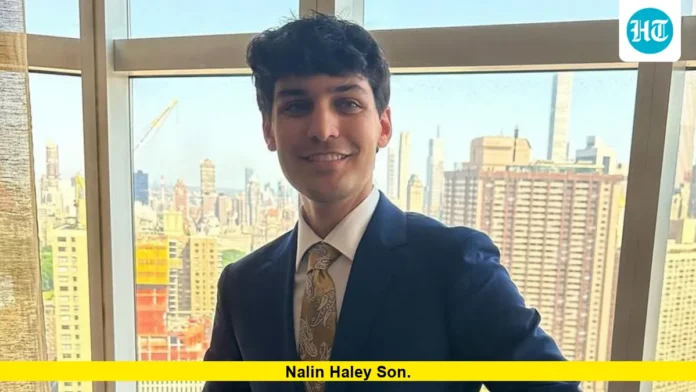
Nalin Haley, the son of Indian-origin former U.S. Ambassador to the UN Nikki Haley, has publicly stated that naturalised U.S. citizens should not be allowed to hold public office, and he has called for a limitation on foreign students in American universities.
Opening paragraph
Nalin Haley told a recent interview that naturalised U.S. citizens should not be eligible for public-office roles because “growing up here is a big part of understanding the country.” He also said the U.S. must impose stricter limits on international students, claiming that “some of them are spies for foreign governments.”
Background on Nalin Haley
- Nalin Haley was born in 2001 and is the younger son of Nikki Haley and her husband, Michael Haley.
- His mother, Nikki Haley, served as Governor of South Carolina and later as U.S. Ambassador to the United Nations.
- Although Nalin is not currently holding public office, his commentary in recent weeks has gained media attention.
- His heritage is rooted in the Indian-American community through his mother’s Punjabi-Sikh background.
What he said: Key positions
- Naturalised citizens & public office — Nalin declared that “naturalised citizens should not be able to hold public office.” He argued that only those born and raised in the U.S. have the foundational understanding needed for public service.
- Dual citizenship and military service — He stated that dual citizenship “is the stupidest idea” and claimed any American citizen serving in another country’s military should be disqualified.
- Foreign students in U.S. universities — He asserted that the U.S. should cap the number of foreign students in its universities, arguing that “some of them are spies for foreign governments.” He added that American students should be prioritised.
- Broader immigration and visas — He has voiced opposition to current legal immigration flows and certain visa programmes, stating that his fellow graduates are facing job-market disadvantages.
Reactions and broader implications
- His comments have sparked a strong reaction online, with many questioning the logic and fairness of barring naturalised citizens from office given the U.S. economy and politics’ historic reliance on immigrants.
- The remarks land amid ongoing U.S. debates around citizenship, immigration policy, and national identity. His stance signals a more hard-line “America-first” viewpoint.
- For U.S. audiences, the idea of excluding naturalised citizens from public office would represent a major shift in eligibility norms. Currently, many public‐office roles (state and local) allow naturalised citizens.
- Universities may face scrutiny if the claims about international students being “spies” gain traction; this could influence policy discourse on foreign student visas and campus security.
Why it matters
- Citizenship rights: Naturalised citizens legally enjoy full citizenship status, but Nalin’s stance challenges that by suggesting a tiered eligibility for leadership roles.
- Political eligibility: The U.S. Constitution requires “natural‐born” citizenship only for the presidency. Nalin’s proposal would go much further than current requirements for most offices.
- Education policy & national security: The linkage he draws between international students and national security frames higher education as an arena of geopolitical risk, which may affect policy debates.
- Generational & identity politics: As someone born in 2001, Nalin takes up a voice in younger conservative circles, potentially shaping how Gen Z engages with immigration and American identity debates.
Timeline of key events
| Date | Event |
|---|---|
| Nov 2025 | Nalin Haley’s interview airs, where he outlines his views on public office eligibility, dual citizenship, foreign students, and immigration. |
| Immediately | Social media reacts to his remarks, with both support and criticism from different U.S. and diaspora communities. |
| Ongoing | Discussion intensifies around citizenship, eligibility for public office, and how foreign student programs should be managed in the U.S. |
Conclusion
Nalin Haley’s commentary — that naturalised U.S. citizens should not hold public office and that foreign students in U.S. universities should be limited — raises provocative questions about citizenship, eligibility, and national loyalty in America. His lineage and public platform mean his views are being watched closely. Whether these views translate into broader political policy remains uncertain.
Join the conversation—what do you think about his stance? Feel free to comment below and stay tuned for further updates.

