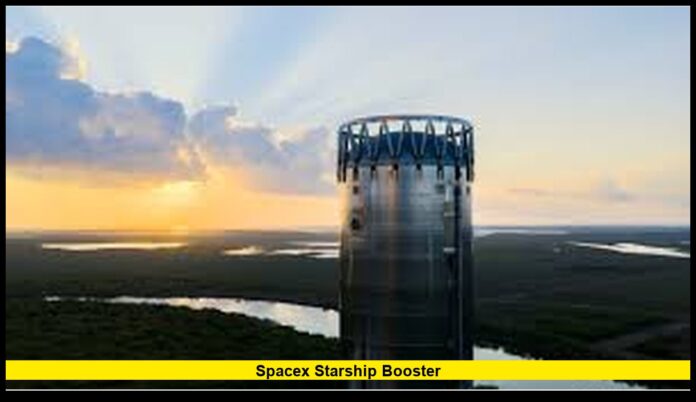
The spacex starship booster known as Booster 18 experienced a major structural failure during a pressure proof test at SpaceX’s Starbase facility in South Texas on November 21, 2025. The incident abruptly halted work on the company’s newest Super Heavy design and triggered an internal review of the booster’s updated systems.
Booster 18 is the first of the Version-3 Super Heavy lineup, featuring reworked structures and plumbing meant to improve reliability and performance. The damage occurred shortly after the vehicle was placed on a test stand for early system checks. Despite the severity of the rupture, no engines were installed and no injuries were reported.
Table of Contents
Overview of the Nov. 21 Booster Event
Booster 18 had rolled out for its first round of ground evaluations, which included pressurization tests of its gas and tank systems. During the test window, the lower section of the booster ruptured. Images and footage captured from public observation areas showed the tank shell split along its lower bands, with visible tearing that indicated a sudden over-pressure event.
The failure ended the test immediately. SpaceX personnel cordoned off the area while recovery teams inspected the damaged components.
What Makes Booster 18 Significant
Booster 18 is the introductory model for SpaceX’s Version-3 Super Heavy architecture. The company has steadily increased performance goals for Starship, and this booster incorporates several upgrades, including:
- Stronger tank materials
- Revised internal plumbing
- A redesigned interface for propellant delivery
- Structural changes to support future high-thrust engine sets
This version was expected to support upcoming integrated Starship flights once ground qualification tests were completed.
Timeline of the Incident
November 20, 2025
Booster 18 arrived at the test area after undergoing initial inspections at the build site.
Early November 21, 2025
Ground crews began a pressure proof test to assess the booster’s structural limits under controlled conditions.
Later that morning
A rupture occurred in the lower tank region, sending debris outward and causing visible deformation to the structure. The booster remained upright, but the lower section showed severe damage.
The Technical Side of the Failure
A pressure proof test is designed to verify tank integrity before introducing cryogenic propellants. It applies internal pressure to ensure the booster can withstand operating loads.
When a tank fails during one of these tests, it usually points to issues such as:
- Weak welds
- Structural inconsistencies
- Faults in new plumbing routes
- Problems with material bonding
- Incorrect pressure thresholds within test procedures
Because Booster 18 introduces several new elements, the failure is likely tied to the updated design rather than the test stand or external hardware.
The booster did not contain fuel, and its engines had not yet been installed, reducing the risk of fire or explosion.
Impact on the Starship Program
SpaceX has been targeting frequent Starship flight tests as part of its development strategy. A fully validated Version-3 booster would help support higher-capacity missions and faster turnaround.
The setback affects short-term schedules in several ways:
- Test windows for static fires may shift
- Another booster might need reassignment for upcoming flights
- Starbase ground operations could be reorganized to accommodate repairs
- Engineers must evaluate all Version-3 systems to confirm whether changes are needed across future builds
SpaceX is known for rapid iteration, but large-scale structural repairs or redesigns can extend development timelines.
Regulatory and Local Oversight
The Starbase launch and test site operates under close review. Ground-test incidents typically require documentation and follow-up evaluations to ensure continued safety for workers and the surrounding area.
While the event did not involve hazardous fuel or flight hardware, the size of the rupture makes it a notable occurrence for both regulators and local officials monitoring Starbase activity.
SpaceX’s Initial Response
SpaceX confirmed that the booster experienced a malfunction during its pressure testing sequence and that the root cause is being investigated. Engineers are now reviewing structural data, weld inspections, pressure logs, and video records to determine what triggered the failure.
Decisions still need to be made regarding whether Booster 18 can be repaired or whether a replacement booster will take its place in the Version-3 lineup. Similar past incidents have resulted in full scrapping of specific test vehicles, though each case differs.
How This Event Fits Into Starship Development History
Starship’s development has included several dramatic moments, including successful launches and notable test failures. Ground testing is often where weaknesses appear, and the company has repeatedly used failures as learning tools to strengthen the next iteration.
Booster 18’s failure highlights:
- The challenges of scaling up hardware
- The importance of tank integrity during early testing
- The high-risk, fast-iteration method SpaceX relies on
Every rupture, fire, or anomaly provides real-world data that shapes the next design cycle.
What Comes Next
In the coming weeks, observers expect:
- Engineering updates on the cause of the rupture
- A determination on whether Booster 18 will be repaired
- Rollout progress for other Super Heavy boosters
- A potential adjustment to upcoming Starship integrated flights
Starbase activity tends to move quickly, so new developments are likely to emerge soon as SpaceX evaluates the best path forward.
Continuing Attention on the spacex starship booster Program
The spacex starship booster remains central to SpaceX’s long-term plans, and Version-3 represents a major step in that direction. Although the Nov. 21 event is a setback, it is also part of the company’s iterative approach, which embraces rapid testing and redesign to accelerate progress.
Have thoughts on this development? Drop a comment below and stay tuned for more verified updates.

