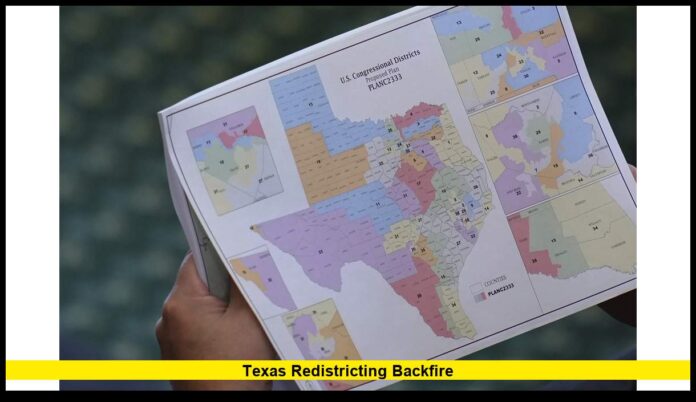
The Texas redistricting backfire is becoming one of the biggest political stories ahead of the 2026 elections. As of November 2025, state leaders are facing growing legal challenges and shifting demographics that could reshape Texas politics. What began as a plan to strengthen Republican control may now be creating more uncertainty than stability.
Table of Contents
Court Challenges Put Pressure on State Leaders
Texas lawmakers drew new political maps in 2021 after the U.S. Census showed the state gained two additional congressional seats due to rapid population growth. Most of that growth came from Hispanic, Black, and Asian communities. Yet the final maps, created by the Republican-led legislature, gave both new districts to GOP-leaning areas.
Civil rights groups immediately filed lawsuits, claiming the new maps violated the Voting Rights Act by weakening minority voting power. A federal court in San Antonio allowed several of these cases to move forward in 2023, signaling that the issue remains unresolved.
This year, those legal cases are coming to a head. Judges are reviewing whether the state intentionally drew districts to favor one party and reduce minority influence. The Department of Justice has also joined the legal fight, adding more weight to the ongoing battle.
If the courts rule against the state, Texas could be forced to redraw its maps again — possibly before the 2026 midterm elections.
Why Analysts Say the Strategy May Have Backfired
When the current maps were created, Texas Republicans sought to protect their majority by consolidating power in rural and suburban districts. But three key factors now suggest that the plan could backfire:
- Demographics Are Changing Fast.
Texas’ population growth continues to come mostly from minority communities. Many of those new residents live in urban and suburban areas like Houston, Austin, Dallas, and San Antonio. These regions are increasingly competitive and trending away from the GOP. - Courts Are Scrutinizing the Process.
Federal judges have questioned whether the maps intentionally diluted minority votes. Even a small change to district boundaries could make several Republican-held seats far more competitive. - Internal Divisions Are Growing.
Disagreements within the Texas GOP — especially on issues like immigration and education — are creating cracks in voter support. Suburban voters who once leaned conservative are shifting toward moderate or independent candidates.
The result is a tense political landscape. What was meant to solidify control may instead make several seats vulnerable to Democratic challenges in 2026.
How the Maps Were Drawn
During the 2021 redistricting process, Texas lawmakers prioritized safe Republican districts. Despite booming growth in diverse regions, mapmakers divided communities to protect existing incumbents.
Key examples include:
- Houston Area: Diverse neighborhoods were split across districts, reducing the collective strength of Hispanic and Black voters.
- Austin Region: The city was divided into multiple districts stretching into Republican rural areas, limiting Democratic influence.
- Dallas-Fort Worth Metro: Fast-growing Hispanic suburbs were broken up across districts to preserve GOP advantages.
Critics argue that these boundaries do not reflect the state’s population changes and fail to represent growing communities fairly.
Federal Court Review and Timeline
The Western District of Texas is now handling multiple lawsuits challenging the maps for both the Texas House and U.S. congressional districts.
Here’s the current timeline:
- 2023: The court allowed Voting Rights Act lawsuits to proceed.
- 2024: Evidence was presented showing that minority populations grew, but representation did not.
- 2025: The cases entered their final phase, with rulings expected in early 2026.
If the judges determine that the maps violate federal law, Texas could be required to redraw them before the 2026 elections. That process would be fast, contentious, and closely watched nationwide.
Political Stakes for 2026
Texas currently holds 38 seats in the U.S. House of Representatives, the second most in the country. Control over even a few districts could affect which party holds power in Congress.
Several regions could shift if the courts order new maps:
- Houston Suburbs: Minority voter strength could increase, making several Republican seats more competitive.
- Austin-San Antonio Corridor: Rapid growth could lead to a newly drawn district leaning Democratic.
- Dallas-Fort Worth Region: Adjustments could expand opportunities for Latino and Black representation.
Republicans remain dominant in statewide offices, but losing even a handful of congressional or legislative seats could signal a significant shift heading into the next decade.
Reactions Across the Political Spectrum
State leaders have strongly defended the maps, calling them “fair and legal.” They argue that district lines were based on traditional redistricting standards, such as population balance and geographic compactness — not racial or partisan factors.
Democrats and advocacy groups disagree. They contend that the maps ignore demographic realities and silence communities that have driven the state’s growth. Civil rights organizations, including the NAACP Legal Defense Fund and MALDEF, continue to lead legal challenges.
For voters, the issue has become about more than party politics. Many Texans — regardless of affiliation — have expressed frustration over the lack of transparency in how the maps were drawn.
Why Texas Keeps Facing Redistricting Controversies
Texas has faced redistricting disputes for decades. Courts have repeatedly ruled that past maps violated federal law by discriminating against minority voters.
- In 2011, federal judges struck down several maps for intentional discrimination.
- In 2018, the U.S. Supreme Court reviewed another challenge but declined to require major revisions.
- Now, in 2025, the same arguments are resurfacing once again — showing how redistricting remains one of the state’s most persistent political battles.
The outcomes of these cases could set new national precedents for how states redraw political boundaries after each census.
Growing National Interest
Texas’ redistricting battles have drawn attention beyond the state. Similar disputes are unfolding in Alabama, Louisiana, Georgia, and Florida, where courts are also examining racial fairness in political maps.
The U.S. Supreme Court’s recent decisions in these states have strengthened the Voting Rights Act’s protections, which could influence the Texas case as well.
Because Texas has one of the largest congressional delegations, any map change could shift the balance of power in Washington. Political analysts say the state’s redistricting outcomes may help determine control of Congress in 2026 and beyond.
Changing Voter Landscape
Beyond the courtroom, Texas is undergoing a quiet transformation. The state’s cities are expanding rapidly, suburban populations are diversifying, and younger voters are registering in record numbers.
- Harris County (Houston area) now reflects one of the most diverse populations in the country.
- Travis County (Austin) continues to lean strongly Democratic.
- Collin and Denton Counties (north of Dallas) are shifting from solid red to purple.
These changes make it increasingly difficult for any political map to guarantee long-term control. Even without court-ordered redrawing, population trends alone are likely to reshape Texas politics over the next decade.
Looking Ahead
The federal court’s ruling, expected in early 2026, could determine whether new maps must be drawn before the election cycle begins. Both parties are preparing for every possible outcome.
Republicans are working to mobilize rural voters and maintain strong turnout. Democrats are focusing on voter registration drives and local outreach in fast-growing urban areas.
No matter how the legal case concludes, the political consequences will be significant. Texas’ growing diversity and national influence ensure that its redistricting debate will remain a defining story for years to come.
As Texas awaits the court’s decision, the question remains — will the 2021 redistricting plan strengthen political control or ultimately backfire? Share your thoughts below and join the conversation.

