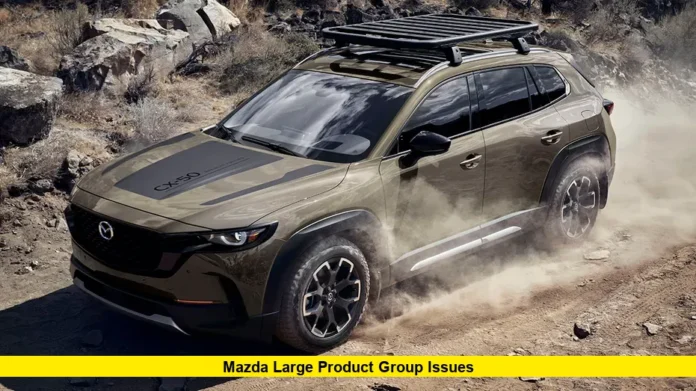
The term “Mazda Large Product Group issues” has entered the spotlight as Mazda confronts challenges tied to its new “Large Product Group” platform and its rollout in the U.S. market. In recent updates, Mazda has publicly acknowledged specific drivability concerns with early plug-in hybrid versions of its large platform SUVs, signaling that the issues are real and actively being addressed.
What the “Large Product Group” means
Mazda’s “Large Product Group” refers to its architecture for its larger vehicles—primarily SUVs with two-row or three-row seating—such as the Mazda CX-90 and its kin. This platform features longitudinal engine layouts, rear-wheel drive bias, and offers electrified powertrains including plug-in hybrid (PHEV) options. The CX-90 and related models are positioned to compete in more premium segments of the U.S. auto market.
Key Issues Emerging for U.S. Buyers
The core concerns that fall under Mazda Large Product Group issues include:
- Drivability & calibration problems: Mazda has admitted that some early examples of the large-platform vehicles, especially those with PHEV systems, suffered from less refined driving dynamics compared with customer expectations.
- Testing and development pressures: The company cited pandemic-era conditions and accelerated launch timelines as factors that contributed to limited real-world calibration prior to U.S. market introduction.
- Brand risk and market positioning: Mazda’s move into higher-priced, larger vehicles increases buyer expectations. If the driving experience, service support or reliability fall short, the brand’s reputation in this premium SUV space could face headwinds.
- Model rollout timing and availability: Some of the new large-platform vehicles are being introduced across different regions at different times, creating potential inconsistencies in features, variants or support for U.S. customers.
Why these issues matter now
For U.S. consumers considering one of Mazda’s newer large SUVs, the Mazda Large Product Group issues highlight important practical implications:
- Resale value may be impacted if early deliveries carry refinement or reliability risks.
- Hybrid performance (PHEV) must meet expectations for smoothness and quality; any compromise here will affect buyer satisfaction.
- In the U.S., competing vehicles from established premium brands already hit high marks for seamless electrified performance; Mazda must shore up the areas identified to maintain competitiveness.
- Service networks and dealer support will face additional demands if early platform models require more calibration or updates.
Mazda’s Response and What’s Being Done
Mazda has taken several steps to mitigate these concerns:
- Acknowledgement: The company publicly recognised the drivability issues on the large platform, signalling transparency.
- Enhanced focus on calibration/testing: Mazda has indicated that future large-platform batches will undergo more rigorous real-world tuning to avoid repeat issues.
- Platform strategy refinement: As part of its wider electrification push, Mazda is aligning its large platform rollout with stricter development timelines and quality-control protocols.
Tips for U.S. Buyers Considering a Large Platform Mazda
If you’re evaluating a Mazda SUV built on the large-product-group architecture, keep these points in mind:
- Confirm whether the particular vehicle is an early production unit of the large-platform rollout (which may carry higher risk of initial issues).
- Ask a dealer about any software updates, calibration fixes or service bulletins applied to the model you’re considering.
- Compare the vehicle against other large SUVs with electrified variants to ensure the driving experience meets your expectations for this segment.
- Consider waiting for a slightly later model year if you’re cautious about early-adopter risk; by then early refinement kinks may have been worked out.
Conclusion
The phrase “Mazda Large Product Group issues” encapsulates the growing scrutiny around Mazda’s ambitious expansion into larger, electrified SUVs on its new large-vehicle architecture. By acknowledging the early drivability and calibration concerns, Mazda has taken the first step toward correction. For U.S. buyers, the key now will be verifying that the vehicle you’re interested in reflects the improvements and refinements the brand has pledged.
If you’ve experienced one of Mazda’s large-platform vehicles, or you’re thinking about buying one, share your thoughts in the comments and stay tuned for further updates.

