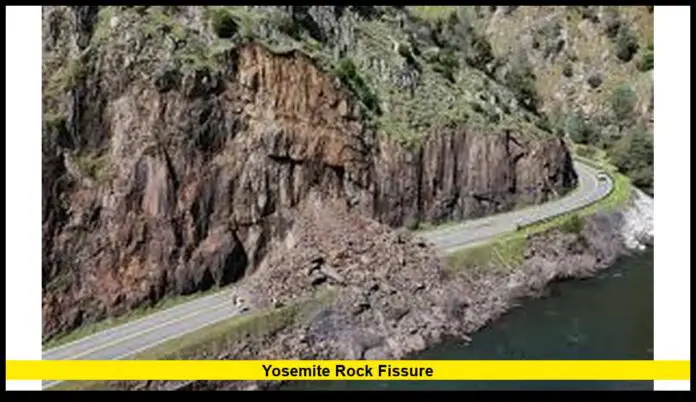
The Yosemite rock fissure first identified near Royal Arches in Yosemite National Park has continued to attract attention in 2025 as scientists and park officials monitor its stability. The fissure, discovered by climbers and confirmed by geologists in late 2023, led to the closure of several popular climbing routes and areas for safety reasons. Recent updates from the National Park Service confirm that portions of the area remain restricted as new monitoring technology tracks ongoing shifts in the granite walls.
Table of Contents
Discovery of the Fissure
The fissure was first detected in August 2023 above the Royal Arches climbing area, one of Yosemite Valley’s most iconic granite formations. The discovery came after climbers reported unusual cracking sounds and visible separations in the rock face. Subsequent inspections by Yosemite park geologists confirmed that a significant crack — several dozen feet long — had developed in the granite slab.
The fissure runs along a section of the Royal Arches formation near the North Dome Gully. Experts determined that the rock mass was at risk of detachment, prompting the park to close several popular climbing routes immediately. These closures included Royal Arches Route, North Dome Gully, and Serenity Crack, among others.
This area is known for its steep terrain and history of rockfall, but the size and location of the fissure made it particularly concerning.
Ongoing Monitoring and Safety Efforts
In 2025, Yosemite National Park continues to monitor the fissure using advanced remote sensing and laser scanning technology. These tools measure minute movements in the rock surface to determine whether the crack is widening or deepening.
Officials from the U.S. Geological Survey (USGS) and the National Park Service have worked together to install sensors that provide real-time data. The monitoring system helps detect early warning signs of rock instability and allows the park to manage risk more effectively.
The park’s geologists reported that the fissure has shown minor seasonal movement, mostly linked to temperature fluctuations and water infiltration. However, as of November 2025, there is no immediate risk of large-scale collapse, though caution remains the priority.
Park ranger Scott Gediman, Yosemite’s long-time spokesperson, stated earlier this fall that “the area remains under close observation, and visitor safety comes first. Climbers and hikers should continue respecting all area closures.”
Why Rock Fissures Form in Yosemite
Yosemite’s dramatic granite cliffs — including El Capitan, Half Dome, and Cathedral Spires — were formed over millions of years through tectonic uplift, glacial erosion, and weathering. While they appear solid and immovable, these formations are constantly shaped by natural processes.
Cracks and fissures typically develop through a combination of:
- Thermal stress: Daily temperature changes cause rock to expand and contract, gradually widening natural fractures.
- Freeze-thaw cycles: Water seeps into cracks and expands when it freezes, exerting pressure that forces the rock apart.
- Seismic activity: Small earthquakes or vibrations can trigger movement in existing fractures.
- Gravity and erosion: Over time, the weight of granite slabs and the pull of gravity can cause large sections to separate.
In Yosemite, these forces are amplified by steep terrain and exposed cliff faces, making rockfalls and fissures a natural, ongoing part of the landscape’s evolution.
Past Rockfall Events in Yosemite
The Yosemite rock fissure isn’t the park’s first encounter with significant rock movement. The park has a long history of rockfalls that have shaped both the physical and safety landscape of the valley.
Some notable examples include:
- October 2017: A massive rockfall on El Capitan killed one climber and injured another. The event dislodged over 1,000 tons of granite.
- September 2014: Another major rockfall in the same area damaged parts of the park’s trail network.
- 2009 and 2010: Rockfalls near Curry Village (now Half Dome Village) led to the relocation of several cabins after repeated events threatened visitor safety.
These incidents highlight why Yosemite’s geologists treat new fissures with extreme caution. While such events are natural, their unpredictability requires constant vigilance.
Closures and Access Restrictions
As of late 2025, the Royal Arches area remains partially closed, with no set reopening date. The restricted zones include climbing routes and nearby hiking trails where falling rock could pose a danger.
Updated signs and park advisories direct visitors away from the unstable sections. Park management has emphasized that the closures are temporary but necessary until long-term data confirms the fissure’s stability.
Climbing groups and local outfitters have generally supported the precautions, acknowledging the importance of safety over access. Many have redirected their activities to other parts of the park, such as Tuolumne Meadows, Cathedral Peak, and El Capitan’s safer routes, which remain open.
Scientific Insights and Geological Research
The fissure’s development has provided researchers with a rare opportunity to study Yosemite’s granite in real time. Scientists are using this event to better understand how large rock formations respond to environmental stress.
The data collected has already offered insights into:
- Micro-movements in granite: Even seemingly solid rock can shift by millimeters due to temperature and moisture changes.
- Impact of climate variability: Wetter winters and hotter summers have intensified freeze-thaw cycles, contributing to the formation of new cracks.
- Early-warning systems: Continuous digital monitoring helps predict when cracks may evolve into hazardous fractures.
These findings are being incorporated into broader research on rockfall hazards in national parks, ensuring that lessons learned in Yosemite can be applied to other regions with similar geology, such as Zion and Grand Canyon National Parks.
Visitor Safety and Park Recommendations
Yosemite National Park urges all visitors to stay updated on current closures and advisories before visiting. Official updates are posted at entrance stations, visitor centers, and the park’s online channels.
For hikers and climbers, the park recommends:
- Checking daily bulletins on restricted zones.
- Avoiding any approach to the Royal Arches and North Dome Gully areas.
- Listening for cracking sounds or falling debris when near cliffs.
- Reporting unusual rock activity to rangers immediately.
Visitors are also encouraged to stay on designated trails and avoid shortcuts that lead beneath exposed granite walls. The park emphasizes that while rockfalls are rare, they can happen without warning.
Balancing Access and Preservation
Yosemite’s management faces the ongoing challenge of balancing public access with environmental and geological safety. The park welcomes millions of visitors each year, many drawn by its towering granite walls and world-class climbing routes.
The current situation highlights the delicate relationship between human recreation and natural processes. Park officials stress that closures are not meant to limit enjoyment but to preserve both human safety and the integrity of the natural landscape.
Meanwhile, the park continues investing in geotechnical research, collaborating with universities and the U.S. Geological Survey to monitor rock behavior using drone mapping, 3D modeling, and motion sensors. These efforts aim to reduce risk while allowing future visitors to safely experience Yosemite’s iconic formations.
Looking Ahead
As of November 2025, the Yosemite rock fissure remains under active surveillance. While the area is stable for now, park scientists will continue monitoring through winter and spring — periods when freeze-thaw cycles are most intense.
The long-term goal is to reopen the closed areas once the fissure shows consistent inactivity. Until then, the park continues to prioritize data collection and public safety, reinforcing Yosemite’s reputation not only as a natural wonder but also as a living laboratory for geology.
Yosemite’s beauty comes with constant change — a reminder that even the strongest rock evolves over time. Have you visited the park recently or noticed any changes? Share your experience below and join the discussion.

