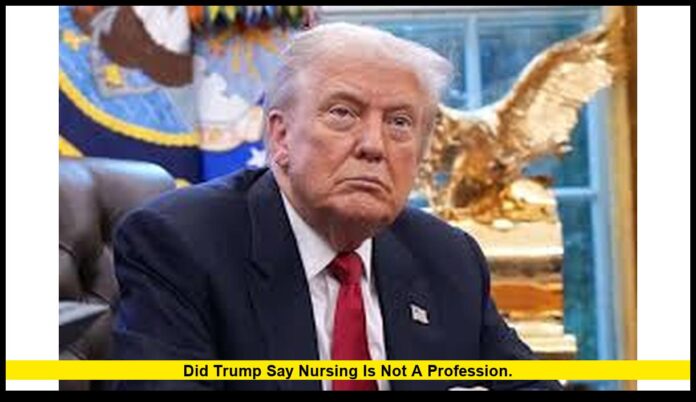
Did Trump say nursing is not a profession? In recent days this question has spread across social media and news feeds, prompted by a regulatory change by the U.S. Department of Education tied to the One Big Beautiful Bill Act (OBBBA). While there is no documented instance of former President Donald Trump uttering that precise phrase, the controversy revolves around the re-classification of nursing programs and what counts as a “professional degree” for federal student-loan purposes.
Table of Contents
What’s happening
Under the new rulemaking tied to the OBBBA, the Education Department has formally changed how it defines “professional degree” programs. Programs in nursing — including advanced practice nursing and post-baccalaureate nursing tracks — have been excluded from the “professional degree” designation as defined for the purposes of higher federal borrowing limits. This means that nursing students and advanced nursing programs will fall under stricter loan caps and lose certain benefits previously associated with professional-degree status.
Why people believe Trump “said” nursing isn’t a profession
The confusion stems from headlines and commentary framing the policy shift as if it were a direct statement from Trump about the nursing field’s worth. The regulation is a technical change tied to student-loan eligibility, but many interpret or represent it as a broader dismissal of nursing as a “profession.” Nursing associations themselves have voiced strong concern that the rule treats nursing differently from law, medicine and other fields historically labelled as professional degrees.
Clarifying the record
- There is no found instance of Trump himself stating “nursing is not a profession.”
- The change originates in the regulation by the Education Department, not a speech or quote from Trump.
- Nursing programs will still lead to licensure and practice, but for loan-cap purposes they will no longer qualify under the “professional degree” category that enables higher federal borrowing.
- Nursing organizations argue the timing is harmful: the U.S. already faces a significant nursing shortage, and any barrier to graduate-level nursing education could aggravate workforce gaps.
What changed for federal student-loans
From a practical standpoint, here’s how the new rules will affect nursing students:
- Graduate students in nursing who would previously access higher borrowing limits under “professional degree” status will now be subject to stricter caps.
- The definitions now list typical professions such as medicine, dentistry, pharmacy, law, etc., under “professional degree” status; nursing, physician assistant programs, physical therapy and some others are excluded.
- The changes are slated to take effect July 1 2026 for new borrowers, meaning prospective nursing-students and current enrollees must assess the impact.
Why nursing organizations are raising alarm
- Nursing educators say advanced nursing degrees (nurse practitioner, nurse educator) build capacity for both care delivery and training more nurses — and restricting them could limit that pipeline.
- Many prospective or current nursing students already manage high tuition burdens; the loan caps may force more students to either take on private debt, delay education, or pursue different careers.
- With thousands of U.S. hospitals reporting nurse-staffing shortages and many rural/underserved areas lacking advanced nursing clinicians, any additional barrier may have ripple effects on patient care.
What to watch
- The Education Department’s formal rule-text in the Federal Register that will finalize the definition of “professional degree” and the loan eligibility criteria.
- Responses from the American Nurses Association (ANA), the American Association of Colleges of Nursing (AACN) and state nursing associations — including potential legal or legislative action.
- Guidance from university financial-aid offices for nursing programs, which will update students on how the new classification affects borrowing.
- Data on nursing program enrollment, especially in advanced practice and educator tracks — changes in those numbers may reflect an impact from the new rule.
Bottom line
So, to answer the question: Did Trump say nursing is not a profession? — no, there is no verified quote from Trump stating that nursing is not a profession. Instead, what occurred is a regulatory redefinition from the Education Department under the Trump administration that excludes nursing from the category of “professional degree” for federal student-loan purposes. That technical change has sparked controversy, particularly among nursing educators and workforce advocates, because of its potential to hinder funding access for nursing students at a time when the U.S. healthcare system depends critically on their expansion.
If you’re considering nursing school or advising someone who is, keep a close eye on financial-aid updates and institutional announcements regarding the rule’s implementation.
Bold closing line: Want to share your perspective or experiences with nursing education and loan access under these changes? Leave a comment below and stay tuned for further updates.

