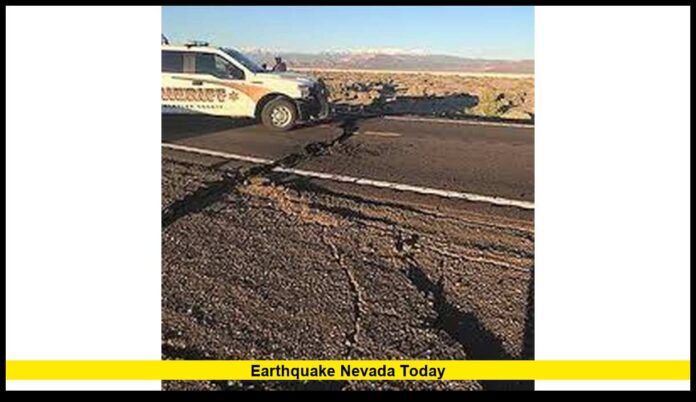
The earthquake Nevada today brought fresh attention to the state’s active seismic zones after a moderate tremor was recorded early Thursday morning, December 4, 2025. The U.S. Geological Survey (USGS) confirmed that a magnitude 4.6 earthquake struck near Tonopah, Nevada, shortly after 5:42 a.m. Pacific Time, rattling homes and businesses across several western counties.
Table of Contents
Earthquake Details: Magnitude and Location
According to the latest data from the USGS Earthquake Hazards Program, the 4.6-magnitude earthquake occurred approximately 19 miles southeast of Tonopah, in Nye County, Nevada. The quake originated at a depth of 8.9 kilometers (5.5 miles), which is considered relatively shallow—making it more likely to be felt at the surface.
Shaking was reported across a wide area, including Tonopah, Goldfield, Hawthorne, and parts of Bishop, California. Residents described a strong jolt followed by light rolling motion lasting several seconds.
Key Facts:
- Magnitude: 4.6
- Time: 5:42 a.m. PT, Thursday, December 4, 2025
- Epicenter: 19 miles southeast of Tonopah, Nevada
- Depth: 8.9 km (5.5 miles)
- Nearest City: Tonopah, population ~2,400
- Felt Reports: More than 1,100 submitted to the USGS “Did You Feel It?” system as of noon
No major structural damage or injuries have been reported as of mid-day. Emergency management officials in Nye County confirmed that teams inspected local infrastructure and found no significant damage to bridges, roads, or utilities.
Aftershocks and Seismic Activity
USGS analysts have confirmed several small aftershocks following the main event. The largest, a magnitude 2.9 tremor, occurred about 25 minutes later, centered in the same general region.
Experts note that this area of western Nevada is part of the Walker Lane Seismic Belt, a zone of crustal movement that absorbs about 20–25% of the tectonic strain between the Pacific and North American plates. The Walker Lane runs roughly parallel to the San Andreas Fault but extends through eastern California and western Nevada.
Residents in this corridor are accustomed to mild-to-moderate earthquakes, but Thursday’s tremor was one of the stronger events recorded near Tonopah this year.
State and Local Response
The Nevada Seismological Laboratory at the University of Nevada, Reno (UNR), confirmed that the shaking was “moderate but noticeable.” Local emergency services in Tonopah, Goldfield, and nearby rural communities reported no calls related to injuries or fires, though a few residents contacted officials about cracked plaster and minor property vibration.
Nevada Department of Transportation (NDOT) engineers conducted precautionary checks on U.S. Route 95—the main highway corridor running through Tonopah—and found no visible damage or closures. Power remained uninterrupted throughout the region.
Emergency management officials reminded residents that Nevada ranks third in the United States for seismic activity, behind California and Alaska. Preparedness efforts are ongoing statewide, especially in western and southern Nevada where faults are more active.
Expert Insights: Understanding Nevada’s Earthquake Risk
Geologists emphasize that Nevada’s position along the Basin and Range Province makes it naturally prone to earthquakes. The state experiences hundreds of small tremors each year, most of which go unnoticed. However, the region has also seen significant historical earthquakes that serve as reminders of its seismic potential.
Notable past events include:
- 1932 Cedar Mountain Earthquake – Magnitude 7.2, one of the largest in Nevada’s history.
- 1954 Dixie Valley–Fairview Peak Earthquake Sequence – Magnitudes 6.6 and 7.1 within minutes of each other.
- 2020 Monte Cristo Range Earthquake – Magnitude 6.5 near Tonopah, damaging highways and causing rockfalls.
Thursday’s 4.6-magnitude quake is minor by comparison, but scientists say it highlights the state’s ongoing tectonic activity. The USGS notes that smaller earthquakes can sometimes act as stress releases that prevent larger ones, though no evidence currently suggests a significant event is imminent.
Community Reactions Across Western Nevada
Residents across Nye County and neighboring regions reported feeling the shaking early in the morning, with many describing the quake as a single strong jolt followed by light rumbling.
Local business owner James Carter of Tonopah said he was opening his store when the tremor hit. “The shelves rattled, but nothing fell. You could definitely feel it—it felt like a truck hitting the building,” he said.
Social media posts from nearby communities like Hawthorne and Goldfield show residents sharing similar experiences, with some noting pets becoming anxious moments before the shaking began—a common occurrence during seismic activity.
Several schools and public offices briefly activated safety protocols before resuming normal operations once the all-clear was given.
Preparedness and Safety Recommendations
Emergency officials used the event as a reminder for residents to review their earthquake preparedness plans. Even though Nevada earthquakes are typically moderate, experts recommend the following precautions:
Before an Earthquake:
- Secure heavy furniture and wall hangings.
- Keep an emergency kit with food, water, flashlights, and first-aid supplies.
- Review family emergency plans and meeting points.
During an Earthquake:
- Drop, Cover, and Hold On.
- Stay indoors until the shaking stops.
- Move away from windows, mirrors, and heavy objects.
After an Earthquake:
- Check for gas leaks, water damage, and structural cracks.
- Expect aftershocks for hours or days following the main quake.
- Follow updates from local authorities and the USGS Earthquake Map for real-time information.
The Nevada Division of Emergency Management reaffirmed its commitment to ongoing earthquake awareness programs. Statewide drills, such as the Great Nevada ShakeOut, continue to educate residents on safety procedures each year.
No Disruptions to Transportation or Utilities
Following inspections Thursday morning, transportation and utility networks in western Nevada remained operational.
- Roads: U.S. Route 6 and U.S. Route 95 are open with normal traffic flow.
- Airports: Tonopah Airport (TPH) and nearby regional airfields reported no interruptions.
- Utilities: No power, gas, or water outages have been confirmed in Nye or Esmeralda counties.
The Nevada Department of Public Safety stated that the region’s earthquake response protocols worked efficiently, ensuring quick assessments and public reassurance.
Seismologists Monitoring for Additional Activity
As of Thursday afternoon, seismic instruments across Nevada and eastern California continue to record minor aftershocks. Experts from UNR and the USGS are analyzing data to determine whether this morning’s event fits within a larger fault adjustment sequence.
Dr. Graham Kent, director of the Nevada Seismological Laboratory, noted that this level of activity is consistent with the region’s typical stress release patterns. “We don’t see indications of escalating activity at this time, but we’ll continue monitoring the area closely over the next 48 hours,” he said.
The USGS ShakeMap shows the strongest intensity readings centered near Highway 95, with lighter shaking felt as far north as Fallon and south toward Pahrump.
A Calm But Important Reminder
While the earthquake Nevada today caused no major harm, it serves as an important reminder that the Silver State remains seismically active. Residents are encouraged to remain alert, check emergency kits, and stay informed through official updates.
As Nevada continues to grow in population and infrastructure, awareness and preparedness remain key to minimizing risks when future quakes strike.
Even minor earthquakes like today’s event remind us that preparedness saves lives. Stay aware, stay safe, and stay ready for whatever nature brings next.

