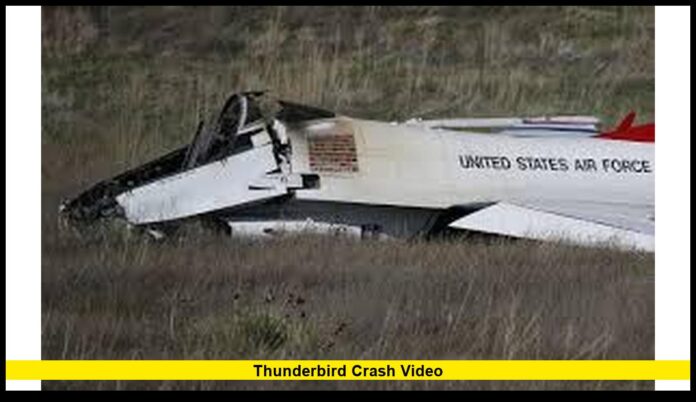
The Thunderbird crash video circulating online this week has drawn nationwide attention after a U.S. Air Force F-16 Fighting Falcon from the Thunderbirds demonstration team went down during a routine training exercise in southern Nevada.
The incident occurred on Wednesday, December 3, 2025, near Creech Air Force Base, roughly 50 miles northwest of Las Vegas. The pilot successfully ejected from the aircraft before impact and was later transported to a nearby military hospital for evaluation. Officials have confirmed that the pilot sustained non-life-threatening injuries.
Table of Contents
Details of the Thunderbird Crash
The U.S. Air Force released an official statement early Thursday morning confirming the crash. The F-16 Fighting Falcon, assigned to the elite U.S. Air Force Air Demonstration Squadron, was conducting an aerial training maneuver when the pilot experienced mechanical issues.
Eyewitnesses near the Nevada Test and Training Range reported seeing the jet flying unusually low before it nosedived toward an unpopulated area. Moments later, a parachute was seen deploying — later confirmed to be the pilot ejecting safely.
Emergency crews responded immediately to the crash site. The area has been secured by Air Force personnel while investigators from Nellis Air Force Base and the Air Force Safety Center begin examining the wreckage.
Key Details at a Glance
| Information | Details |
|---|---|
| Incident Date | December 3, 2025 |
| Location | Near Creech Air Force Base, Nevada |
| Aircraft Type | F-16C Fighting Falcon |
| Squadron | U.S. Air Force Thunderbirds |
| Pilot Status | Ejected safely, non-life-threatening injuries |
| Ground Damage | None reported |
| Investigation | Ongoing by Air Force Safety Center |
Thunderbird Crash Video Goes Viral
Within hours of the crash, multiple clips surfaced online showing the incident from different angles. The Thunderbird crash video appears to capture the jet’s descent, a flash of light as it impacts the desert terrain, and a plume of smoke rising from the site.
Some of the footage, believed to have been filmed by bystanders traveling along U.S. Highway 95, quickly went viral across social media platforms like X (formerly Twitter), TikTok, and Instagram.
Military officials have urged the public to avoid sharing unverified clips or speculation, emphasizing that the crash investigation is still active. Verified segments of the video, released by local authorities, confirm that the pilot ejected seconds before impact — a critical factor credited with saving their life.
Air Force and Public Response
The U.S. Air Force Thunderbirds issued an official statement expressing relief that the pilot survived and thanking first responders for their rapid assistance.
“The safety of our pilots and the public remains our top priority. We are cooperating fully with investigators to determine what caused yesterday’s mishap,” the statement read.
The Air Force Thunderbirds, based at Nellis Air Force Base, are the service’s premier aerial demonstration team. They are known for their precision flying and performances at airshows across the United States and abroad.
No civilians were injured, and no property damage was reported in connection with Wednesday’s crash. Local law enforcement and Air Force officials have secured a half-mile perimeter around the site for recovery operations.
Investigation Underway
Military investigators are now working to determine the cause of the crash. Early assessments suggest a mechanical malfunction may have contributed, but officials stress that all potential factors — including environmental conditions and human error — are being reviewed.
The Air Force Safety Investigation Board (SIB) has been activated to analyze flight data and debris. The process typically takes several weeks to complete.
Aircraft recovery crews began clearing the site Thursday morning, while specialized teams conduct environmental inspections to ensure no hazardous materials leaked from the wreckage.
Officials from Nellis Air Force Base, Creech Air Force Base, and the Federal Aviation Administration (FAA) are coordinating closely throughout the investigation.
Background: The U.S. Air Force Thunderbirds
The Thunderbirds are one of the most iconic demonstration teams in the world, performing complex aerial maneuvers in F-16 Fighting Falcons. Founded in 1953, the team showcases the professionalism, skill, and precision of the U.S. Air Force at more than 70 airshows each year.
The F-16 used by the Thunderbirds is a specially modified version of the standard combat aircraft. It features distinctive red, white, and blue livery and performs at altitudes as low as 100 feet during shows.
While crashes involving the Thunderbirds are rare, they have occurred in the past. The last reported incident before this week’s was in June 2017, when an F-16 overturned during landing at Dayton International Airport. In that case, both crew members survived.
The Air Force confirmed that all Thunderbirds aircraft will undergo standard safety checks before the next scheduled flight performance.
Eyewitness Accounts of the Crash
Residents near the Amargosa Valley area and travelers along U.S. Highway 95 described seeing the aircraft descend rapidly.
One driver, who captured part of the Thunderbird crash video, said the jet appeared to lose altitude abruptly before the pilot’s parachute became visible. “It looked like the jet just dropped. Then I saw the pilot eject — it happened so fast,” the witness recounted.
Another local resident reported hearing a loud boom followed by a column of smoke visible from several miles away.
Officials confirmed that small brush fires ignited near the impact zone but were quickly extinguished by Air Force fire crews stationed at Creech.
Public Reaction and Online Discussion
Videos of the incident have generated widespread reaction online, with thousands of users expressing relief that the pilot survived. Many fans of the Thunderbirds shared personal memories of attending their airshows, emphasizing the risks military aviators face even during training.
The Air Force has requested that anyone with firsthand video of the incident contact investigators to assist in piecing together the flight’s final moments. Verified footage may help determine when the aircraft began to experience mechanical issues.
Air Force spokespersons have also clarified that the Thunderbirds’ upcoming appearances will be reviewed after the investigation concludes, but the team remains committed to resuming performances once safety standards are confirmed.
The Role of Training Exercises
Training flights like the one conducted on December 3 are essential for maintaining precision and readiness. The Thunderbirds perform year-round rehearsals to perfect complex maneuvers that require absolute coordination.
Pilots typically complete extensive safety briefings and aircraft checks before each mission. Every Thunderbird pilot is a highly experienced Air Force officer, often with combat flying backgrounds.
While military aviation carries inherent risk, officials emphasize that strict protocols and redundant systems minimize the likelihood of fatal incidents.
Previous Thunderbird Incidents
The Thunderbirds’ history includes a few rare but serious accidents over the decades.
- 1982: Four Thunderbird pilots died during a training exercise near Indian Springs, Nevada.
- 2003: A Thunderbird F-16 crashed during an airshow in Mountain Home, Idaho; the pilot safely ejected.
- 2017: A Thunderbirds jet flipped during landing in Dayton, Ohio; both pilots survived.
Each incident has led to strengthened safety procedures and equipment upgrades within the Air Force demonstration program.
Aviation Experts Emphasize Safety Measures
Aviation analysts point out that the successful ejection demonstrates how modern safety technology saves lives. The F-16’s Advanced Ejection System automatically activates within milliseconds, allowing the pilot to escape even at low altitude.
Experts also credit the Air Force’s rapid response protocols for preventing secondary damage and ensuring the public’s safety.
The investigation into the Thunderbird crash continues as officials review flight data and video evidence. While the viral footage has drawn intense attention, the focus remains on understanding the cause and ensuring future flight safety.

