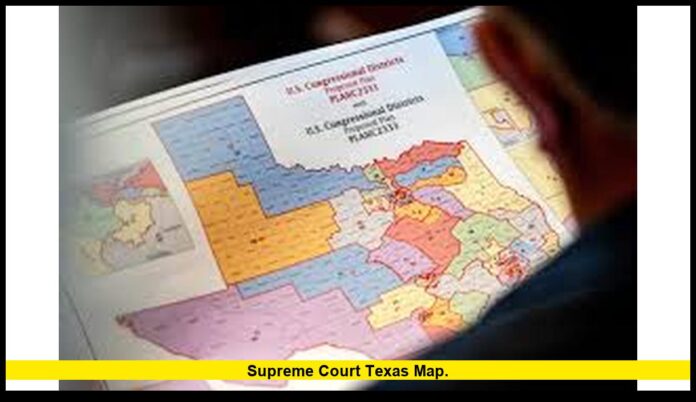
The U.S. Supreme Court on Dec. 4, 2025 temporarily allowed Texas to use a newly drawn congressional map for the 2026 elections, reinstating the plan after a lower court blocked it earlier this year. The decision keeps the map in place while legal challenges continue, giving state officials clarity as they prepare for the next election cycle. The ruling also places renewed national attention on how states balance race, partisanship, and constitutional rules when drawing political districts. This development arrives as debates over supreme court texas map continue to shape the political landscape across the country.
Table of Contents
Immediate effect on the 2026 election cycle
The Court’s order halts a federal district court injunction that had prevented Texas from using the map. Election administrators can now move forward with candidate filings, primary logistics, and voter notification processes under the new boundaries. This clarity is especially significant because Texas is one of the fastest-growing states in the country, and its population shifts require precise planning to ensure that all eligible voters receive accurate district information.
Why the lower court blocked the map
The three-judge federal panel in El Paso ruled earlier in 2025 that Texas lawmakers likely used race improperly when drawing several districts, creating what the court described as an unconstitutional racial gerrymander. That ruling would have forced lawmakers to redraw several metropolitan districts, potentially altering the political makeup of multiple regions. The injunction was issued after the candidate filing period had opened, which prompted concerns about voter confusion and election disruption.
Supreme Court reasoning
Although the Supreme Court did not issue a full written opinion, the unsigned order indicated that the timing of the district court’s intervention was a central factor. The majority said that changing district lines in the middle of an election cycle risked substantial disruption. Several justices also suggested that the lower court acted too aggressively by blocking the map before a full trial on the merits. The Court’s liberal justices dissented, expressing concern that reinstating the map could leave minority communities without fair representation during a crucial election.
How the map reshapes Texas politics
The newly reinstated map is expected to influence several U.S. House races across Texas. Analysts believe Republicans could gain up to five seats due to shifts in several urban and suburban districts. Large population centers, including the Dallas–Fort Worth region, Houston suburbs, and parts of the Rio Grande Valley, saw significant boundary adjustments.
The revisions create districts that lean more Republican than before, altering long-standing political dynamics in communities that have seen rapid growth and increasing demographic diversity. Texas Democrats have warned that the new lines could diminish the voting power of Black and Hispanic residents, particularly in metropolitan areas where population growth has been driven by minority communities.
Reactions across the state
Texas Republican leaders praised the Supreme Court’s action, saying the map more accurately reflects statewide voting patterns and population trends. They argue that the plan meets constitutional requirements and ensures consistency for voters heading into the 2026 primaries.
Democratic officials and voter advocacy groups criticized the decision, saying it enables a map that fractures minority-majority neighborhoods and reduces their influence in congressional elections. They noted that the lower court had already ruled that several districts likely relied too heavily on race, and they expressed concern that those findings could go unaddressed for another full election cycle.
What voters should understand now
Texans will see different district lines in 2026 than those used in the last election. Counties are now preparing updates to precinct maps, election websites, registration databases, and sample ballots. Voters in fast-growing regions should be especially aware of changes, as new boundaries may alter which candidates appear on their ballots.
Officials expect to complete voter notification processes in early 2026, giving residents time to understand how new lines affect their representation. Any appeals or additional hearings will not interrupt the current election calendar unless courts issue further orders.
Next steps in the legal battle
The case continues through the federal appeals system. The Supreme Court’s emergency order does not decide whether the map ultimately violates the Constitution. A full hearing on the merits—including detailed arguments about racial data, district shapes, and legislative intent—will occur later in 2026 or 2027. If the appeals court upholds the El Paso panel’s finding, lawmakers may eventually have to redraw portions of the map.
However, because redistricting cases often take years to resolve, the Supreme Court may ultimately revisit the dispute to clarify how courts should evaluate racial-gerrymandering claims. Observers say this case may become a major test of how the Court interprets race, partisanship, and legislative discretion in the modern redistricting era.
National significance
This decision adds Texas to a growing list of states where redistricting disputes have escalated to the federal courts. Several states have seen maps challenged due to questions about race-based line drawing or partisan manipulation. The outcome in Texas could help shape future standards used when courts evaluate whether lawmakers improperly considered race or partisanship in drawing congressional districts.
The ruling also underscores how timing influences election law decisions. Courts often attempt to avoid mid-cycle changes that could confuse voters, complicate election planning, or alter campaigns already underway. The Supreme Court’s emphasis on timing in this case may guide lower courts faced with similar challenges in the future.
Impact heading into the 2026 elections
With the map reinstated, candidates and political strategists are recalibrating their plans. Several incumbents now face new constituencies, while challengers may see new opportunities in districts that have been reshaped. Donor networks, local parties, and grassroots organizers are assessing how demographic changes within the new boundaries might influence turnout trends.
Despite the political uncertainty, the reinstated map gives campaigns a clear framework for building their messaging and outreach strategies. Many observers expect Texas to host some of the most closely watched congressional races of the upcoming cycle.
Civic significance for Texans
The legal battle over the map highlights the ongoing importance of redistricting as a cornerstone of democratic representation. For voters, understanding how district lines are drawn—and how those lines evolve through court rulings—is essential to participating effectively in elections. As Texas continues to grow, debates over fair representation will likely remain central to the state’s political landscape.

