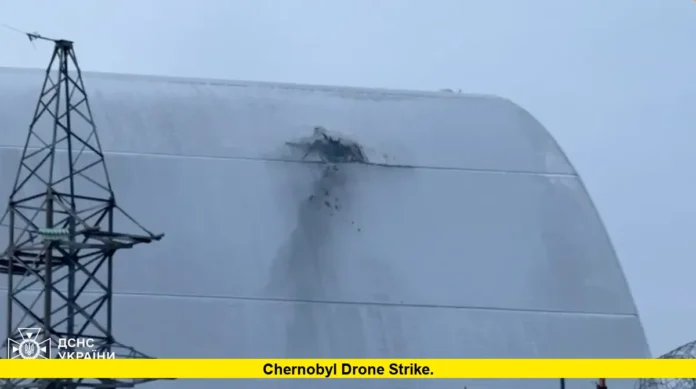
The protective steel arch covering the ruined reactor at the Chernobyl Nuclear Power Plant — known as the New Safe Confinement (NSC) — can no longer perform its primary safety function, according to a report issued December 5, 2025. The impact of the chernobyl drone strike has compromised this vital structure, triggering renewed global concern about nuclear safety in wartime Ukraine.
Table of Contents
What Happened: The Drone Strike That Hit Chernobyl
In the early hours of February 14, 2025 — around 1:50 a.m. local time — an unmanned aerial vehicle struck the roof of the New Safe Confinement that covers Reactor 4 at Chernobyl. The roof was carrying out what it was built to do: safely contain radioactive waste from the 1986 disaster and allow for long-term dismantling and waste management.
Ukrainian officials condemned the strike and attributed it to a drone carrying a high-explosive warhead; the strike caused a fire in the shelter’s insulation layers. Emergency services responded and extinguished the blaze — though thermal imaging indicated the fire smoldered for weeks afterward.
At the time, no immediate increase in background radiation was recorded, and the inner containment structure remained intact. The outer breach seemed confined, giving initial hope that the damage was limited.
What’s New: The December 2025 Inspection Report
During an inspection in late November 2025, experts evaluated the integrity of the shelter over Reactor 4. Their findings mark a sharp escalation in concerns about long-term nuclear safety at Chernobyl.
- The inspection confirmed that the drone strike severely compromised the protective shield’s ability to contain radioactive waste. The structure has now lost its primary safety functions, including the confinement capability.
- Importantly, investigators found no permanent damage to the shelter’s load-bearing structures or to internal radiation monitoring systems. Sensors remain functional.
- Radiation levels at the site remain stable and within safe parameters. So far, the breach has not resulted in any detectable leak or spike in radioactive emissions.
Still, the investigators emphasized that the limited, temporary roof repairs carried out in the spring are far from sufficient. Comprehensive restoration is now needed to prevent further degradation — essentially, to restore Chernobyl’s containment integrity for the decades-long decommissioning process.
Why This Matters: From Cold War Disaster to Modern Conflict Risk
A site that remains hazardous even decades later
The New Safe Confinement was built after the 1986 meltdown at Chernobyl. The steel-and-concrete dome was designed to contain the radioactive remains for around a century while dismantling and remediation proceeded. Damage to that structure now starkly highlights how nuclear legacy sites remain dangerously vulnerable — especially during armed conflicts. The drone strike didn’t destroy the inner containment, but it wounded the outer shield and undermined its function. Over time, even minor structural failures could create paths for radioactive dust or particles to escape — especially if further strikes occur or if the compromised sections worsen.
Political and environmental stakes
The site sits just north of Kyiv — Ukraine’s capital — and is part of a wider zone once rendered uninhabitable after the 1986 disaster. Any renewed leak or contamination could force re-evacuations, threaten public health, and destabilize ecosystems.
The fact that the breach emerged from a weaponized drone attack underscores how nuclear safety is now integrally tied to modern warfare tactics. The 2025 warning sends a strong signal: even decades-old nuclear legacies are at risk, and the global community cannot afford complacency.
Long-term implications for decommissioning and waste management
Beyond the immediate holdings, the compromised shield endangers plans to dismantle Reactor 4, safely manage radioactive waste, and perform necessary environmental remediation. Delays or failures in restoration may stall or jeopardize decades-long efforts. Funding and technical expertise for such a project — already vast — must now be urgently mobilized and might face complications due to wartime pressures.
What Happens Now: Repair Plans and Future Risks
The initial limited repairs following the February strike are insufficient. Experts are calling for comprehensive restoration to re-establish the NSC’s confinement capability.
Financially, the restoration is expected to be costly. Estimates suggest that repairs could exceed one hundred million euros — far beyond the modest contingency funds previously held for emergencies.
Meanwhile, pledged international financing may help — but those plans remain fragile. Further strikes — or shifts in control of surrounding territory as the war continues — could stall or complicate repair efforts altogether.
Additionally, ongoing power outages pose risk to monitoring systems and essential maintenance operations. Attacks intentionally targeting support infrastructure could indirectly threaten containment integrity and delay urgent safety work.
Broader Significance for Nuclear Safety in War Zones
The case of the Chernobyl drone strike is not merely about one damaged building. It highlights a dangerous trend: nuclear and radioactive sites, even long-decommissioned ones, remain targets — intentionally or not — in modern conflict.
For nations and international bodies, this raises urgent questions:
- Should more robust protective measures be adopted for vulnerable nuclear sites under conflict threat?
- Do global agreements need updates to safeguard radioactive infrastructure even in wartime?
- How can monitoring and maintenance continue reliably when war disrupts power, supply chains, and access to expertise?
The 2025 warning sends a strong signal: the world must acknowledge that even decades-old nuclear legacies are at risk under conflict conditions. Neglecting them could have consequences for generations.
What You Should Know: Present Situation at Chernobyl
- The drone strike occurred February 14, 2025, damaging the outer cladding and insulation of the New Safe Confinement over Reactor 4. Fires resulted.
- Emergency response contained the fire; radiation monitoring showed no leaks, and inner containment held.
- The latest inspection reveals the protective shelter has lost its primary safety function — i.e., it can no longer guarantee confinement of radioactive materials.
- Structural supports and monitoring systems remain intact; no immediate collapse risk but long-term integrity cannot be guaranteed without comprehensive repairs.
- Radiation levels remain stable — so far. No confirmed leaks or spikes.
- Restoration will be expensive and challenging due to the site’s radioactive nature, structural complexity, and ongoing war.
Conclusion: A Warning — and a Call for Global Vigilance
The compromised state of the New Safe Confinement over Chernobyl’s Reactor 4 proves that nuclear disasters don’t end when the reactors shut down. They stay hazardous for decades — and become even more dangerous in times of war. The damage caused by the drone strike doesn’t merely mark another episode in the Russia-Ukraine conflict: it reopens wounds from nuclear history and raises acute new risks for environmental safety and human health.
The international community must treat this as more than just a Ukrainian problem. The Chernobyl drone strike underscores how modern warfare endangers aging nuclear infrastructure — and how little margin for error exists when radioactive waste is involved.
Let me know what you think in the comments and stay tuned for updates.

