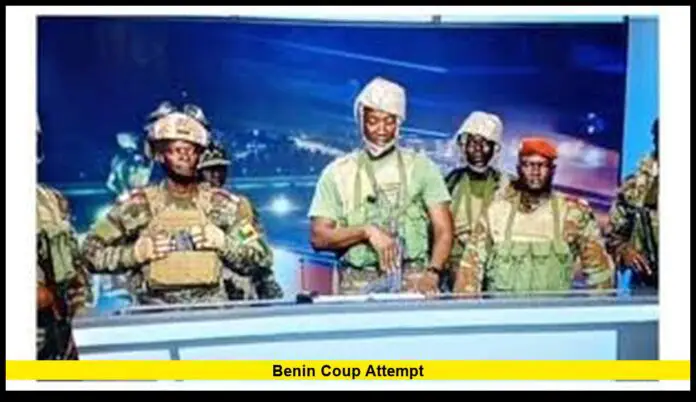
The benin coup attempt on December 7, 2025, created a brief but intense period of uncertainty in the country after a small group of soldiers seized the national broadcaster and declared they had removed President Patrice Talon. Government officials later confirmed the attempt was thwarted and that security forces had restored control.
A group identifying itself as the “Military Committee for Refoundation” appeared on state television early in the morning and claimed it had taken charge of the government. The soldiers named Lieutenant Colonel Pascal Tigri as their leader and said the constitution had been suspended. Their televised announcement was interrupted shortly afterward as the station’s signal went dark.
Within hours, Benin’s interior minister reassured the public that loyal forces remained in command and that the mutineers had failed to gain wider support within the military. Gunfire was reported in parts of Cotonou, including near the presidential residence, prompting residents to shelter indoors until authorities confirmed the situation had stabilized. Embassies in the capital also advised foreigners to remain inside until calm returned.
Table of Contents
What Happened and What’s Confirmed
The attempted takeover began in the early morning when the small military faction occupied the state broadcaster. Their statement was short-lived. Security personnel moved quickly to retake control of the station and surrounding areas, restoring normal programming soon after.
Key confirmed developments include:
- Soldiers identifying as the Military Committee for Refoundation staged the brief takeover.
- Lieutenant Colonel Pascal Tigri was presented as the group’s spokesperson and de facto leader.
- Benin’s armed forces leadership rejected the attempt and remained aligned with the constitutional government.
- Gunfire was heard in sections of Cotonou during the confrontation.
- Public order was restored the same day, and authorities urged residents to continue daily activities with vigilance.
Why This Attempt Matters
Benin has long been considered one of West Africa’s more stable nations. In recent years, however, tensions have grown due to political disputes and increasing security challenges in the country’s northern regions. The attempted coup marks a serious breach in a nation not typically associated with military uprisings.
The event also comes at a sensitive time, as the country prepares for leadership transitions under its election schedule. A coup attempt, even a brief one, can raise concerns about institutional stability and the capacity of security forces to contain internal fractures.
Rapid Response from National Authorities
Government officials emphasized that only a small faction participated in the mutiny and that the wider armed forces refused to support it. Their response included:
- Immediate deployment to critical government facilities
- Reestablishment of control over the national broadcaster
- Public communication to reduce panic and address misinformation
- Heightened security around the presidential residence and strategic sites
Authorities did not immediately provide details on arrests or disciplinary measures but indicated that further announcements would follow pending investigations.
Regional and International Reaction
Regional organizations quickly denounced the attempted overthrow and expressed support for Benin’s legitimate government. West African leaders voiced concern about the spread of military takeovers across the region, stressing the need for stability and constitutional rule.
Foreign missions in Cotonou increased precautions for their personnel and urged citizens to remain aware of ongoing security updates. These advisories were precautionary and were lifted as conditions normalized.
Impact on Benin’s Political Climate
Benin’s government has been preparing for upcoming elections, and political leaders have sought to manage internal tensions. The coup attempt adds pressure on authorities to reinforce public confidence in state institutions.
Key implications include:
- Potential delays or adjustments to political timelines
- Increased scrutiny of military cohesion
- Renewed attention to the factors contributing to unrest
- Continued monitoring from regional partners
While officials maintain that the situation is fully under control, analysts note that such an incident can influence national dialogue in the months ahead.
Security Environment and Underlying Pressures
Benin’s military has faced rising challenges, especially in the north where militant activity has expanded. These pressures have strained resources and heightened debate about security preparedness.
The mutineers referenced grievances related to governance and national security, though there is no confirmation that these concerns extend beyond the small faction involved. Authorities insist the episode does not reflect the position of Benin’s broader military leadership.
What U.S. Readers Should Know
Americans with family, travel plans, or business ties in Benin should monitor official advisories and remain alert to any updated security guidance. Events like this typically prompt temporary restrictions or enhanced precautions but do not necessarily indicate long-term instability.
For U.S. policymakers, the situation underscores the importance of diplomatic engagement in West Africa, especially in nations navigating both internal political pressures and regional security threats.
What Happens Next
Benin’s government is expected to release additional details regarding arrests, charges, or disciplinary steps tied to the attempted coup. Regional bodies may also issue further statements or send delegations aimed at supporting constitutional order.
Authorities will continue monitoring military installations and sensitive areas to ensure no follow-up actions occur. For now, daily activity in Cotonou has largely returned to normal, though the incident has raised questions about future stability.
The benin coup attempt highlighted vulnerabilities that Benin’s leaders will likely address through strengthened security measures and political dialogue. Observers will be watching closely for updates on the investigation and any long-term reforms that emerge.
Share your thoughts below and stay tuned for more updates as the story develops.

