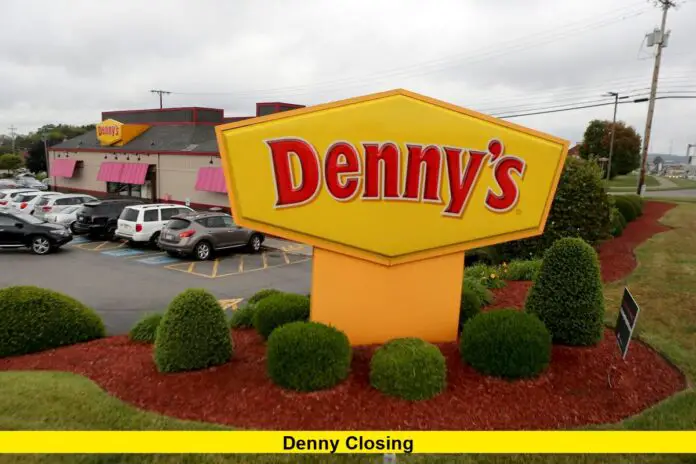
On December 9, 2025, the iconic American diner chain Denny’s confirmed it is closing 150 underperforming restaurants nationwide by the end of the year — a sweeping adjustment that marks one of the largest downsizing moves in the chain’s decades-long history. While the term “denny closing” may conjure fears that the entire chain is shutting down, the company insists these closures are part of a targeted strategy to streamline operations and rebound with stronger momentum heading into 2026.
Table of Contents
Why is Denny’s closing so many locations?
A pre-existing plan to cut underperforming units
The plan to shutter 150 restaurants was first announced in 2024. By that point, Denny’s had already closed 88 locations. The remaining 70–90 closures were scheduled to finish by the end of 2025. Company leadership describes the process as “surgical and methodical,” focused on eliminating weaker-performing units to strengthen the overall health of the franchise system.
Declining same-store sales and financial strain
In its latest quarterly report, Denny’s revealed a 2.9% year-over-year drop in same-store sales during the third quarter of 2025. The company said this trend, combined with rising operational costs and shifts in customer behavior, made continued operation of many low-volume restaurants unsustainable.
A shift in strategy ahead of an ownership change
In early November 2025, Denny’s announced a $620 million acquisition by a consortium including TriArtisan Capital Advisors (owner of TGI Fridays), Treville Capital Group, and franchiser Yadav Enterprises. The company emphasized that the closure plan predated the buyout — and remains independent of it. Nevertheless, the restructuring has gained renewed attention in light of the sale. The acquisition — expected to close in early 2026 — will take Denny’s private and give its new owners greater flexibility to reshape the brand.
Which locations have already shut down — and where is Denny’s still open?
While Denny’s has not released a comprehensive national list of shuttered restaurants, some closures have been confirmed across multiple states. Notable recent closures include:
- In California: a location at 1000 W. Steele Lane in Santa Rosa (Coddingtown Mall), along with previously shuttered spots in Oakland and San Francisco.
- Other states: restaurants in Idaho (Boise, Nampa), Massachusetts (Worcester), Ohio, Oregon, Pennsylvania, and Texas.
Despite the closures, Denny’s continues to operate hundreds of diners: the company reported over 1,300 restaurants still open across the United States. The chain also says it plans to open new locations as the downsizing ends — signaling that this is a recalibration, not a full shutdown.
What happens next for Denny’s — and for fans of late-night pancakes?
A projected rebound by 2026
Company executives say the goal is to return to “net flat to positive growth by 2026.” According to them, rationalizing the portfolio — removing weaker locations — has already improved average performance per remaining unit. The closures are intended to allow Denny’s to allocate resources more efficiently: improving service, updating operations, and reinvesting in markets that still show strong demand.
Modernization and franchise system improvement
Industry observers anticipate that under the new private ownership, Denny’s may accelerate efforts to modernize. That could mean redesigning some restaurants, enhancing digital ordering and delivery options, simplifying menus, or launching smaller-format diners or offshoots — all aimed at adapting to changing customer habits and competitive pressure from fast-casual and delivery-focused brands.
Mixed public response
Reactions from longtime Denny’s customers have been mixed. Some express sadness and nostalgia — especially in communities losing their local 24-hour diners. Others view the move as necessary, noting that prices had risen and service quality had slipped in some locations. For diners, the closures may reduce late-night or 24/7 options in certain areas — but with many locations still operating, fans may not lose access entirely.
What “denny closing” really means for consumers
- It’s not a full shutdown. Denny’s is not shutting down nationwide — the closures target underperforming, low-traffic restaurants.
- Some diners will disappear — but others will stay. Many locations will remain open. In fact, Denny’s intends to open new restaurants in some markets.
- Quality and stability may improve. With fewer, better-performing locations to manage, Denny’s could refocus on improving service, atmosphere, and menu quality where it counts.
- Change likely ahead. Under new ownership, expect possible updates like digital ordering, updated store designs, or new formats — even as the brand tries to retain its classic diner identity.
The broader significance: is Denny’s just the start?
Denny’s move reflects a larger trend across the U.S. casual dining industry. Rising labor costs, shifting consumer preferences, more competition from fast-casual and delivery-oriented brands, and increasing real estate expenses have forced many chains to reconsider widespread footprints. By streamlining operations now, Denny’s aims to avoid reactive closures later: instead, it’s choosing a proactive reset — trimming where needed to stay competitive over the long term.
For patrons, this could mean fewer 24-hour late-night breakfasts in certain towns — but for the brand, it may signal a revitalization that preserves its legacy in America’s dining scene. Ultimately, Denny’s appears to be betting that a leaner, more efficient structure will allow it to remain relevant in a rapidly changing market.
What do you think this means for Denny’s future — and for the classic late-night diner culture many Americans grew up with? Share your thoughts below or stay tuned for more updates.

