The question “when is the next Fed rate decision” is top of mind for investors, borrowers, and consumers as the Federal Reserve prepares for its final policy announcement of the year. The next rate decision is scheduled for December 10, 2025, following the Federal Open Market Committee’s two-day meeting on December 9–10.
Table of Contents
The Official Date and Timeline
The Federal Reserve follows a fixed annual meeting calendar, and the December session marks the last meeting of 2025. The two-day gathering concludes with a formal statement at 2:00 p.m. Eastern Time on December 10, outlining whether the federal funds rate will be raised, lowered, or held steady.
A press conference with the Fed Chair is set for 2:30 p.m. Eastern Time. During this briefing, the Chair discusses economic conditions, policy considerations, and the outlook for the months ahead. This briefing often moves financial markets, as it shapes expectations for future rate actions.
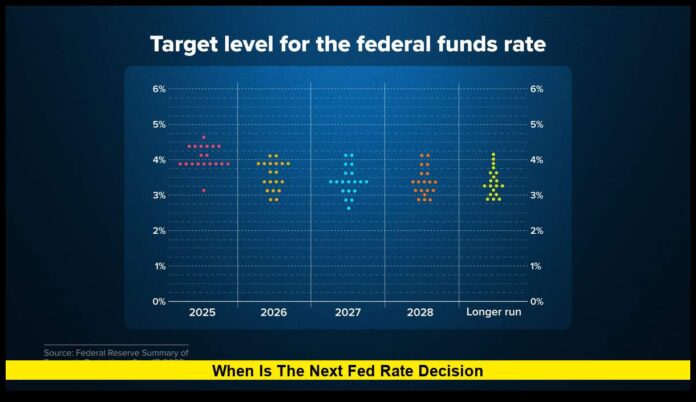
The December meeting is especially significant because it includes the release of the Fed’s Summary of Economic Projections, a report that outlines forecasts for inflation, unemployment, growth, and the long-term rate path.
Why This Decision Matters Right Now
The federal funds rate influences almost every corner of the economy. Mortgage rates, car loans, credit card interest, savings account yields, and business borrowing costs all respond to changes in Fed policy.
The economy is entering this meeting with notable shifts:
- Inflation remains above the Fed’s 2 percent target but has eased from previous peaks.
- Labor market data points to cooler hiring and slower wage growth.
- Financial markets are pricing in a high likelihood of an additional rate cut, which would follow earlier cuts made this year.
- The federal funds rate currently sits in a target range of 3.75% to 4.00%, the product of several adjustments throughout 2025.
If a cut occurs at the December meeting, rates would fall to the lowest level in nearly three years, making borrowing slightly more affordable while signaling concern about slower economic momentum.
Economic Factors Shaping the Decision
The Fed’s approach always centers on its dual mandate: maximum employment and stable prices. As December’s meeting approaches, policymakers are weighing several key trends:
Cooling Labor Market
Recent data shows slower job creation and more cautious hiring across multiple industries. This trend supports arguments for another rate cut because a softer labor market can ease inflationary pressure.
Inflation That Remains Elevated
Despite improvements, inflation continues to sit above the policy target. Some policymakers urge caution, warning that aggressive rate reductions could reignite price pressures.
Economic Growth Losing Steam
Growth indicators show moderation. Consumers are spending more selectively, and businesses are watching costs carefully. Lower rates could stimulate demand and investment.
Divergent Views Within the Fed
While some officials lean toward additional cuts to support growth, others prefer to wait for clearer inflation progress. These viewpoints will influence the final decision and the tone of the Chair’s remarks.
Strong Market Expectations
Financial markets have already priced in a likely quarter-point cut. Bond yields, futures data, and analyst projections all reflect the expectation that the December meeting may bring the third rate cut of the year.
What to Watch on December 10
Several key moments during decision day will impact households and businesses across the country:
1. The Rate Announcement at 2:00 p.m. ET
This moment determines whether borrowing costs will fall, remain steady, or rise. Even small changes ripple across the financial system.
2. Updated Economic Projections
The December projections are among the most important of the year. They reveal the Fed’s expectations for inflation, employment, GDP growth, and future rate levels heading into 2026.
3. The Press Conference
The Fed Chair’s remarks often influence markets more than the decision itself. Reporters’ questions and the Chair’s responses provide clues about future policy shifts.
4. Market Reaction
Stock prices, bond yields, mortgage rates, and the U.S. dollar all typically react within minutes. This volatility can continue throughout the day as analysts interpret the Fed’s message.
How the Fed’s Decision Impacts Everyday Americans
The federal funds rate may seem distant from day-to-day life, but its effects reach nearly every U.S. household. Here’s how:
Mortgage Rates
Homebuyers and homeowners tracking refinancing opportunities pay close attention. Lower rates can improve affordability and open refinancing options for millions.
Credit Cards and Personal Loans
Credit card interest rates closely follow the federal funds rate. A cut may offer modest relief, though high consumer debt levels mean many households still face elevated borrowing costs.
Auto Loans
Dealers and lenders often adjust rates within days of a Fed announcement. A lower benchmark rate can translate into reduced monthly payments for new buyers.
Savings Accounts
High-yield savings rates have remained strong during the Fed’s tightening period. Additional cuts could eventually soften returns.
Business Borrowing
Companies rely on lending for growth and payroll. Lower rates can boost business investment, potentially supporting job creation and economic expansion.
Timeline of Remaining FOMC Meetings
Below is a simplified view of the upcoming meeting schedule that will shape rate policy heading into the new year:
| Meeting | Date | Details |
|---|---|---|
| Final 2025 Meeting | December 9–10, 2025 | Rate decision and economic projections released December 10 |
| First 2026 Meeting | January 27–28, 2026 | First policy update of the new year |
These meetings set the trajectory for interest rates and guide expectations for markets and consumers.
Why December’s Meeting Sets the Tone for 2026
The final meeting of the year not only closes out 2025 but also signals the Fed’s outlook for the new economic cycle. If policymakers suggest further rate cuts in 2026, it could mark a turning point toward more supportive monetary policy. On the other hand, a cautious tone might indicate that inflation concerns remain at the forefront.
Either way, December’s decision will serve as a critical indicator of where the economy—and interest rates—are headed in the coming year.
As the December 10 announcement approaches, keep an eye on the data, the projections, and the message from the Fed Chair to understand how the next steps in monetary policy may affect your finances. Feel free to share your thoughts or predictions in the comments.

