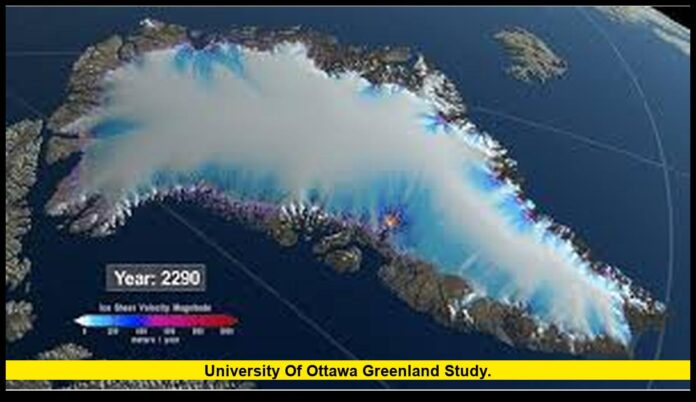
A new scientific breakthrough from a major research team has placed global attention on the university of ottawa greenland study, which has produced the most detailed three-dimensional temperature models ever created for the crust and upper mantle beneath Greenland and northeastern Canada. These findings offer fresh insight into how the Greenland Ice Sheet responds to geological forces and how those forces shape future sea-level changes.
Table of Contents
A New Look Beneath Greenland’s Surface
The study reveals sharp variations in subsurface heat flow beneath Greenland—variations far more dramatic than earlier broad-scale models suggested. By mapping temperature structure in three dimensions, researchers uncovered warm zones and cooler regions that directly influence how the ice sheet moves, melts, and interacts with the underlying bedrock.
These temperature contrasts help explain why certain parts of Greenland have historically been more responsive to climate warming than others. The findings allow scientists to better link deep-Earth processes to surface ice behavior, creating more reliable projections of how much meltwater will contribute to global sea-level rise.
Why Subsurface Heat Matters for Ice and Coastlines
The ice sheet’s stability is shaped not only by atmospheric and ocean temperatures but also by the thermal structure of Earth’s interior. When crustal and mantle temperatures rise, rocks beneath the ice can soften. Softer rock changes how the land rebounds as ice melts, and that rebound affects local sea levels around the world.
Accurate understanding of these processes is critical because regional land movement can either magnify or offset global sea-level rise. The new models give scientists a clearer picture of how Greenland’s unique geology interacts with ongoing climate-driven ice loss.
How Researchers Built the High-Resolution Models
To create the 3-D heat maps, scientists combined several types of data and ran extensive simulations using high-performance computing systems. The work involved:
- Satellite observations
- Ground-based geodetic stations
- Gravity and seismic measurements
- Large-scale numerical modeling
The team tested hundreds of thousands of possible temperature structures to find the best-fitting model. This multi-layered approach allowed them to resolve previously hidden variations in heat flow across Greenland.
The result is one of the most advanced thermal models ever built for any polar region.
Key Findings That Reshape Sea-Level Forecasting
Researchers identified several important discoveries that have direct implications for sea-level predictions:
1. Strong Lateral Heat Variation Beneath Greenland
Parts of Greenland sit above geological zones that are significantly warmer than others. These warmer regions influence ice flow speed and long-term ice stability.
2. Evidence of Past Mantle Hotspot Influence
Some of the warmest subsurface zones align with areas believed to have been affected by an ancient mantle hotspot. This provides new geological context for why Greenland’s ice has evolved the way it has.
3. More Accurate Regional Sea-Level “Fingerprints”
When the new thermal maps are added to sea-level models, regional projections change. In some coastal regions, predicted local sea levels rise or fall differently once updated solid-Earth responses are included.
4. Reduced Uncertainty for Coastal Planning
Communities that depend on precise long-term sea-level guidance—such as coastal cities in the U.S.—benefit from improved modeling that accounts for these newly understood geological factors.
What This Means for the United States
Greenland is one of the largest contributors to global sea-level rise, and changes there directly affect the U.S. coastline. Updated heat-flow models give experts better tools to refine projections for regions such as:
- The Eastern Seaboard
- The Gulf Coast
- Alaska
- Low-elevation island territories
By tightening the range of expected land uplift or subsidence, the new models help local decision-makers plan for infrastructure needs, flood resilience, and long-term adaptation strategies.
Scientific Limitations Acknowledged
While groundbreaking, the study does not replace climate forecasting or determine the future rate of greenhouse-gas emissions. Instead, it enhances the physical accuracy of the solid-Earth component used in sea-level modeling.
Researchers note that subsurface heat is only one factor influencing Greenland’s melt rate. Ocean temperatures, atmospheric conditions, and future emissions still determine the overall trajectory of global sea-level rise. However, having a more precise understanding of Earth’s interior significantly improves the reliability of regional projections.
Next Steps in the Research
The team’s work opens up several pathways for continued advancement:
- Improving seismic data coverage in remote areas
- Integrating the new heat maps into next-generation ice-ocean-Earth models
- Conducting targeted field studies to validate predictions
- Studying how similar subsurface processes affect Antarctic ice
These steps are expected to refine projections even further and help bridge gaps between global average sea-level rise and the local realities faced by individual communities.
A Clear Takeaway for Readers
The university of ottawa greenland study does not alter the broader understanding that human-caused warming drives global ice loss. Instead, it sharpens the geological picture beneath Greenland, revealing how Earth’s interior influences the pace and pattern of sea-level rise.
For U.S. coastal communities—from New England to the Gulf—this research offers improved clarity at a time when accurate data is essential for long-term planning.

