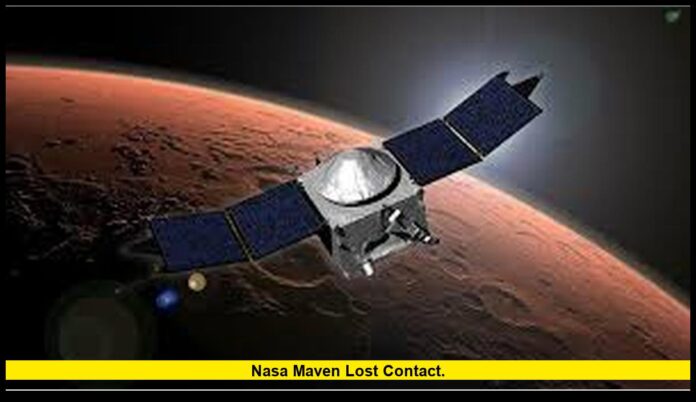
NASA announced that the nasa maven lost contact event unfolded on December 6, 2025, when the MAVEN spacecraft failed to re-establish communications after passing behind Mars. The orbiter, in service for more than a decade, had been operating normally before the expected blackout. When the spacecraft reappeared from behind the planet, the Deep Space Network did not receive its usual signal, triggering an immediate response from mission teams.
Table of Contents
How the loss of contact occurred
MAVEN regularly enters periods of communication blackout when Mars obstructs the line of sight. These planned losses of signal are routine. Engineers expected contact to resume as it always has, with a clean telemetry stream indicating status, orientation, power, and instrument health. Instead, no carrier signal or telemetry returned.
Before the occultation, MAVEN’s systems showed no anomalies. Its power levels, thermal conditions, attitude control, and science instrumentation performance were all within expected ranges. Because the last data looked healthy, engineers are now analyzing what could have occurred in the short window behind Mars that prevented the spacecraft from transmitting afterward.
Why MAVEN is critical to Mars exploration
MAVEN has been central to understanding how Mars lost most of its atmosphere over billions of years. The spacecraft studies the upper atmosphere, ionosphere, and solar interactions to trace how charged particles and solar wind strip atmospheric gases into space. These insights directly influence planning for future missions, including crewed flights and robotic landers.
The orbiter is also part of NASA’s communications relay network for surface missions. Rovers often rely on orbiters to pass along high-volume science data because direct-to-Earth communications are slower and more limited. MAVEN’s relay role helps deliver imagery, instrument readings, and mission updates from the Martian surface to scientists on Earth.
The investigation underway
NASA’s recovery protocol began immediately after the missed communication window. Teams are performing a structured series of diagnostics:
- Searching across multiple Deep Space Network antennas for even a faint signal
- Re-analyzing the final telemetry packet for subtle warning signs
- Sending repeated command attempts to prompt a response
- Reviewing possible onboard safemode transitions
- Examining potential software glitches that could disable the transmitter
- Assessing whether an attitude-control fault may have pointed MAVEN away from Earth
None of these possibilities has been confirmed, and NASA continues to emphasize fact-based analysis rather than speculation.
Potential technical issues engineers are evaluating
While the cause remains unknown, engineers are methodically reviewing a wide range of scenarios:
Communications subsystem malfunction:
If MAVEN’s transmitter, antenna, or radio hardware experienced a fault, the spacecraft may be unable to send signals even if the rest of the system is functioning.
Power or battery event:
Although MAVEN’s power looked normal before the blackout, a sudden solar event, battery anomaly, or unexpected power draw could interrupt communications.
Attitude or pointing issue:
The spacecraft must aim its antenna precisely at Earth. If its attitude control system experienced an error, the antenna may no longer be aligned.
Software or computer-lockup condition:
A corrupted command sequence or autonomous safemode entry could leave MAVEN in a state where it is running but not transmitting.
Each possibility requires different recovery strategies, so engineers are reviewing telemetry line-by-line and sending carefully structured commands.
Impact on Mars surface missions
NASA maintains several orbiters around Mars to support communications. Although MAVEN is a key relay, the Mars Reconnaissance Orbiter and Mars Odyssey continue to operate normally. These spacecraft can manage relay duties, but they cannot fully replace MAVEN’s science capabilities.
Surface missions will remain supported, but the loss of one relay asset tightens scheduling and reduces redundancy. Mission planners are adjusting communication windows, prioritizing essential rover and lander data while recovery efforts unfold.
Scientific consequences if MAVEN remains silent
MAVEN provides the only dedicated long-term atmospheric escape dataset at Mars. Losing this capability would create gaps in:
- Monitoring solar wind interactions
- Tracking ionospheric behavior
- Observing space-weather-driven atmospheric variations
- Understanding long-term climate evolution
Its measurements are essential for future mission risk assessments, especially for vehicles that must navigate the Martian upper atmosphere.
Even a temporary outage interrupts multi-year measurement sequences that researchers rely on to detect patterns in solar cycles and atmospheric change.
NASA’s ongoing communication efforts
NASA has issued regular public updates, confirming the timeline, outlining recovery steps, and clarifying that all actions follow established deep-space anomaly procedures. The agency continues to coordinate across engineering teams, science groups, and operations specialists to maintain an uninterrupted search effort.
The situation remains active, and updates will be provided as soon as engineers obtain verifiable new information.

