In 2026, federal undergraduate student loans carry a 6.39% fixed rate, graduate loans 7.94%, and PLUS loans 8.94%. Private student loan rates vary widely but can start below federal rates for highly qualified borrowers, while refinance rates often begin around 4%.
As borrowing costs rise and federal loan rules continue shifting this year, many Americans are taking a closer look at financing choices for education, emergencies, and major expenses. Understanding how to compare personal and student loans options is more important than ever, especially as updated rates and new federal policies reshape the lending landscape. Clear, verified information helps borrowers make confident decisions that protect their budgets and long-term financial health.
This in-depth guide breaks down the latest confirmed developments as of June 2026, explaining how personal loans and student loans differ, what has recently changed, and how borrowers can evaluate the best option for their needs.
Table of Contents
Why Borrowers Are Reassessing Loans in 2026
Loan decisions are becoming more consequential for households across the United States as the financial environment continues to evolve in early 2026. After several years of elevated interest rates compared to pre-pandemic lows, the overall cost of borrowing remains higher than many consumers were accustomed to earlier in the decade. Even with some rate stabilization, lenders are pricing loans more cautiously, and credit standards in many segments have tightened. For families already contending with sustained increases in housing, insurance, healthcare, and everyday essentials, taking on new debt now carries greater long-term implications.
At the same time, federal student loan programs have undergone meaningful restructuring over the past two years. Repayment systems have been recalibrated, income-driven plan formulas adjusted, and administrative oversight strengthened. Millions of borrowers have seen changes in how monthly payments are calculated, how forgiveness timelines operate, and how servicing is managed. These updates have prompted both current borrowers and prospective students to reassess whether federal loans, private student loans, or refinancing options align best with their financial outlook.
The broader credit environment has also become more complex. Lenders are using more data-driven underwriting models, meaning small differences in credit score, debt-to-income ratio, or employment history can produce significantly different loan offers. Borrowers with strong credit profiles may still access competitive rates, while those with thinner credit files or recent financial disruptions may face higher costs or stricter terms. This widening gap in lending outcomes makes preparation and comparison more important than ever.
Personal loans and student loans each carry distinct advantages, limitations, and eligibility standards. Personal loans offer flexibility in how funds are used and may provide fast approval, but they typically lack the structured repayment protections built into federal student loans. Student loans, particularly federal ones, provide defined repayment frameworks and hardship options, yet they are restricted to qualified educational expenses and subject to annual borrowing limits.
The updates implemented through 2025 have made it essential to understand not only how these products function in theory, but how they operate under current rules and economic conditions. Interest rate structures, repayment flexibility, borrower protections, and total long-term costs must all be weighed carefully. In 2026, selecting the right loan is no longer just about accessing funds — it is about protecting financial stability in an environment where margins for error are smaller and long-term consequences are greater.
Current Interest Rates: Personal vs. Student Loans
Personal Loan Rates in 2026
Personal loan interest rates in 2026 remain relatively elevated compared with pre-pandemic levels, though qualified borrowers can still find competitive offers. The rate you receive depends heavily on your credit score, income, debt-to-income ratio, loan amount, repayment term, and the lender you choose. Recent market data shows that the best borrowers can qualify for rates starting around 6%–7% APR, while many borrowers see rates in the low-to-mid teens, and those with weaker credit profiles may face APRs approaching 36%.
Current Average Personal Loan Rates
As of June 2026, the average personal loan interest rate is approximately 12.27%, according to Bankrate data. Meanwhile, Federal Reserve data shows the average rate on a 24-month bank personal loan is around 11.40%.
Typical APR Ranges by Borrower Profile
| Credit Profile | Typical APR Range |
|---|---|
| Excellent Credit (720+) | 6% – 12% |
| Good Credit (690–719) | 10% – 16% |
| Fair Credit (630–689) | 15% – 22% |
| Poor Credit (Below 630) | 20% – 36% |
These ranges vary by lender and loan term, but they provide a general benchmark for what borrowers can expect in 2026.
Factors Affecting Personal Loan Rates
Credit Score
Your credit score remains the most important factor in determining your rate. Borrowers with strong credit histories generally receive the lowest APRs, while those with recent delinquencies or high debt levels pay significantly more.
Loan Term
Shorter loan terms often come with lower interest rates because lenders face less risk. However, monthly payments are usually higher. Longer terms reduce monthly payments but increase total interest costs over the life of the loan.
Income and Debt-to-Income Ratio
Lenders evaluate your ability to repay. Borrowers with stable income and lower debt burdens often qualify for more favorable rates.
Lender Type
Different lender categories offer different pricing structures:
- Credit unions often provide some of the lowest average borrowing costs.
- Traditional banks typically favor borrowers with stronger credit profiles.
- Online lenders may offer faster approvals and competitive rates but sometimes charge origination fees.
Best Personal Loan Lenders in 2026
Several lenders continue to stand out for competitive rates and borrower-friendly features.
Known for no mandatory fees, fast funding, and rate discounts for qualifying borrowers. SoFi remains a leading choice for borrowers with good-to-excellent credit.
Frequently offers some of the lowest advertised rates available to highly qualified borrowers and provides large loan amounts with flexible repayment terms.
Offers competitive rates, joint loan applications, and repayment terms extending up to seven years.
Popular among borrowers with limited credit history because it considers factors beyond traditional credit scores.
Offers competitive rates for qualified borrowers and relationship discounts for eligible customers.
How to Get the Lowest Rate
To secure the best personal loan rate in 2026, borrowers should:
- Check and improve their credit score before applying.
- Compare prequalified offers from multiple lenders.
- Consider shorter repayment terms when affordable.
- Reduce existing debt to improve debt-to-income ratios.
- Look for autopay discounts and relationship benefits.
Should You Take a Personal Loan in 2026?
Personal loans can be useful for debt consolidation, home improvements, emergency expenses, or major purchases. With average rates hovering around 11%–13%, borrowers should compare offers carefully and avoid accepting the first loan available. Even a few percentage points difference in APR can save thousands of dollars over the life of a loan.
For borrowers with strong credit, 2026 still offers opportunities to secure personal loan rates below 10%, while those with weaker credit may benefit from improving their financial profile before applying.
Student Loan Rates in 2026
Student loan interest rates in 2026 vary depending on whether you have federal or private loans. Federal loan rates are fixed by law and depend on the loan type, while private loan rates are based on creditworthiness, income, and market conditions.
Federal Student Loan Interest Rates (2025–26 Academic Year)
For federal loans first disbursed between July 1, 2025, and June 30, 2026, the rates are:
| Loan Type | Interest Rate |
|---|---|
| Direct Subsidized Loans (Undergraduate) | 6.39% |
| Direct Unsubsidized Loans (Undergraduate) | 6.39% |
| Direct Unsubsidized Loans (Graduate/Professional) | 7.94% |
| Direct PLUS Loans (Parents & Graduate Students) | 8.94% |
These rates are fixed for the life of the loan once borrowed.
Private Student Loan Rates in 2026
Private lenders offer both fixed and variable rates. As of mid-2026:
- Fixed rates generally range from about 2.5% to 18%
- Variable rates generally range from about 2.5% to 18%
- Borrowers with excellent credit typically qualify for the lowest rates.
Examples of average private loan rates reported in 2026 include:
- Average 10-year fixed private loan: 8.20%
- Average 5-year variable private loan: 6.84%
Student Loan Refinance Rates
Borrowers refinancing existing student loans in 2026 can often find:
- Fixed refinance rates starting around 4%
- Variable refinance rates sometimes slightly lower
- Actual rates depend on credit score, income, debt-to-income ratio, and loan term.
Major 2026 Federal Student Loan Changes
Several federal student loan reforms are taking effect beginning July 2026, including:
- New borrowing caps for graduate and professional students.
- New limits on Parent PLUS borrowing.
- Transition toward a new federal repayment framework known as the Repayment Assistance Plan (RAP) for future borrowers.
Should You Choose Federal or Private Loans?
For most students, federal loans remain the preferred first option because they offer:
- Fixed interest rates
- Income-driven repayment programs
- Potential loan forgiveness opportunities
- More flexible hardship protections
Private loans may be useful when federal aid is insufficient or unavailable, especially for borrowers with strong credit profiles who can secure lower rates.
Key Takeaway
In 2026, federal undergraduate student loans carry a 6.39% fixed rate, graduate loans 7.94%, and PLUS loans 8.94%. Private student loan rates vary widely but can start below federal rates for highly qualified borrowers, while refinance rates often begin around 4%.
Best Companies to Refinance Student Loans
Several financial institutions offer competitive options for refinancing student loans, helping borrowers potentially lower their interest rates, reduce monthly payments, or simplify repayment by combining multiple loans into one. Some of the best companies to refinance student loans in the United States :
Earnest is frequently recognized as one of the strongest overall student loan refinance providers. The lender offers highly customizable repayment options, allowing borrowers to choose repayment terms that fit their financial situation rather than selecting from a limited set of predefined terms.
Key benefits include:
- Flexible repayment terms
- No origination fees
- Ability to skip one payment annually in certain circumstances
- Fast online application process
- Competitive fixed and variable interest rates
Earnest is particularly attractive for borrowers seeking personalized repayment schedules and strong customer service.
SoFi remains one of the most recognizable names in student loan refinancing. In addition to competitive rates, the company provides various member benefits that extend beyond lending services.
Advantages include:
- Career coaching and networking resources
- Unemployment protection programs
- Flexible loan terms
- No application or origination fees
- Dedicated customer support
Many borrowers choose SoFi because of its combination of financial products and member-focused benefits.
Laurel Road specializes in refinancing solutions for professionals, particularly those working in healthcare fields such as medicine, dentistry, and nursing.
Key features include:
- Specialized refinancing programs for medical professionals
- Competitive fixed and variable rates
- Rate discounts for automatic payments
- Flexible repayment options
- No application fees
Healthcare workers often benefit from customized programs that account for residency and fellowship periods.
Unlike many traditional lenders, LendKey operates as a marketplace connecting borrowers with community banks and credit unions across the United States.
Benefits include:
- Access to credit union and local bank rates
- Competitive refinancing options
- Multiple repayment term choices
- Strong customer support
- No application fees
Because community financial institutions often participate in the platform, borrowers may discover lower rates than those offered by larger national lenders.
RISLA (Rhode Island Student Loan Authority)
RISLA is a nonprofit lender known for borrower protections and repayment flexibility. Despite its name, borrowers do not necessarily need to live in Rhode Island to qualify.
Notable advantages include:
- Income-based repayment assistance
- Loan forgiveness provisions in certain hardship situations
- Competitive interest rates
- No fees for refinancing
- Strong borrower support programs
RISLA is often recommended for borrowers who value additional safety nets and consumer-friendly policies.
Purpose and Flexibility: How the Loans Differ
What Personal Loans Are Used For
Personal loans are among the most flexible borrowing tools available in 2026. Unlike student loans or auto loans, which are restricted to specific purposes, personal loans can generally be used for a wide range of financial needs. This flexibility makes them attractive to borrowers who need quick access to funds without navigating purpose-specific eligibility rules.
Borrowers commonly use personal loans for:
Debt consolidation
Many individuals combine high-interest credit card balances into a single fixed-rate personal loan. This can simplify repayment by replacing multiple due dates with one monthly payment and, in some cases, reduce overall interest costs if the borrower qualifies for a lower rate.
Emergency medical bills
Unexpected healthcare expenses remain a major financial strain for many households. Personal loans can help cover out-of-pocket costs, procedures, or payment gaps not covered by insurance, allowing borrowers to spread payments over time rather than relying on high-interest credit cards.
Home improvements
From essential repairs to energy-efficiency upgrades, personal loans can finance projects that improve property value or livability. Unlike home equity loans, personal loans typically do not require collateral, which reduces risk to the borrower’s property.
Large purchases
Major expenses such as appliances, furniture, or event-related costs are often financed through personal loans when savings are insufficient. Fixed repayment schedules provide predictable budgeting compared to revolving credit.
Unexpected expenses
Job transitions, urgent travel, or sudden household repairs can disrupt even well-planned budgets. Personal loans provide a structured way to manage these unplanned costs.
Because lenders generally do not require a detailed spending justification, borrowers appreciate the autonomy personal loans provide. The application process is often streamlined, with many lenders offering online approval decisions within minutes and funding within a few business days. Prequalification options allow borrowers to compare estimated rates without affecting their credit score.
However, flexibility should be paired with careful planning. Interest rates vary widely based on creditworthiness, income stability, and lender policies. While approval times are typically fast, borrowers should evaluate annual percentage rates (APR), fees, and total repayment costs to ensure the loan supports — rather than strains — their long-term financial health.
What Student Loans Are Designed For
Student loans are specifically structured to finance higher education and are limited to qualified academic expenses. Unlike personal loans, which offer broad spending flexibility, student loans are tied directly to a school’s certified cost of attendance and are intended solely to support enrollment and educational progress.
Student loans are designed to cover expenses such as:
Tuition
The primary cost of instruction at colleges, universities, and eligible vocational programs. Tuition often represents the largest share of borrowing.
Fees
Mandatory institutional charges, including registration fees, lab fees, technology fees, and other school-required costs.
Housing
Room and board expenses for students living on campus, as well as approved housing estimates for those living off campus.
Textbooks
Required printed or digital learning materials necessary for coursework.
Course materials
Supplies, lab equipment, specialized program tools, and required academic resources tied directly to a student’s field of study.
Federal student loans offer more borrower protections than most other consumer loan products. These protections may include in-school deferment, meaning payments are not required while the student is enrolled at least half-time. Federal loans also provide structured repayment plans, including income-driven options that adjust monthly payments based on earnings and family size. Additional safeguards such as deferment, forbearance, and potential forgiveness programs add layers of financial security.
Even private student loans, while generally offering fewer protections than federal loans, are built with education-related costs in mind. Funds are typically disbursed through the school, and borrowing limits are aligned with verified academic expenses. Though private lenders set their own repayment terms, these loans remain purpose-specific and are structured around the educational timeline.
Because student loans are intended exclusively for school-related expenses, they operate within a regulated framework that prioritizes academic financing rather than general consumer spending. This focused design distinguishes them clearly from broader-use lending products.
Major Federal Policy Changes Affecting Student Loans (Updated 2026)
The federal student loan landscape continues to evolve in 2026, with policy adjustments shaping how borrowers repay debt, how much students can borrow, and what options are available for financing higher education.
Changes to the SAVE Repayment Plan
The Saving on a Valuable Education (SAVE) income-driven repayment plan remains a central part of the federal repayment system, but its future has faced ongoing legal and administrative challenges. Court rulings and policy reviews have temporarily limited or modified certain provisions of the plan, creating uncertainty for millions of borrowers.
As a result, some borrowers have experienced pauses, recalculations, or delays in payment adjustments and forgiveness timelines. While the plan itself has not been universally eliminated, its implementation has been inconsistent, prompting many borrowers to explore alternative income-driven repayment (IDR) plans such as PAYE, REPAYE (now incorporated into SAVE), or IBR.
For affected borrowers, monthly payments and long-term forgiveness expectations may shift depending on how federal agencies finalize program rules and respond to legal outcomes.
Federal Loan Limits and Program Adjustments
As of 2026, there have been no fully enacted federal laws eliminating Graduate PLUS loans, but policymakers continue to debate reforms that could impose stricter borrowing caps for graduate and professional students.
Current federal loan programs still allow:
- Direct Unsubsidized Loans (with annual and aggregate limits)
- Graduate PLUS Loans (to cover remaining costs, subject to credit approval)
However, proposals at the federal level have included:
- Capping total graduate borrowing
- Reducing reliance on PLUS loans
- Introducing accountability measures for institutions tied to student outcomes
While these proposals have not all been implemented, the direction of policy discussions signals a potential shift toward limiting federal exposure to large graduate-level debt in the future.
Expansion of Institutional Financing Options
In response to ongoing uncertainty around federal lending and repayment programs, many colleges and universities have begun strengthening their own financing solutions.
These include:
- School-backed loan programs
- Income-share agreements (ISAs)
- Extended tuition payment plans
Some institutions are positioning these options as alternatives to private student loans, often highlighting predictable terms, fixed interest rates, or repayment structures tied to post-graduation income.
While these programs can help bridge funding gaps, they vary widely in terms, protections, and long-term costs. Borrowers are increasingly encouraged to compare institutional financing carefully against federal loan benefits, such as income-driven repayment and forgiveness options.
Practical Ways to Compare Personal and Student Loans Options
Borrowers evaluating different loan types should focus on these key areas:
Interest Rates
Federal student loans typically offer lower, fixed rates compared to the broad and often higher range of personal loan APRs. Private student loans can sometimes rival personal loan rates for top-tier credit applicants, but the variability is wide.
Repayment Flexibility
Student loans, especially federal ones, offer:
- Income-based repayment
- Deferment options
- Forbearance programs
- Long-term forgiveness possibilities
Personal loans rarely offer income-based plans or built-in safeguards. Repayment schedules are usually fixed and must be followed regardless of financial circumstances.
Loan Purpose
Student loans can only be used for education, but personal loans may address a variety of financial needs. Borrowers seeking flexibility often gravitate toward personal loans when expenses are not tied to school.
Eligibility Requirements
Federal student loans do not require credit checks for most undergraduate applicants, and no cosigner is needed. Personal loans, however, depend entirely on creditworthiness, income stability, and debt-to-income ratios.
Private student loans and personal loans share similar approval criteria, making them more accessible to applicants with strong credit.
Policy Stability
Student loan policies are currently undergoing major redesigns, which can affect repayment and borrowing opportunities. Personal loan structures, by contrast, remain relatively stable, with changes tied mainly to market interest rates rather than legislation.
🔎 Key Differences: Personal Loan vs Student Loan
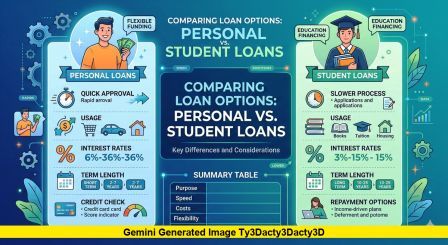
| Feature | Personal Loan | Student Loan |
|---|---|---|
| Purpose | Flexible — can be used for almost anything (medical, travel, debt consolidation) | Specifically for education costs (tuition, books, housing) |
| Interest Rates | Average around ~12.26% (range ~6%–35% depending on credit) | Federal ~6.39% for undergraduates; private loans ~2.7%–17.9% |
| Repayment Term | Usually 1–7 years | Often 10–25+ years with flexible plans |
| Eligibility | Based heavily on credit score and income | Federal loans often don’t require credit checks |
| Borrower Protections | Limited protections | Income-driven repayment, deferment, forgiveness options |
| Loan Amount | Typically $1,000–$50,000 (sometimes up to $100k) | Based on cost of education and federal limits |
Sources: Personal loan rates average about 12.26% with terms of one to seven years. Student loans generally have lower rates (federal ~6.39% for undergraduates; private ranges vary widely) and provide repayment protections not available with most personal loans.
The Broader Economic Environment
The lending landscape in 2026 is being shaped by ongoing adjustments in federal interest rate policy, which have started to ease borrowing costs after a period of aggressive rate hikes. While these gradual reductions provide some relief to borrowers, interest rates still remain noticeably higher than the historically low levels seen in the early 2020s. This means that, although loans may be slightly more affordable than they were at peak rate periods, they are not as inexpensive as many borrowers became accustomed to just a few years ago.
These conditions have a direct impact on both personal and student loans, but not in identical ways. Personal loan rates—especially those from private lenders—tend to respond quickly to changes in the broader financial market. As a result, borrowers may notice fluctuations in interest rates, approval criteria, and loan terms as lenders react to inflation trends, economic growth signals, and monetary policy decisions.
Student loans, particularly federal ones, operate under a different structure. Federal student loan interest rates are set once per year based on U.S. Treasury benchmarks and remain fixed for the life of the loan. This creates a more predictable borrowing environment for students, even when market conditions are shifting. However, new borrowers each academic year may still experience different rates depending on when they take out their loans.
Private student loans, on the other hand, behave more like personal loans. Their rates can vary frequently and are influenced by credit scores, lender policies, and broader economic conditions. In times of uncertainty, lenders may tighten requirements or increase rates to manage risk.
Looking ahead, borrowers should be prepared for continued variability in private lending costs. Financial institutions are likely to remain cautious, adjusting their offerings in response to inflation pressures, labor market conditions, and any future changes in federal monetary policy. For individuals considering borrowing, this environment underscores the importance of timing, comparing lenders, and understanding how economic trends can affect long-term repayment costs.
How Borrowers Can Make the Best Decision
Borrowers who want to make a smart financial decision should carefully review all available loan options before choosing a financing method. Following a structured approach can help reduce long-term costs and avoid unnecessary debt.
1. Check Eligibility for Federal Student Loans First
Before considering private lenders or personal loans, borrowers should determine whether they qualify for federal student loans. These loans often come with important benefits such as fixed interest rates, income-driven repayment plans, deferment or forbearance during financial hardship, and potential loan forgiveness programs. Because of these protections, federal loans are usually the safest starting point for students seeking education funding.
2. Prequalify With Multiple Lenders
If additional funds are needed after federal aid, borrowers can explore private student loans or personal loans. Many lenders allow prequalification with a soft credit check, which does not affect the borrower’s credit score. Comparing offers from several lenders helps identify the best interest rates, repayment terms, and fee structures. Even small differences in interest rates can significantly affect the total repayment cost over time.
3. Evaluate Repayment Protections
Interest rates are important, but repayment flexibility should also be considered. Borrowers should review whether a loan offers features such as grace periods, flexible repayment schedules, or temporary payment pauses during financial hardship. Loans with stronger borrower protections can make repayment more manageable if financial circumstances change.
4. Consider Long-Term Financial Goals
Borrowers should think beyond the immediate need for funds and evaluate how the loan fits into their long-term financial plans. Factors such as expected career path, potential starting salary, and existing financial obligations can affect the ability to repay debt comfortably. Understanding the total debt load helps prevent financial strain after graduation or during repayment.
5. Review School-Based Financing Options
Some colleges and universities provide institutional loans, tuition payment plans, or partnerships with lenders that may offer favorable terms. These options are sometimes overlooked but can provide lower interest rates or more flexible repayment conditions depending on the institution.
6. Stay Updated on Policy Changes
Student loan policies and repayment programs can change over time. Borrowers should stay informed about updates related to repayment plans, forgiveness programs, or government relief initiatives. Staying updated allows borrowers to adjust their repayment strategy and take advantage of any new benefits that may become available.
By following these steps—researching options, comparing lenders, and thinking about long-term financial stability—borrowers can make a more informed decision and choose financing that best supports their future financial health.
Final Thoughts
As federal rules tighten and interest rates adjust, understanding how to compare personal and student loans options has become essential for students, families, and anyone planning major financial decisions. Borrowers who take time to understand today’s lending environment can secure better terms, protect their credit, and avoid surprises in the years ahead.
FAQs
1. Can I use a personal loan to pay for college?
Yes, but it’s not ideal. Student loans usually offer lower interest rates and better repayment options.
2. Are student loans always cheaper than personal loans?
In most cases, yes—especially federal student loans with fixed, lower interest rates.
3. Do personal loans affect credit score?
Yes, applying and repaying a personal loan can impact your credit score positively or negatively.
4. Can student loans be forgiven?
Yes, certain federal student loans may qualify for forgiveness programs based on your job or repayment plan.
5. Which loan is easier to get?
Federal student loans are generally easier to qualify for, while personal loans require good credit and income.
Share your thoughts below and tell us how these changes are shaping your borrowing plans.

