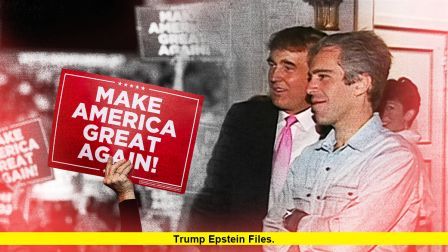
In a major verified development in the trump epstein saga, President Donald Trump appears in newly released photographs from the estate of convicted sex offender Jeffrey Epstein, igniting fresh political debate as the U.S. government prepares to publicly disclose a massive trove of related Department of Justice files under a federal transparency law by December 19, 2025. These events mark a significant moment in one of the most closely watched political and legal controversies in recent U.S. history.
Table of Contents
New Photos Show President Trump Among High-Profile Figures
On December 12, 2025, House Democrats on the Oversight Committee publicly released 19 selected images from a collection of more than 95,000 photographs provided by Epstein’s estate. Among the images are several featuring President Trump in social settings with other influential figures. The committee said the photos are part of an ongoing review and that additional images may be disclosed in the coming days and weeks.
The released images show President Trump in several scenes, including a photo of him smiling while surrounded by multiple unidentified women whose faces have been obscured for privacy. Other images depict Trump in proximity to Epstein and others at gatherings whose dates and locations have not been provided. The photos also include prominent individuals such as former President Bill Clinton, former Trump adviser Steve Bannon, Microsoft co-founder Bill Gates, and director Woody Allen. None of the images on their own provide evidence of illegal conduct by any of those pictured.
Democratic lawmakers described the photos as raising questions about the extensive social circle surrounding Epstein and called on the Justice Department to comply fully with the statutory deadline to release all unclassified files. Republicans on the committee have countered that the selective release of photographs without context can be misleading and constitutes political posturing rather than substantive oversight.
Federal Law Requires Broad Disclosure of Epstein Files
The backdrop to this release is the Epstein Files Transparency Act, a law signed by President Trump on November 19, 2025, that mandates the public disclosure of all unclassified Justice Department records related to Epstein’s criminal cases. Under the law, the DOJ must make these documents available in a searchable and downloadable format no later than December 19, 2025.
The act passed both chambers of Congress with overwhelming support. It requires not just the release of images but a broad array of documents, records, and files the DOJ holds relating to investigations of Epstein and his associate, Ghislaine Maxwell. Maxwell, who was convicted in 2021 for her role in aiding Epstein’s sex-trafficking network, is currently serving a prison sentence. The law also obligates the Attorney General to provide congressional committees with an unredacted list of government officials and politically exposed persons named in the files, though privacy protections for victims are to be preserved.
President Trump’s signing of the transparency law followed months of political pressure from both sides of the aisle. While the law compels release, debates have continued over what may be included and how redactions should be handled to protect personal privacy and avoid disclosing sensitive information unrelated to the public interest.
Judicial Orders Expand Access to Investigative Materials
In addition to the statutory mandate, federal courts have issued orders that further open key Justice Department materials in the Epstein case. A judge in Florida recently authorized the release of grand jury transcripts from the sex-trafficking investigation into Epstein and Maxwell. Another federal judge in New York lifted prior protective orders and directed the release of investigative materials related to Epstein’s 2019 federal sex-trafficking indictment. These rulings reflect judicial recognition of the new transparency law’s requirements and emphasize balancing public access with victims’ privacy.
Legal analysts note that while the unsealing of grand jury records and related documents could provide unprecedented insight into the scope of Epstein’s network, such materials may not necessarily reveal new prosecutable evidence or directly implicate those pictured in public releases. Instead, these records are expected to offer broader context about the investigative process and associations documented during the probes.
Political Reactions: Bipartisan Pressure and Partisan Conflict
The release of photos and the impending disclosure of DOJ files have intensified political reactions across Washington. Democrats argue that the Trump administration was slow to embrace transparency, pointing to delays and selective releases as evidence of resistance. They have used the photo disclosures strategically to pressure the White House and DOJ to meet the legal deadline and ensure full compliance with the transparency law’s requirements.
Republicans have defended the president, asserting that releasing decontextualized photos can unfairly harm reputations and fuel misinformation. GOP lawmakers on the House Oversight Committee have accused Democrats of targeting Trump politically and producing selective evidence to shape a narrative rather than present facts.
Both sides have emphasized that inclusion in photos or files does not equate to guilt or participation in criminal activity. With the Justice Department now operating under clear legal obligations, the broader release of documents is expected to dominate political headlines through the rest of December.
Public Impact and Transparency Expectations
As the December 19 deadline draws near, public interest in the Epstein files continues to grow. The convergence of judicial orders and statutory requirements means that an unprecedented volume of material will soon be accessible to journalists, researchers, and the general public. Observers anticipate that historians and legal experts will comb through the files, seeking to piece together a more complete picture of Epstein’s activities and the extent of documented associations with prominent individuals.
Despite the release of photos featuring President Trump, there have been no criminal charges against him in connection with Epstein’s sex-trafficking crimes, and the president has repeatedly denied knowledge of criminal conduct. Trump has acknowledged knowing Epstein socially decades ago but has said he severed ties well before Epstein’s arrests.
Critics and supporters alike are watching closely as the final week of document disclosure unfolds. Some advocacy groups have called for additional oversight to ensure that all DOJ materials are turned over to the public in compliance with the law. Others argue that the focus should remain on victim protection and careful handling of sensitive personal information.
What Comes Next: The Final Week Before Full Disclosure
With just days left until the legally mandated disclosure deadline, the government is poised to release one of the largest public archives of legal and investigative documents in recent memory. This moment represents both a legal milestone and a test of transparency in federal law enforcement, especially given the political polarization surrounding the issue.
The photos released so far, including those featuring President Trump, serve as a precursor to what may be an extensive public archive. Experts caution that documents will need careful contextualization to prevent misinterpretation. The coming week promises intensive review by media outlets and independent analysts as the full contents of the Epstein files become publicly searchable.
Beyond political debate, the disclosure could have lasting implications for public understanding of high-profile interactions with Epstein, the role of investigative agencies, and the federal government’s accountability mechanisms.
Let us know what you think about the latest developments and stay tuned as the Epstein files are released and analyzed in the coming days.

