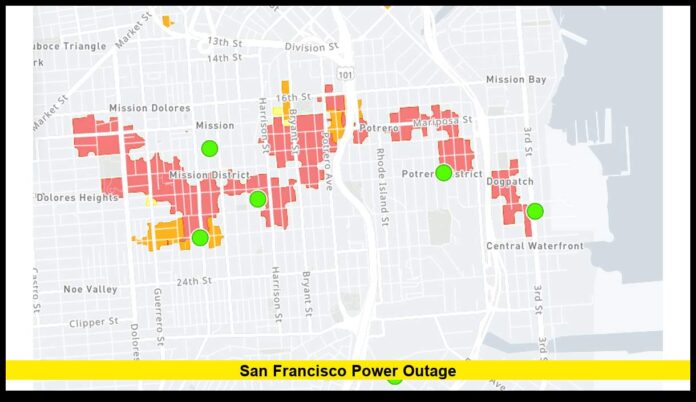
The San Francisco power outage that began early this morning, December 21, 2025, has disrupted large portions of the city, impacting homes, public transit systems, and major businesses. As of this afternoon, utility crews from Pacific Gas and Electric Company (PG&E) have confirmed that electricity has been restored to most affected areas, though smaller pockets in downtown and the Mission District remain without power.
The incident marks one of the most significant power disruptions in San Francisco this winter, highlighting the city’s vulnerability to infrastructure stress during periods of heavy rainfall and high winds.
Table of Contents
Overview of the Outage
At approximately 4:45 a.m. Pacific Time, PG&E reported widespread outages across multiple neighborhoods, including SoMa, Financial District, Potrero Hill, Nob Hill, and parts of the Sunset District. The outage initially affected more than 72,000 customers, cutting electricity to residential blocks, office towers, and several major transit systems.
PG&E technicians identified damaged transmission equipment near Potrero Hill Substation as the likely source of the problem. Early reports indicate that strong winds and rain overnight caused debris to strike power lines, triggering an automatic shutdown to prevent further electrical surges.
Restoration Efforts and Current Status
As of 3:00 p.m. PT, PG&E confirmed that over 90% of affected customers have regained power. Restoration teams are still addressing smaller grid failures in localized areas where transformers were damaged.
Neighborhood restoration timeline:
| Area | Power Status | Estimated Full Restoration |
|---|---|---|
| Financial District | Restored | Completed at 12:15 p.m. |
| SoMa | Mostly restored | Ongoing minor work |
| Mission District | Partial outages | Expected by 6:00 p.m. |
| Sunset District | Fully restored | Completed at 1:00 p.m. |
| Potrero Hill | Limited remaining outages | Ongoing overnight work |
PG&E field crews are inspecting transmission lines using both ground personnel and drone technology to ensure there are no remaining faults or fire risks.
A company spokesperson stated that no injuries or fires were reported as a result of the outage.
Impact on Public Transit and Services
The San Francisco Municipal Transportation Agency (SFMTA) temporarily suspended service on several Muni Metro lines between 5:00 a.m. and 8:30 a.m. due to loss of power in the subway’s electrical system.
Affected routes included:
- Muni Metro T-Third Line
- K-Ingleside/Taraval
- N-Judah (partially delayed through the downtown tunnel)
Buses were deployed to assist stranded commuters until regular rail service resumed midmorning.
BART (Bay Area Rapid Transit) experienced only brief signal issues near the Embarcadero Station, but trains continued operating with minimal delay.
City officials also confirmed that traffic lights in more than 40 intersections across SoMa and Market Street were temporarily out, causing heavy congestion during the early commute. Traffic officers were dispatched to manage intersections manually until signals were reactivated midmorning.
Hospitals and Emergency Facilities
Major hospitals across San Francisco, including UCSF Medical Center, Zuckerberg San Francisco General Hospital, and Kaiser Permanente San Francisco, operated on backup generators throughout the outage. All patient care systems remained fully functional, and there were no disruptions to emergency services.
San Francisco Fire Department reported a small number of elevator rescues during the early hours of the blackout, but no serious injuries occurred.
Business and Economic Effects
The outage had a significant, though temporary, impact on downtown San Francisco’s business district. Office towers in Embarcadero Center and Market Street experienced early morning shutdowns, with thousands of employees unable to access their workplaces until elevators and lighting were restored.
Retailers and restaurants in Union Square also experienced delays in opening, particularly those without independent generators. Payment systems and point-of-sale terminals were temporarily offline, affecting morning sales during the peak holiday shopping period.
Financial analysts estimate that the few hours of downtime across commercial operations could amount to millions in short-term revenue losses, especially given the proximity to the Christmas shopping weekend. However, businesses resumed normal operations by early afternoon.
Residential Impact and Safety Measures
In residential areas, power loss led to temporary disruptions in heating systems and internet access. The San Francisco Department of Emergency Management urged residents to:
- Unplug sensitive electronics to avoid power surges once electricity returned.
- Check on elderly neighbors or those reliant on electric-powered medical devices.
- Use flashlights instead of candles to prevent accidental fires.
As temperatures dropped into the mid-40s overnight, local shelters reported a slight increase in visitors seeking warmth during the early hours of the blackout.
PG&E’s Response and Infrastructure Assessment
PG&E released a public statement around 10:00 a.m., confirming that the outage originated from a transmission fault linked to weather-related debris. Engineers quickly isolated the issue and began rerouting power through alternative lines to stabilize the grid.
In its midday briefing, PG&E highlighted that the company had pre-positioned repair crews across the Bay Area in anticipation of storm-related outages. This preparation, combined with upgraded smart-grid technology, allowed for faster response times compared to previous incidents.
Key measures implemented during restoration:
- Real-time rerouting through smart substations.
- Drone-assisted inspection of damaged transmission lines.
- Preventive clearing of debris near affected poles.
By leveraging new infrastructure monitoring systems, PG&E claims that full restoration for remaining customers is expected before midnight tonight.
City Officials and Emergency Management Updates
San Francisco Mayor London Breed addressed the situation during a morning press briefing at City Hall. She emphasized coordination between city departments, PG&E, and emergency services to ensure public safety.
Breed stated, “Our teams have been working throughout the night to assist residents and keep essential services running. The majority of power has now been restored, and we are grateful for the quick response from city crews and PG&E technicians.”
City officials also confirmed that no evacuations or emergency shelters were required during the outage. All schools and public offices remained open, though some reported minor delays in the morning.
Weather Conditions Contributing to the Outage
Meteorologists from the National Weather Service Bay Area Office reported that a strong Pacific storm system brought heavy rain and gusts up to 55 mph across San Francisco overnight.
Fallen branches and saturated soil created ideal conditions for short circuits and equipment failures. The storm also caused localized flooding in parts of the Marina District and Outer Sunset, though no major structural damage was reported.
Power outages were also briefly reported in Daly City and South San Francisco, but those were restored before dawn.
Recent History of Power Outages in San Francisco
While San Francisco generally has a reliable electrical grid, several weather-related power outages have occurred in recent years.
Notable incidents:
- January 2023: Windstorm knocked out power to 50,000 customers citywide.
- October 2024: Equipment malfunction caused brief outages across downtown.
- December 2025 (current): Weather-related disruption impacting more than 70,000 residents.
PG&E has since invested in grid modernization and undergrounding initiatives, aiming to reduce vulnerability during severe weather. The company plans to underground approximately 10,000 miles of power lines statewide over the next decade.
Public Safety and Emergency Preparedness
City emergency officials urged residents to remain alert during winter storms and to follow standard safety precautions:
- Keep battery-powered radios and flashlights on hand.
- Avoid using generators indoors due to carbon monoxide risks.
- Report downed power lines immediately to 911 or PG&E emergency hotlines.
- Keep cell phones fully charged during storm forecasts.
The San Francisco Department of Emergency Management continues to update residents through its official Twitter and SMS alert systems.
Community Response
Despite early-morning challenges, many San Franciscans took to social media to share updates and express gratitude toward repair crews. Several local businesses provided free coffee and Wi-Fi access to residents waiting for power restoration.
Neighborhood associations praised the city’s quick coordination and PG&E’s faster-than-usual response compared to previous years. By early afternoon, most of the city had resumed normal routines.
Broader Context: California’s Power Grid Challenges
The San Francisco power outage underscores the broader challenges California faces in maintaining reliable electricity during periods of climate-driven weather volatility.
The state has seen an increase in storm-related outages and fire-prevention shutoffs as utility companies work to balance grid safety with modernization. PG&E’s ongoing infrastructure upgrades — including enhanced circuit breakers and underground wiring — are part of a statewide effort to make California’s grid more resilient.
Analysts emphasize that urban centers like San Francisco remain especially sensitive to disruptions because of dense populations and older electrical infrastructure in some districts.
Restoration Outlook and Preventive Measures
By evening on December 21, full restoration is expected across all affected areas. PG&E has committed to additional overnight monitoring to ensure grid stability and prevent follow-up outages.
City engineers are also reviewing drainage and vegetation management systems around critical substations to minimize the risk of future power loss during storms.
Upcoming preventive initiatives include:
- Accelerated line maintenance in high-risk weather zones.
- Upgrades to substation transformers across SoMa and Mission Bay.
- Expansion of underground wiring along Market Street corridors.
These efforts aim to provide San Franciscans with a more resilient power system heading into 2026.

