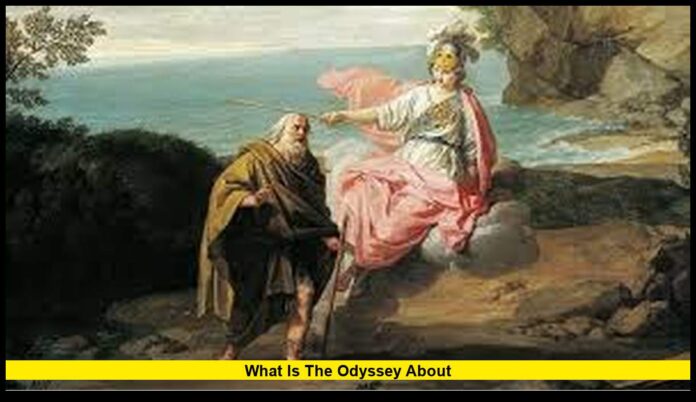
What is the Odyssey about is a question many readers ask when approaching one of the most influential works in world literature. The Odyssey is an ancient Greek epic poem traditionally attributed to Homer, and it tells the story of a long, dangerous journey home after war. More than an adventure tale, it explores identity, loyalty, resilience, and the struggle between fate and free will.
Written in ancient Greece and still widely studied today, The Odyssey remains relevant because its themes reflect timeless human experiences.
Table of Contents
The Basic Story of The Odyssey
At its heart, The Odyssey tells the story of Odysseus, the king of Ithaca, and his long struggle to return home after the Trojan War has ended. Although the fighting is over, peace does not come easily for Odysseus. His journey home stretches across ten difficult years, marked by danger, temptation, and constant uncertainty.
As Odysseus travels across open seas and unfamiliar lands, he faces challenges that test far more than physical strength. Each obstacle demands intelligence, patience, and emotional control. Survival depends on his ability to think ahead, adapt to change, and resist distractions that could pull him away from his ultimate goal.
Back in Ithaca, the story unfolds in a different but equally tense way. Odysseus’s wife, Penelope, and his son, Telemachus, are left to defend their household in his absence. Suitors flood the palace, convinced that Odysseus will never return. They consume his resources, pressure Penelope to remarry, and threaten the future of the kingdom.
The epic moves back and forth between these two struggles—Odysseus’s journey through the unknown and his family’s fight to preserve their home. Together, these parallel stories reveal the emotional cost of separation and the strength required to endure long periods of uncertainty. Through this structure, The Odyssey shows that perseverance is not only about surviving hardship, but also about remaining faithful to one’s purpose despite time, doubt, and adversity.
Who Is Odysseus
Odysseus stands apart from many traditional heroes because his strength is not his defining trait. Instead of relying on physical power alone, he survives through intelligence, strategy, and emotional awareness. His reputation rests on his ability to think quickly, adapt to changing situations, and outmaneuver opponents who are stronger or more dangerous.
Cleverness shapes nearly every decision Odysseus makes. He plans carefully, observes his surroundings, and uses words as effectively as weapons. When faced with impossible odds, he chooses patience and deception over confrontation. This approach allows him to escape dangers that would defeat a less thoughtful hero.
At the core of Odysseus’s character is a powerful sense of identity. He never forgets who he is or where he belongs, even when temptation offers an easier path. His loyalty to his home and family drives his long journey and keeps him focused on returning to Ithaca rather than settling elsewhere.
Odysseus’s flaws are just as important as his strengths. Pride sometimes pushes him to reveal himself when silence would be safer. Impatience leads to costly mistakes that extend his journey. These imperfections create consequences, reminding readers that intelligence does not prevent error.
Together, these traits make Odysseus a deeply human figure. He succeeds not because he is perfect, but because he learns, adapts, and endures. That complexity is what makes him a compelling hero rather than an idealized symbol of strength.
The Journey Home and Its Challenges
Odysseus faces many obstacles that delay his return. These challenges are not random; each one reveals something about his character and the world he navigates.
Major episodes include:
- The encounter with Polyphemus, the Cyclops
- Temptation by the Sirens
- Imprisonment by Circe
- Detention by Calypso
- A journey to the Underworld
Each event tests Odysseus’s judgment and self-control.
The Role of the Gods
The gods play a constant and influential role throughout The Odyssey, shaping events in ways that both assist and obstruct Odysseus’s journey. They are not distant observers. Instead, they interact directly with the human world, reflecting how ancient Greek culture understood the relationship between mortals and divine power.
Some gods actively support Odysseus, guiding him through danger and offering protection at key moments. Others stand firmly in his way, using storms, delays, and hardship as punishment for past actions. This balance of help and opposition creates ongoing tension and reinforces the idea that success depends on both divine favor and human choice.
Among the most important divine figures is Athena, the goddess of wisdom. She consistently supports Odysseus and his son Telemachus, offering guidance, encouragement, and strategic help. Athena values intelligence and restraint, qualities Odysseus often demonstrates, which explains her loyalty to him throughout the epic.
In contrast, Poseidon, the god of the sea, acts as Odysseus’s greatest obstacle. Enraged after Odysseus blinds his son Polyphemus, Poseidon uses his power to delay the hero’s return. Storms, shipwrecks, and dangerous detours reflect Poseidon’s ongoing anger and remind readers that personal actions can have lasting consequences.
Above all the gods stands Zeus, who maintains order among both gods and humans. Zeus does not consistently favor or oppose Odysseus. Instead, he acts as an authority figure who enforces balance, justice, and limits. His role highlights the belief that even the gods operate within a system of rules.
Together, these divine forces reflect ancient Greek beliefs about fate, free will, and responsibility. While the gods influence events, Odysseus remains accountable for his decisions. The epic suggests that success comes from respecting the gods while also exercising wisdom, patience, and self-control.
This dynamic relationship between divine power and human effort gives The Odyssey much of its depth and lasting relevance.
Penelope and the Meaning of Loyalty
While Odysseus travels, Penelope remains in Ithaca. She faces constant pressure from suitors who want to marry her and claim Odysseus’s throne.
Penelope’s strength lies in:
- Intelligence and patience
- Emotional endurance
- Loyalty despite uncertainty
Her clever strategies mirror Odysseus’s own cunning, making her an equal partner in the story.
Telemachus and the Path to Adulthood
Telemachus begins the epic as an unsure young man. Over time, he grows into a confident leader.
His journey includes:
- Searching for news of his father
- Confronting powerful adults
- Learning responsibility and courage
This growth story adds another layer to what is the Odyssey about, showing that the epic is also about maturity and self-discovery.
Hospitality as a Central Theme
One of the most important ideas in The Odyssey is hospitality, or how hosts treat guests and how guests behave in return.
Examples include:
- Generous hosts who receive blessings
- Cruel or selfish hosts who face punishment
- The suitors who abuse hospitality in Ithaca
These moments reflect social values of ancient Greece while still resonating today.
Identity and Recognition
Odysseus often hides his identity during his journey. When he returns home, recognition becomes a key theme.
Moments of recognition involve:
- His scar
- His knowledge of personal details
- His actions rather than words
These scenes emphasize that identity is proven through character and deeds.
Justice and Restoration of Order
The final section of The Odyssey focuses on restoring balance. Odysseus confronts the suitors who have taken advantage of his household.
This conclusion highlights:
- Justice after long suffering
- The importance of rightful leadership
- The restoration of social and moral order
The ending reinforces the idea that endurance leads to resolution.
Read Also:- Cast of The Odyssey 2026: Complete Lineup and Details for Christopher Nolan’s Epic Adaptation
Why The Odyssey Still Matters Today
What is the Odyssey about reaches far beyond monsters, storms, and mythical lands. At its core, the story reflects struggles that people continue to face in modern life. Although the setting is ancient, the emotional experiences feel familiar, which is why the epic still resonates with readers today.
One of the strongest themes is the search for home and belonging. Odysseus does not simply want to survive; he wants to return to a place where he is known and loved. In a world where people often move, change careers, or feel disconnected, that longing for home remains deeply relatable.
The story also explores the challenge of resisting temptation. Odysseus is repeatedly offered easier paths, comfort, or escape from responsibility. Each time, he must decide between short-term relief and long-term purpose. These moments mirror modern struggles with distraction, desire, and difficult choices.
Another enduring theme is the cost of long absence. Time away changes people. Relationships strain, uncertainty grows, and emotional distance forms. The epic shows how absence affects not only Odysseus, but also Penelope and Telemachus, highlighting the shared burden of waiting and uncertainty.
Finally, The Odyssey emphasizes the strength of loyalty and patience. Penelope’s endurance and Telemachus’s gradual growth prove that perseverance can be as powerful as action. Their quiet strength balances Odysseus’s physical journey and reminds readers that resilience often takes many forms.
Together, these themes give The Odyssey lasting meaning. They show that while the world changes, human challenges remain the same. That timeless connection is why the story continues to speak to modern readers across generations.
The Structure of The Odyssey
The poem is structured in a non-linear way. It begins near the end of Odysseus’s journey and then moves backward through storytelling.
This structure:
- Builds suspense
- Allows character reflection
- Highlights memory and experience
The approach was innovative and influential.
The Odyssey as a Cultural Foundation
The Odyssey has shaped storytelling across centuries. Its influence appears in literature, film, and modern narratives focused on long journeys and personal trials.
The epic helped establish:
- The hero’s journey framework
- Character-driven storytelling
- Moral exploration through narrative
Its impact remains visible across many forms of media.
What Is the Odyssey About in Simple Terms
In simple terms, The Odyssey is about:
- A man trying to return home
- A family waiting despite uncertainty
- Growth through hardship
- The value of wisdom over strength
It is a story about survival, love, and identity.
Why Schools Continue to Teach The Odyssey
Educators continue to teach The Odyssey because it offers far more than a historical story or a mythological adventure. The epic provides students with a rich foundation for learning how stories convey meaning, values, and human experience across time.
One of the key reasons The Odyssey remains part of school curricula is its ability to develop critical thinking. Students are encouraged to examine characters’ choices, question motivations, and explore how decisions lead to consequences. Odysseus’s actions often invite debate, allowing learners to think beyond simple ideas of right and wrong.
The poem also supports ethical discussion. Themes such as loyalty, honesty, justice, and responsibility appear throughout the story. Classrooms use these moments to discuss moral dilemmas that still apply to modern life, helping students connect ancient ideas to their own experiences.
Another important reason is its value for literary analysis. The Odyssey introduces students to narrative structure, symbolism, character development, and recurring themes. It helps readers understand how storytelling techniques shape meaning and emotional impact, skills that transfer to all forms of literature.
Finally, the epic strengthens cultural understanding. Through its depiction of ancient Greek beliefs, social values, and traditions, students gain insight into a civilization that influenced Western thought, language, and storytelling. This broader perspective deepens historical awareness and appreciation for cultural continuity.
What makes The Odyssey especially effective in classrooms is its balance. The story offers intellectual depth while remaining engaging and accessible. Adventure, suspense, and emotional stakes keep students interested, ensuring the learning experience feels meaningful rather than distant or abstract.
The Enduring Power of the Story
Thousands of years after its creation, The Odyssey continues to resonate because it reflects the human experience. Its characters struggle, fail, learn, and endure.
Understanding what is the Odyssey about helps readers see why the epic remains one of the most important works in literary history.
What part of The Odyssey do you find most compelling? Share your thoughts and continue exploring classic stories that still speak to modern life.

